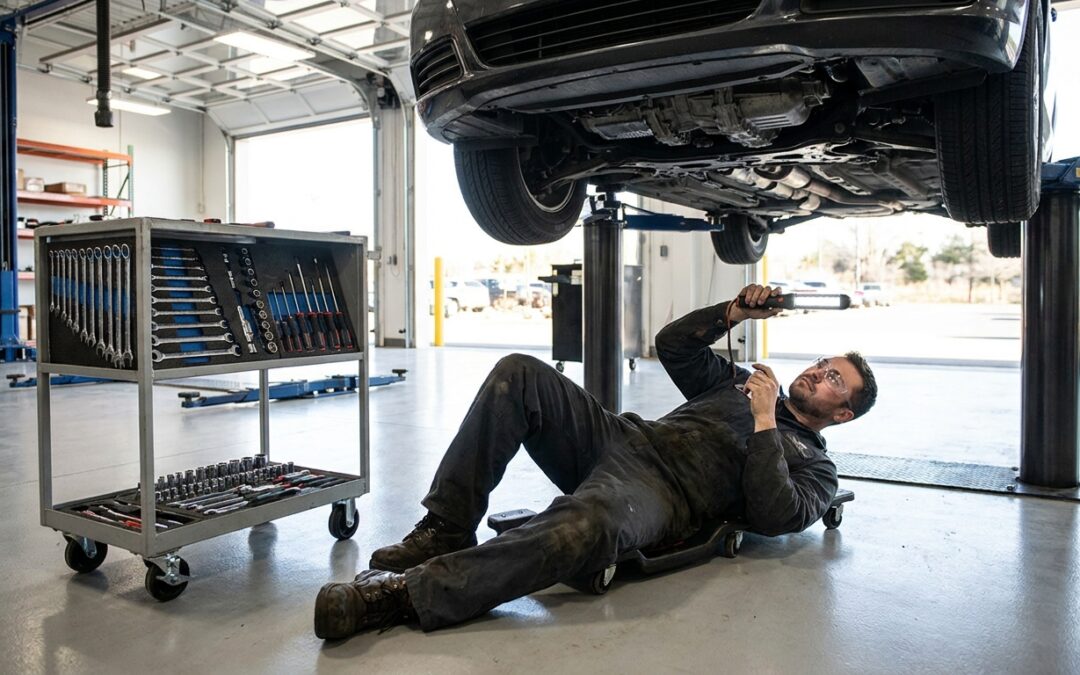
Transmission RepairQueen Creek AZ: 2026 Costs, Signs & Same-Day Diagnosis
Real 2026 pricing, the warning signs a technician actually looks for, and what a same-day transmission repair Queen Creek AZ diagnosis can save you before a small leak turns into a full rebuild.
If your car is hesitating before it shifts, slipping between gears, or leaving a reddish puddle on your driveway, you’re probably searching for transmission repair Queen Creek AZ because something already feels wrong. That instinct is usually right. Transmissions rarely fail out of nowhere — they send warning signs for weeks or months before they leave you stranded on Ellsworth Road or the Ironwood exit off the 60.
Queen Creek’s climate makes this worse than it would be almost anywhere else in the country. Transmission fluid is rated to handle heat, but between our summer pavement temperatures and stop-and-go traffic near Founders Park and San Tan Valley, fluid breaks down faster here than the manufacturer’s maintenance schedule assumes. That’s the single biggest reason we see more transmission repair Queen Creek AZ visits between June and September than any other stretch of the year.
What’s Happening Inside Your Transmission
Your transmission is a sealed hydraulic system built around exact pressure and exact clearances. Automatic transmissions use fluid pressure to engage clutch packs and bands that lock different gear sets together as you accelerate. When that fluid is clean, cool, and at the right level, the shifts are smooth enough that you never think about it. When the fluid degrades — from heat, age, or contamination — everything downstream starts to suffer.
Heat is the number one enemy. Every 20-degree increase above normal operating temperature roughly cuts transmission fluid life in half. In a Queen Creek summer, a transmission that’s towing a trailer, idling in traffic on Combs Road, or just sitting in a parked car in full sun can run well past the temperature range the fluid was designed for. Once fluid oxidizes, it loses its ability to hold the exact hydraulic pressure the valve body needs, and that’s when you start feeling delayed engagement, slipping, or hard shifts.
Manual transmissions fail differently — usually clutch wear, worn synchros, or a failing throw-out bearing — but the same rule applies: fluid condition and mileage-based wear are the two variables that decide whether you’re looking at a $400 adjustment or a $3,000+ rebuild. This is why an accurate diagnosis matters more than almost any other repair category. Guessing wrong on a transmission issue is one of the most expensive mistakes a shop — or a DIYer — can make.
We hear the same story constantly from Queen Creek customers: the shift felt “a little off” for weeks, they assumed it would work itself out, and then it didn’t. Transmission repair Queen Creek AZ almost never starts as an emergency — it starts as a subtle change in how the car feels between gears. Learning to trust that first instinct, rather than waiting for it to get dramatically worse, is the single best way to keep a repair small.
According to fueleconomy.gov’s vehicle maintenance guidelines, following your manufacturer’s fluid service intervals is one of the most effective ways to prevent major drivetrain failures, transmissions included. Those intervals assume moderate climates, though — in Queen Creek, we generally recommend shortening them.
Not Sure What’s Wrong?
Get a free transmission inspection at Network Automotive before you spend a dollar on repairs. We’ll tell you straight whether it’s a $150 fix or something bigger.
Common Causes & How Transmission Repair Works
Most of the transmission repair Queen Creek AZ jobs that come through our bay fall into a handful of repeatable categories. Knowing which one you’re dealing with changes the cost by thousands of dollars, which is exactly why we start every job with a real diagnostic instead of a guess.
| Symptom | Likely Cause | Typical Fix |
|---|---|---|
| Slipping between gears | Worn clutch packs, low or burnt fluid | Fluid/filter service, or clutch pack rebuild |
| Delayed or hard shifting | Failing solenoid, worn valve body, low fluid pressure | Solenoid or valve body replacement |
| Fluid on the ground | Bad pan gasket, seal, or cooler line | Gasket/seal replacement, cooler line repair |
| Grinding or whining noise | Worn bearings, torque converter issue | Bearing service or torque converter replacement |
| Won’t shift out of park/neutral | Shift solenoid, linkage, or internal failure | Solenoid replacement or deeper internal repair |
| Transmission won’t engage at all | Severe internal failure, burnt clutches | Rebuild or replacement |
Solenoids and the valve body control which gear the transmission engages and when. On many of the vehicles we service — Ford F-150s, Honda Odysseys, Toyota Camrys, and Ram 1500s are common around Queen Creek — a failing solenoid is genuinely one of the more affordable fixes and one we can often confirm the same day with a scan tool and a pressure test.
Internal wear — clutch packs, bands, bearings — is the more expensive category, and it’s usually the result of years of heat-degraded fluid finally catching up with the hardware. This is also where the repair-vs-replace conversation becomes real, and it’s something we walk through with every customer before any work begins, not after.
One thing we won’t do is push a full rebuild when the actual fix is a $400 solenoid. Every transmission repair Queen Creek AZ estimate we write breaks out the exact part that’s failing, why we believe that’s the cause, and what happens if you choose to wait. That transparency is the difference between a shop you trust once and one you keep coming back to for a decade.
If your transmission fluid smells burnt or looks dark brown/black instead of red, that’s not cosmetic — it’s a sign the fluid has already broken down internally. Get it checked before you drive it much further.
Our Diagnostic & Repair Process
Every transmission repair Queen Creek AZ visit at Network Automotive follows the same process, whether the fix ends up being a $150 fluid service or a full rebuild.
- Listen first. We ask exactly when the symptom happens — cold start, highway speed, towing, reverse only — because the pattern narrows down the cause before we even open the hood.
- Scan for codes. Modern transmissions log fault codes for solenoid performance, slip ratios, and temperature spikes. This alone often points us straight to the problem.
- Check fluid condition and level. Color, smell, and level tell us whether we’re dealing with maintenance neglect or a mechanical failure.
- Road test. We drive the vehicle under the exact conditions that trigger the symptom, monitoring live data the whole time.
- Pressure and line testing. If the road test and codes point to a hydraulic issue, we test line pressure at the valve body to isolate solenoids, pumps, or internal leaks.
- Written estimate, no surprises. You get a clear breakdown of parts, labor, and timeline before we touch anything beyond diagnostics.
- Repair. From fluid/filter service to solenoid replacement to a full internal rebuild, the work is done in-house with OEM or OEM-equivalent parts.
- Verification road test. We don’t hand the keys back until we’ve confirmed the shift quality and fluid pressure are correct under real driving conditions.
Cost & Time: What Transmission Repair Actually Costs in Queen Creek
Here’s the honest range we quote for transmission repair Queen Creek AZ, based on what we actually charge in our shop in 2026 — not a national average pulled from somewhere else in the country.
- Fluid & filter service: $150–$220, about 45–90 minutes
- Solenoid replacement: $350–$750, typically same-day
- Valve body replacement: $600–$1,400, usually 1 day
- Torque converter replacement: $900–$1,800, 1–2 days
- Clutch replacement (manual): $1,200–$2,200, 1–2 days
- Full transmission rebuild: $2,500–$3,800, 3–5 days
- Remanufactured transmission replacement: $3,200–$5,500 depending on vehicle, 2–4 days
Two variables move these numbers more than anything else: how far the wear has progressed before it’s caught, and whether the vehicle is a common domestic/Japanese model (parts readily available) or a lower-volume import or diesel platform (parts take longer, cost more). We quote exact numbers after diagnosis, every time — the ranges above are there so you’re never walking in blind.
Financing is available on larger transmission repair Queen Creek AZ jobs, and every repair — big or small — carries the same 3-year/36,000-mile nationwide warranty. That warranty matters more than most customers realize: it means a rebuild we perform today is still covered if it acts up two years and two states away.
Get A Real Number, Not A Guess
Free transmission inspection, written estimate before any work starts, and financing options available on larger repairs.
When Is It Urgent? Safety & Warning Signs
Not every transmission symptom means pull over immediately, but some absolutely do. Here’s how to tell the difference.
- Transmission won’t engage any gear, or slips out of gear while driving
- Burning smell from under the vehicle, especially combined with slipping
- Grinding or metallic noise when shifting
- Vehicle lurches or bangs into gear instead of shifting smoothly
- Warning light specifically for the transmission (not just check engine)
- Visible fluid puddle combined with any shifting symptom
What To Do Right Now
- Stop driving if it’s a red-flag symptom. Continuing to drive a slipping or grinding transmission almost always turns an affordable repair into a rebuild.
- Check the fluid yourself if you can safely do so. Note the color and smell — this helps us diagnose faster when you call.
- Call or book online. Tell us the exact symptom and when it happens; that detail speeds up your diagnostic appointment.
- Get the free inspection. We’ll scan, road test, and give you a written number before any repair work begins.
- Approve only what you need. We’ll always tell you if a cheaper fix is a real option before recommending a bigger repair.
Why Choose Network Automotive
Queen Creek drivers have a lot of options for transmission repair. Here’s why customers keep choosing Network Automotive for transmission repair Queen Creek AZ instead of a dealership or a chain shop.
- Free transmission inspection and written estimate before any work starts
- 3-year / 36,000-mile nationwide warranty on transmission repairs
- ASE-certified technicians who specialize in domestic, Japanese, and diesel drivetrains
- Same-day diagnostics on most solenoid and valve body issues
- Honest repair-vs-replace guidance — we tell you when a rebuild beats a used swap, and when it doesn’t
- See our full transmission and drivetrain services, learn more about our shop, or check current service coupons before you book
Service Area
We handle transmission repair Queen Creek AZ and throughout the surrounding East Valley communities, including neighborhoods around Founders Park, Ironwood Crossing, San Tan Heights, and the Ellsworth Loop corridor. If you’re not sure whether your address falls inside our service radius, call us — we’ll tell you straight, and if we can’t help directly we’ll point you toward someone who can.
- Queen Creek & San Tan Valley
- Mesa & East Mesa
- Gilbert
- Apache Junction
- Chandler
- Prescott
Queen Creek Transmission Repair FAQ
How much does transmission repair cost in Queen Creek, AZ?
It depends entirely on what’s wrong. A fluid and filter service runs $150–$220, a solenoid replacement is typically $350–$750, and a full rebuild lands between $2,500 and $3,800. We give you an exact number after a free diagnostic, never a guess.
What are the warning signs my transmission needs repair?
Slipping between gears, delayed engagement, hard or rough shifting, grinding noises, a burning smell, a transmission warning light, or fluid on the ground are the most common early signs. Catching any of these early is almost always cheaper than waiting.
Can I keep driving with a slipping transmission?
You can for a short time, but you shouldn’t. A slipping transmission is generating extra heat and friction damage every mile you drive, and what starts as a $350 solenoid fix can turn into a $2,800 rebuild within a few weeks of continued driving.
Is transmission repair different for a manual vs. an automatic?
Yes. Automatics fail through fluid pressure, solenoids, and clutch packs. Manuals fail through clutch wear, synchros, and bearings. The diagnostic process and the parts involved are different, but the same rule applies to both: earlier diagnosis means a cheaper repair.
Should I repair my transmission or replace it?
It depends on the extent of internal damage and the age/value of the vehicle. If damage is limited to a solenoid, valve body, or seal, repair is almost always the better value. If there’s extensive internal wear on an older vehicle, a remanufactured replacement can sometimes make more financial sense. We walk through both options with real numbers before you decide.
Does Network Automotive warranty transmission repairs?
Yes. Every transmission repair we perform is backed by a 3-year / 36,000-mile nationwide warranty on parts and labor, so you’re covered even if you’re driving well outside Queen Creek.
How long does transmission repair take?
A fluid service or solenoid replacement is often same-day. Valve body or torque converter work usually takes 1–2 days. A full rebuild typically takes 3–5 days depending on parts availability for your specific vehicle.
Does Arizona heat really make transmission problems worse?
Yes, significantly. High ambient and pavement temperatures accelerate fluid breakdown, and stop-and-go traffic adds heat load right when the transmission needs cooling most. This is a major reason transmission repair Queen Creek AZ visits spike every summer.
Get A Straight Answer On Your Transmission
Free inspection, written estimate, and a 3-year/36,000-mile warranty on every repair. Don’t let a $350 fix turn into a $2,800 one.