
A loud exhaust has a way of announcing itself at the worst times: backing out of the driveway at 6 AM, idling in a school pickup line, or droning on the highway until your ears ring. Whether your car developed the noise gradually or woke up one day sounding like a race car, a loud exhaust is more than an annoyance. It is usually a symptom, sometimes of a simple worn part and sometimes of a leak that can affect performance, fuel economy, and even the air inside your cabin. Here is how to figure out why your exhaust got loud, what quiets it properly, and which noises should send you straight to a shop.
First, Understand Why Exhausts Get Loud
Your exhaust system routes combustion gases from the engine, through the catalytic converter and muffler, and out the tailpipe, quieting the engine’s pulses along the way. When the system is loud, something in that path has changed:
- Rust and corrosion: Mufflers and pipes corrode from the inside out, since exhaust moisture collects in the system, especially on vehicles driven mostly on short trips.
- Leaks at joints and gaskets: Flange gaskets, clamps, and welds fail with age and heat cycling, letting gases escape before the muffler can do its job.
- Physical damage: Speed bumps, debris, and bottoming out can crack pipes or knock components loose.
- Failed hangers: Broken rubber hangers let the system sag and rattle against the underbody.
Each cause has a different fix, which is why proper diagnosis beats bolting on parts and hoping.
Read the Noise: What Different Sounds Mean
The character of the sound narrows the search considerably. A deep rumble or roar that got worse over months usually means a muffler failing internally or a growing leak ahead of it. Ticking or puffing that is loudest on cold start often points to an exhaust manifold leak or cracked flange that seals up slightly as metal expands. Rattling over bumps suggests a loose heat shield or broken hanger. Hissing can mean a pinhole leak in a pipe or gasket. And a sudden change from quiet to very loud typically means something let go completely: a rusted-through pipe, a separated joint, or a failed muffler.
Take note of when the noise started and whether anything preceded it, like a pothole hit, a speed bump scrape, or recent work on the car. That history often points to the cause faster than the sound itself.
Location helps too. Noise from under the hood area points toward the manifold and front pipe; noise from under the cabin or rear points to the mid-pipe, resonator, or muffler.
Why a Loud Exhaust Deserves Prompt Attention
A loud exhaust is easy to procrastinate on, but three things make it worth fixing sooner:
Safety: Exhaust gases contain carbon monoxide, and a leak ahead of the tailpipe can allow fumes to find their way into the cabin, particularly at idle with windows up and AC running, which describes a lot of Arizona driving. Any exhaust smell inside the car is a stop-driving-and-get-it-checked symptom.
Performance and economy: Leaks upstream can confuse oxygen sensors, which skews the fuel mixture and hurts fuel economy and emissions. A neglected leak can also contribute to damaging the catalytic converter, one of the most expensive components on the car.
The ticket factor: Excessive exhaust noise can attract exactly the kind of attention no commuter wants, and a failing exhaust can also mean trouble at emissions testing time, which matters for drivers in the Phoenix metro area’s testing counties. Our exhaust and emissions archive digs deeper into that side of things.
How a Shop Actually Quiets an Exhaust
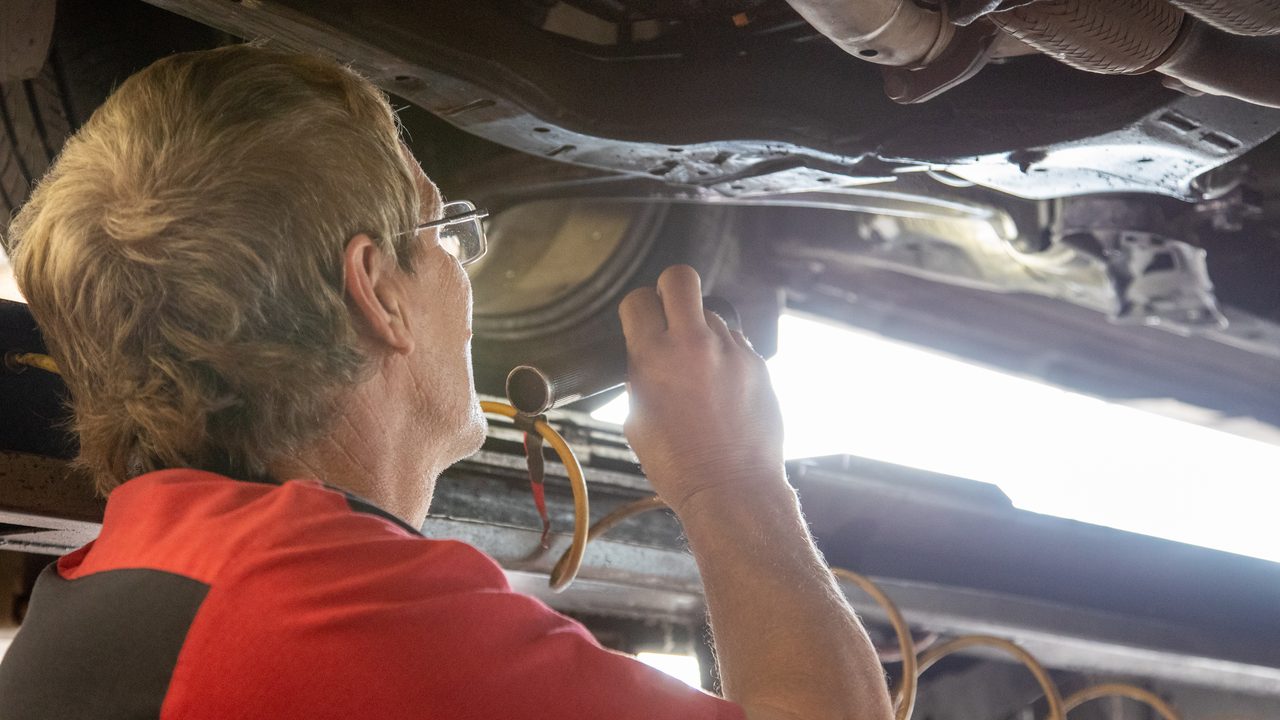
The right repair depends entirely on the cause, which a technician finds by getting the vehicle on a lift, inspecting the full system, and often listening with the engine running. From there, the fix might be tightening or replacing clamps and gaskets, welding a small crack, replacing a section of pipe, hanging the system properly on new hangers, or replacing a muffler or resonator that has failed internally. On older systems, a shop will give you an honest read on whether patching one spot makes sense or whether neighboring sections are close behind it.
Be cautious with the tempting shortcuts. Exhaust tape and paste are temporary at best on a system that gets extremely hot and vibrates constantly, and a patch that falls off on the freeway fixed nothing. If your exhaust got loud suddenly or you smell fumes, skip the experiments and call Call a Shop to get it looked at properly.
A Word About Aftermarket Exhausts
Sometimes the loud exhaust was a choice, installed by a previous owner or a younger version of yourself, and now the drone on the freeway has outlived its charm. That is a fixable situation too. A shop can replace an aftermarket system with quieter components, add or replace a resonator to take the edge off a specific frequency, or repair poorly fitted joints that make even an intentional system louder than it should be. The goal is the sound you actually want at the volume you can live with, and there is a lot of room between showroom-silent and waking the neighbors.
Quiet Is Also a Sign of Health
There is a satisfying flip side: a quiet exhaust usually means a healthy one. When the system is sealed and solid, sensors read accurately, the engine breathes the way it was designed to, the cabin stays free of fumes, and early morning departures stop being a neighborhood event. Fixing a loud exhaust is one of those repairs where you feel the result every single drive.
If your car, truck, or SUV has gotten loud, do not settle in and live with it. Network Automotive Service Center has been family-owned since 1995, and diagnosing and repairing exhaust systems is everyday work for us. Explore our services, check our current coupons, or call Call a Shop to schedule an exhaust inspection. We will find the noise, fix the cause, and give you back a quiet ride.
Next step
Want this looked at by someone who does it every day?
Book online at any of our six Arizona shops, or call and talk to a real person. Family owned since 1995.