A clunk when you shift into drive, a shudder at idle, or a knock every time you cross a speed bump on Val Vista or Gilbert Road usually points to one part most drivers never think about until it fails: the engine mount. Engine Mount Replacement Gilbert AZ isn’t a repair anyone plans for, but rubber and hydraulic mounts have a service life, and once they tear, the vibration and noise only get worse. This guide walks through what a failing mount actually feels like, what causes them to give out in Gilbert’s climate, and what a proper repair involves.
It’s easy to write the noise off as “just an old car” and keep driving, and for a while that’s not unreasonable. But mounts don’t heal, and a small tear only grows with every stop light and every speed bump. Understanding what’s actually happening under the hood makes it a lot easier to decide whether to schedule a repair this week or keep an eye on it for now.
3-5 Most vehicles ride on three to five engine and transmission mounts, and it usually only takes one bad one to make the whole drivetrain feel loose. Engine Mount Replacement Gilbert AZ jobs almost always start with a driver noticing just one specific clunk or shake, not a total loss of power.
Engine Mount Replacement Gilbert AZ: What’s Actually Failing
Engine mounts (and the matching transmission mount) are the rubber-and-metal or hydraulic-filled brackets that hold the engine and transmission to the frame of the car. They do two jobs at once: they hold thousands of pounds of moving machinery in place, and they absorb the engine’s vibration so it doesn’t transfer into the cabin, the steering wheel, or the shifter. When a mount is healthy, you shouldn’t feel the engine move at all when you accelerate, brake, or shift gears.
Most vehicles use a mix of mount types. Simple rubber mounts are solid blocks of vulcanized rubber bonded between two metal brackets. Hydraulic mounts, common on the mount closest to the front of the engine, use a fluid-filled chamber inside the rubber to damp vibration more effectively at idle. A torque strut or “dog bone” mount usually runs from the top of the engine or transmission back to the frame, controlling how far the engine rocks under acceleration rather than holding its full weight. Each type fails a little differently: a rubber mount tends to crack and visibly separate, while a hydraulic mount can look fine from the outside right up until the fluid leaks out and it goes soft and hollow.
When the rubber inside a mount cracks, separates, or the hydraulic fluid inside a fluid-filled mount leaks out, the engine is free to rock on its remaining mounts under torque. That’s the clunk you feel when you put the car in drive or reverse, and it’s the vibration you feel at a red light that wasn’t there a year ago. Left alone, a torn mount lets the engine bang against the frame, subframe, or nearby hoses and wiring, turning what should have been a contained repair into a much bigger one.
It’s worth noting that a clunk or vibration doesn’t automatically mean a mount. Worn CV axles, a loose exhaust hanger, failing sway bar links, and even a low or uneven idle from a misfire can all produce similar symptoms. That overlap is exactly why a load test under the hood, watching how much the engine actually moves in gear, matters more than guessing from the sound alone.
Common Causes Behind Engine Mount Replacement Gilbert AZ
A few things push engine mounts toward failure faster in the East Valley than they would in a milder climate. Under-hood temperatures in Gilbert regularly climb well past what the rubber compound in a mount was designed to handle for years on end, and that heat cycle, hot during the day, cooling overnight, is exactly what dries out and cracks rubber over time. Stop-and-go traffic on Val Vista, Baseline, and the 202 also loads mounts constantly with acceleration and braking torque, which is harder on them than steady highway driving.
| Cause | What It Does | What You’ll Notice |
|---|---|---|
| Heat-cracked rubber | Compound dries out and splits internally | Clunk on shift, growing vibration over months |
| Leaking hydraulic mount | Fluid escapes, mount goes hollow | Sudden onset shake, worse when cold |
| Prior impact or pothole hit | Bracket cracks or tears under shock load | Immediate clunk after the impact |
| High mileage / age | Rubber simply wears past its service life | Gradual increase in cabin vibration |
Age and mileage matter too. Most factory mounts are rated for somewhere between 80,000 and 120,000 miles under normal conditions, but Arizona’s heat routinely shortens that window. Drivers who tow, haul, or regularly floor it from a stop also put more torque through their mounts, which accelerates wear on whichever mount takes the brunt of that load, usually the one on the side of the transmission or the accessory-heavy side of the engine.
Front-wheel-drive vehicles almost always load one mount harder than the others because the engine and transmission sit sideways and torque twists the whole assembly toward that side under acceleration. If you notice the clunk mostly when you first press the gas from a stop, that mount is usually the first one worth checking.
Oil and coolant leaks compound the problem. A mount that sits low in the engine bay can slowly absorb dripping oil or power steering fluid from a separate, unrelated leak, and petroleum products break down rubber compounds far faster than heat alone. If your vehicle has had any fluid leak sitting near a mount for months, it’s worth having that mount inspected even if it isn’t the one making noise yet.
Our Engine Mount Replacement Gilbert AZ Process
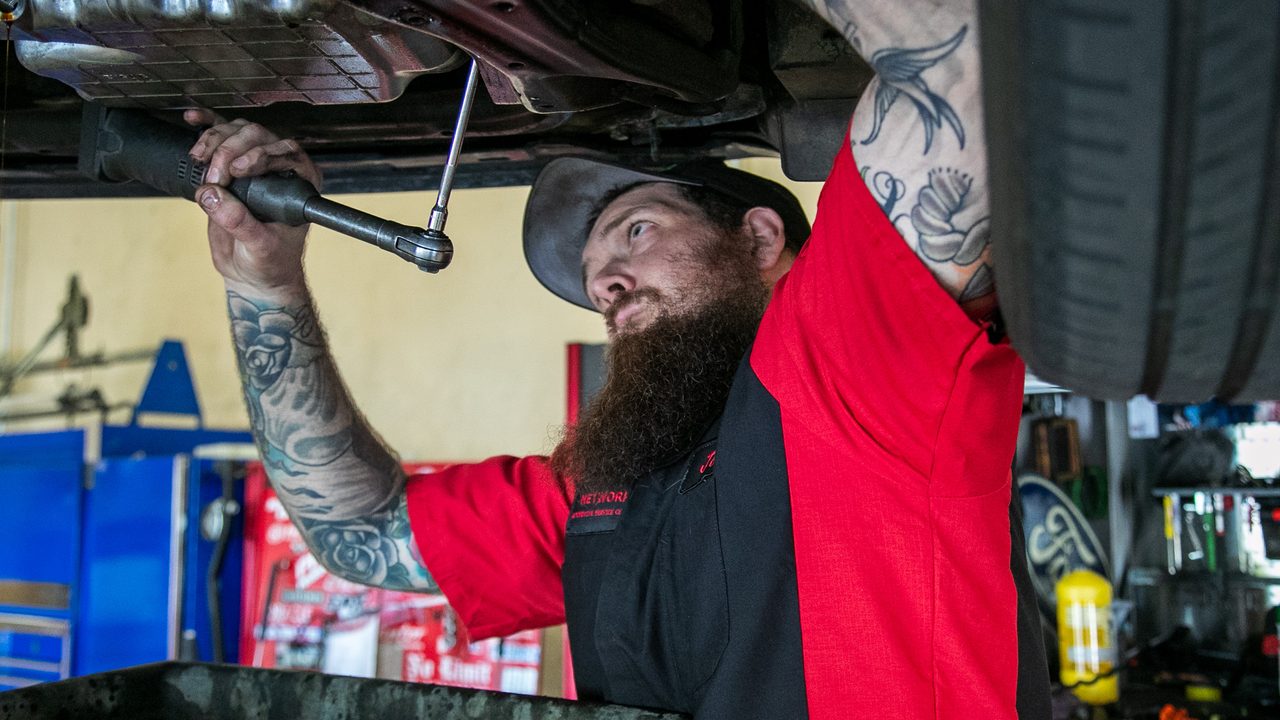
A proper repair starts with confirming which mount (or mounts) are actually bad, not swapping parts based on a guess. Every Engine Mount Replacement Gilbert AZ visit follows the same process, whether it’s an obvious tear or a subtle vibration you can barely describe. Here’s what that process looks like from the moment your car comes in.
- Road test to reproduce the clunk, shake, or knock you’re describing.
- Visual and physical inspection of every mount, checking for visible tears, oil-soaked rubber, or excess engine movement under load.
- Pry-bar and load test with the engine running in gear to watch how much the engine actually shifts on each mount.
- Inspection of nearby components, hoses, wiring, and exhaust, that a bad mount may have already contacted or damaged.
- Written estimate showing exactly which mount(s) need replacement and why, before any work starts.
- OEM-spec or OEM mount installation, torqued to manufacturer specification.
- Second road test to confirm the clunk, shake, or vibration is gone.
Because a rocking engine can wear out other mounts faster once one has failed, we always check all of them together rather than replacing just the one that’s obviously torn. On vehicles with limited access, that road test and pry-bar check also tells us up front whether the intake, splash shield, or a subframe brace has to come off to reach the failing mount, so the estimate you get reflects the actual job rather than a best-case scenario that changes once the car is on the lift.
We also torque every replacement mount to the exact factory specification rather than “snug.” An under-torqued mount bolt can work loose from vibration within a few thousand miles, which brings the same clunk right back and turns a one-time repair into a comeback visit.
Cost & Time for Engine Mount Replacement Gilbert AZ
Pricing depends on which mount is failing, how many need to be replaced, and how accessible that mount is on your particular engine layout. Some mounts bolt on in under an hour; others sit behind the intake, the alternator, or the subframe and take significantly longer to reach. Front-wheel-drive vehicles with transverse engines often have at least one mount that requires supporting the engine with a jack or brace while it’s disconnected, which adds time compared with a simple bolt-on rear mount. Most single-mount jobs are same-day work, while a full set on a harder-to-access engine can take longer.
We always break the cost down by part and labor before starting, and we’ll tell you plainly if a mount can wait or if it’s already stressing other components. There’s rarely a reason to replace every mount preventively if only one has actually failed the load test, so the estimate reflects what your vehicle needs rather than a blanket package.
- Written estimate before any work begins, no surprise add-ons
- OEM-spec mounts matched to your vehicle’s make and model
- Most Engine Mount Replacement Gilbert AZ jobs completed same day
- Nearby hoses, wiring, and brackets inspected during the job at no extra charge
- Post-repair road test included before you leave
- 24-month / 24,000-mile nationwide warranty on parts and labor
If you’re not sure whether it’s worth fixing right now, our current service specials page is worth checking before you book.
Is Engine Mount Replacement Gilbert AZ Urgent?
Not every clunk means you need to pull over immediately, but some signs mean the mount has failed badly enough that continuing to drive risks real damage.
- Loud metal-on-metal clunk every time you shift, not just an occasional one
- Visible engine movement when you rev in park with the hood open
- Rubber debris or torn mount pieces visible under the car
- New rattling or contact noise from hoses or the exhaust near the engine bay
- Sudden, sharp increase in vibration that wasn’t there the day before
None of this means every clunk requires an emergency tow. A mild, occasional clunk on shift that hasn’t changed in weeks is usually safe to schedule normally. What changes the calculation is a sudden jump in severity, visible movement of the engine itself, or contact noise suggesting the engine is already touching something it shouldn’t.
What To Do Right Now About Engine Mount Replacement Gilbert AZ
You don’t need to diagnose the exact mount yourself, but a little detail goes a long way toward a faster, more accurate visit. The steps below take a few minutes and give a technician a real starting point instead of a blank slate.
- Note when the clunk or vibration happens, on shift, at idle, under acceleration, or over bumps.
- Pop the hood and look for anything obviously torn, oily, or out of place near the mounts (only with the engine off).
- Avoid hard acceleration or towing until it’s inspected, since that’s when a weak mount takes the most stress.
- Schedule an inspection so a technician can load-test the mounts rather than guessing from the symptom alone.
- Ask for a written estimate showing exactly which mount is failing before agreeing to any repair.
Why Choose Network Automotive for Engine Mount Replacement Gilbert AZ
A clunk or shake can come from a dozen different parts under the car, so the value of a real shop isn’t just installing a new mount, it’s confirming which mount, if any, is actually the problem before you pay for parts. That’s the approach we take with every vehicle that comes in for this.
- Every mount is load-tested, not just visually inspected, before we recommend replacement
- Written, itemized estimates before any work begins
- OEM-spec parts matched to your specific make and model
- Nearby components checked for damage the failing mount may have already caused
- Full engine and drivetrain services under one roof if other components need attention
- Learn more about our shop and technicians
If your symptoms sound more like a misfire or rough idle than a clunk on shift, our check engine light diagnostic guide covers that separately, and if the noise shows up mainly when braking rather than shifting, see our car shaking when braking guide for that distinct symptom.
Service Area
We work on vehicles from throughout Gilbert and the surrounding East Valley, including drivers near Val Vista Lakes, Cosmo Dog Park, Heritage District, San Tan Village, and the Power Road corridor, as well as neighboring Mesa, Chandler, and Queen Creek. If a clunk or shake started after a pothole, a curb hit, or just years of daily commuting, we can take a look regardless of which part of Gilbert you’re coming from.
Commuters running Val Vista Drive, Greenfield Road, or the daily stretch of the 202 through Gilbert put a lot of stop-and-go cycles on their mounts, and that’s often where we see the earliest symptoms show up. If you’ve noticed the clunk getting more frequent over the last few weeks rather than staying constant, that’s usually a sign the tear is progressing rather than a one-time fluke.
Next step
Want this looked at by someone who does it every day?
Book online at any of our six Arizona shops, or call and talk to a real person. Family owned since 1995.