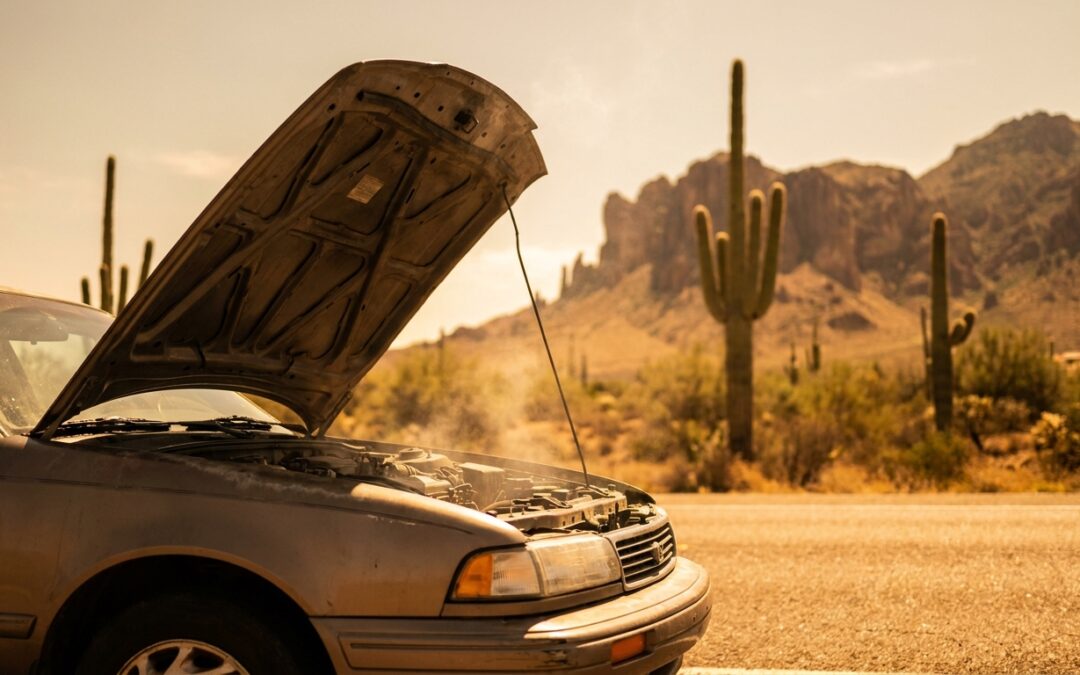
Car Overheating Repair in Mesa, AZ: Why It Happens, What It Costs, and What to Do Right Now
Mesa summer breaks things. If your temp gauge just climbed into the red on the Loop 202, or you’re sitting on the shoulder watching steam roll out from under your hood, this is the mechanic-written guide to car overheating repair in Mesa — what actually fails in 115°F heat, what it costs to fix, and the one move that turns a $300 repair into a $5,000 engine.
You’re on Southern Avenue. It’s 113°F outside. The temp needle that’s been steady for years is suddenly creeping toward the red zone, and you’re trying to decide: pull over right now, or limp it to the next exit? If you’ve been Googling “car overheating repair Mesa AZ” from a parking lot with the hood up, this is the article you want to be reading.
At Network Automotive Service Center, we’ve been fixing overheating cars for East Valley drivers since 1995. Mesa summers are uniquely brutal on a car’s cooling system — ambient temps that hit 118°F, asphalt that radiates back another 30°F, and stop-and-go traffic that gives your radiator no airflow at idle. Every year between May and October, our bays fill with the same handful of failures. This guide walks you through what actually fails in Arizona heat, what it costs to repair in Mesa in 2026, and most importantly — the one thing you should NOT do when your car overheats (it’s the difference between a $300 thermostat and a $5,000 engine rebuild).
The One Thing You Should NOT Do Right Now
Before anything else: if your temperature gauge is in the red, or you see steam, or the high-temperature warning light is on, pull over and shut the engine off. Not at the next exit. Not at the next gas station. Now.
Here’s why this matters more in Mesa than almost anywhere else: a modern engine runs at roughly 195–220°F coolant temp. When it overheats, internal temps can spike past 280°F in seconds. Aluminum heads warp at around 250°F. Head gaskets blow. Oil cooks. Pistons can seize against cylinder walls. Every additional minute of driving with an overheated engine roughly doubles the cost of the repair.
- Pull over immediately if temp gauge is in the red or warning light is on
- Turn off the engine — do not idle, do not “let it cool with the engine running”
- Turn on the heater to MAX if you must keep moving for safety — the heater core pulls heat OUT of the engine. It’ll be miserable inside but it can buy you a mile or two
- Do NOT open the radiator cap while the engine is hot. Pressurized coolant will erupt as scalding steam — serious burns
- Do NOT pour cold water into a hot engine. Thermal shock can crack the block or warp the head instantly
- Call: (480) 444-0242 — we’ll walk you through whether you can drive in or need a tow
Mesa safety reminder: If you pull over on a Mesa freeway between June and September, get out of the car and stand in shade. A disabled vehicle on asphalt at 115°F outside is 140°F inside within minutes. Bring kids and pets out with you.
Why Cars Overheat in Mesa Heat
Your engine generates enormous heat. The cooling system has one job: get that heat out of the engine and into the air before anything melts. Mesa summer makes that job significantly harder because:
- Ambient air temp is already 110°+ — the radiator has less “cool” air to dump heat into
- Stop-and-go traffic at idle means no natural airflow through the radiator — you’re relying entirely on the electric cooling fans
- Hard A/C usage puts extra load on the engine AND on the cooling system (condenser sits in front of the radiator)
- Long highway grades (US-60 toward Gold Canyon, the 60 climb out of Mesa toward Globe) raise engine load and heat
- Aging components that worked fine at 95° ambient fail at 115°
- Coolant degradation — Arizona heat breaks down old coolant faster than cooler climates
Mesa-specific tip: If your car ran fine all spring and started overheating with the first 105°+ day, it was already running on borrowed time. The hot weather didn’t cause the failure — it exposed a marginal cooling system that couldn’t handle the load. Fix it now before something worse happens.
Free Mesa Cooling System Inspection
Stop guessing. Bring your vehicle to Network Automotive and we’ll pressure-test the cooling system, scan for codes, check fan operation, inspect hoses and the radiator, and test your coolant condition.
The Most Common Overheating Causes We See in Mesa
After three decades of East Valley summer work, here’s the honest ranking of what causes overheating — and what each repair runs in 2026:
| Cause | How Common | Typical Mesa Repair Cost | Drive-In Risk |
|---|---|---|---|
| Low coolant / coolant leak | Very common | $120–$650 | Low if caught early |
| Failed thermostat (stuck closed) | Very common | $280–$520 | Moderate |
| Failed radiator fan / fan motor | Very common in AZ | $380–$780 | High at idle, low at highway speed |
| Bad radiator (clogged or leaking) | Common | $550–$1,200 | Moderate |
| Water pump failure | Common | $580–$1,400 | High |
| Failed radiator hose (upper or lower) | Common | $220–$520 | High if it bursts |
| Bad radiator cap | Underrated | $25–$60 | Low |
| Coolant flush long overdue | Maintenance | $140–$220 | Low |
| Failed cooling fan relay / module | Moderate | $220–$580 | High at idle |
| Head gasket failure | Worst case | $1,800–$3,800 | Critical |
| Cracked head / block | Catastrophic | $4,500–$8,000+ | Tow required |
Those are real Mesa 2026 ranges. Your actual number depends on year, make, model, and what the diagnostic finds. The single biggest factor in cost is timing — the same failure caught early costs a fraction of what it costs caught late.
Why fans matter more in Mesa than anywhere else
Most of the country’s cars overheat from coolant leaks or thermostat failure. In Mesa, we see a fourth and equally common cause: cooling fan failure. Why? Because in 75° weather, your car can cool itself at highway speed even with a dead fan — you just get overheating at long red lights. In Mesa summer, a dead fan means the car can’t cool itself at 80 mph either. The fan does 100% of the work. When it dies in July, the car overheats within minutes regardless of speed.
7 Warning Signs Your Car Is About to Overheat in Mesa
- Temperature gauge runs higher than normal — even within “normal” range, if it’s higher than it used to be, something is changing
- Coolant low warning light — coolant level dropping with no visible puddle = small leak or burning through the system
- Sweet, syrupy smell from the engine bay or vents — classic coolant smell, usually means a leak
- White exhaust smoke that smells sweet — coolant burning in the combustion chamber (head gasket warning)
- Coolant in your oil (milky chocolate-milkshake look on the dipstick) — head gasket has failed
- A/C blows warm at red lights but cool on the highway — often a dying fan or low coolant
- Heater works erratically — air pockets in the cooling system, low coolant, or a clogged heater core
How Network Automotive Diagnoses an Overheating Car in Mesa
- Customer interview. When did it start? Idle, highway, towing, A/C on, after fuel-up? Any recent service work? The pattern usually narrows the failure to one of three systems.
- Code scan. Engine, transmission, body, ABS — sometimes an unrelated module sees the temperature spike before the gauge does.
- Coolant pressure test. We pressurize the cooling system to 15 PSI and watch for leaks at hoses, radiator, water pump, heater core, and head gasket areas. Catches 80% of slow leaks in 10 minutes.
- Combustion gas test. If we suspect head gasket, we test for combustion gases dissolved in the coolant — the most definitive head gasket test there is.
- Thermostat & fan operation test. Verify thermostat opens at correct temperature, verify both speeds of the electric fan, verify the fan relay / module commands fan on at correct temperature.
- Coolant condition test. Strip-test pH, freeze point, and conductivity. AZ heat ages coolant fast — even “not that old” coolant can be acidic and eating water pump seals.
- Visual inspection. Radiator fins, hose condition, water pump weep hole, condition of cap and reservoir.
- Written diagnostic report. Plain-English summary, exact parts and labor quoted, root cause identified. No guesses.
- Repair approval — your call. Want to take the report home? Want a second opinion? Take the time you need.
- Verification. After repair, full cooling system bleed, pressure re-test, road test long enough for the thermostat to cycle multiple times. We verify before you pay.
What Does Overheating Repair Cost in Mesa in 2026?
Real numbers, because you don’t have time to call five shops:
- Cooling-system inspection at Network Automotive: Diagnostic fee applies, quoted upfront
- Cooling-system pressure test & full diagnostic: $120–$180 if no obvious failure found — usually credited toward repair if approved
- Coolant flush & refill with OEM-spec coolant: $140–$220
- Thermostat replacement: $280–$520
- Radiator cap: $25–$60 (and yes, this is sometimes the entire fix)
- Upper or lower radiator hose: $220–$520
- Radiator fan / fan motor replacement: $380–$780
- Radiator replacement: $550–$1,200 including coolant
- Water pump replacement: $580–$1,400 depending on if it’s timing-belt-driven
- Head gasket replacement: $1,800–$3,800 on most modern engines
- Cracked head or block: $4,500–$8,000+ — often the point where engine replacement makes more sense than repair
How long does overheating repair take in Mesa?
Most overheating jobs are same-day. Coolant flush, thermostat, hose, or radiator cap is 60–90 minutes. Radiator replacement is 2–4 hours. Water pump is 3–6 hours depending on engine layout. Fan motor or relay is 60–120 minutes. Head gasket is 1–3 days. We have loaner options for longer jobs and prioritize overheating cases during summer.
Mesa Summer Is Here. Don’t Wait.
If your car overheated even once this season, the underlying problem isn’t going to fix itself. Bring it to Network Automotive for a free cooling-system inspection — we’ll find the root cause before it costs you an engine.
How to Prevent Your Car From Overheating This Mesa Summer
Preventing overheating is much cheaper than fixing it. Here’s what we recommend for every East Valley driver before summer:
- Coolant flush every 2–3 years in AZ — not the 5+ years some manufacturers suggest. Arizona heat breaks coolant down faster.
- Pre-summer cooling-system pressure test. Catches slow leaks before they become roadside breakdowns.
- Cap check. Radiator caps fail more often than people think — a $25 part can save a $3,000 engine.
- Visual hose inspection. Squeeze your upper radiator hose. If it’s rock-hard or sponge-soft, replace it.
- Belt & serpentine belt inspection. A broken belt = no water pump = overheat in 2 minutes.
- Fan operation test. With engine running and at operating temp, the fan should kick on when A/C engages or coolant temp climbs. Easy to miss until it’s 115° and your car is dying at a stoplight.
- Don’t ignore a small leak. A drip in your driveway in March is a roadside breakdown in July.
Why Mesa Drivers Trust Network Automotive for Cooling Repairs
- Family-owned since 1995. Three decades of Mesa summers — we know exactly what fails and when.
- ASE-certified technicians. Not seasonal hires guessing their way through your engine.
- Cooling-system inspection & pressure test. No-pressure, no-upsell, written report.
- OEM-spec coolant & parts. The wrong coolant chemistry destroys water pump seals in Arizona heat — we use exactly what the manufacturer specifies.
- 24-month / 24,000-mile nationwide warranty on parts and labor.
- Written estimates up-front. Zero phone-tag, zero “while we were in there.”
- Loaner options on longer repairs so your summer doesn’t stop.
- Priority for overheating cases May through October — we know it’s urgent in Mesa heat.
Read more on the About Network Automotive page, see the full service menu, or browse Mesa service coupons. Already dealing with weak A/C too? See our AC repair Mesa AZ guide.
Proudly Serving Mesa and the Greater East Valley
Network Automotive Service Center handles cooling and overheating repair across:
- Mesa — East Mesa, West Mesa, Las Sendas, Red Mountain, Dobson Ranch, Alta Mesa, downtown
- Gilbert — Agritopia, Morrison Ranch, Seville, Power Ranch
- Queen Creek — Cortina, Ironwood Crossing, San Tan Heights
- Apache Junction — Superstition, Gold Canyon
- Prescott — Prescott Valley and surrounding
Most Mesa customers book at our East Mesa shop near Power Road & US-60 for the fastest in-and-out during summer surge season.
Mesa Car Overheating Repair FAQ
What should I do the moment my car overheats in Mesa?
Pull over immediately and shut the engine off — not at the next exit, not at the next gas station, now. Every additional minute of driving with an overheated engine roughly doubles the cost of the repair. Turn on the heater to MAX if you absolutely must move the car a short distance for safety. Do NOT open the radiator cap while hot. Do NOT pour cold water on a hot engine. Call Network Automotive at (480) 444-0242 for guidance.
How much does it cost to fix an overheating car in Mesa?
It depends on the cause. A thermostat is $280–$520. A radiator cap is $25–$60 and sometimes the entire fix. Cooling fan motor is $380–$780. Radiator replacement is $550–$1,200. Water pump is $580–$1,400. Head gasket is $1,800–$3,800. Our free cooling-system inspection tells you exactly which category your vehicle falls into before any work is authorized.
Why do cars overheat more in Mesa than other cities?
Three reasons: ambient air temperatures past 115°F leave less “cool” air for the radiator to dump heat into, asphalt radiates another 30°F, and Mesa stop-and-go traffic means zero natural airflow at idle. Components that work fine at 95° ambient often fail at 115°.
Can I drive my car if the temperature gauge climbs but is not in the red?
Cautiously and briefly. A gauge that runs higher than normal means the cooling system is on the edge. You should schedule service within days, not weeks. Driving in heavy traffic, with A/C blasting, or up grades will push it into the red eventually — usually at the worst possible time.
How long does it take to fix an overheating car in Mesa?
Most repairs are same-day. Coolant flush, thermostat, hose, or cap is 60–90 minutes. Radiator is 2–4 hours. Water pump is 3–6 hours. Fan motor is 60–120 minutes. Head gasket is 1–3 days. We prioritize overheating cases May through October and offer loaners on longer jobs.
Should I flush my coolant before summer in Arizona?
Yes, if it has been more than 2–3 years. Arizona heat breaks coolant down faster than manufacturer recommendations assume. Old coolant becomes acidic and eats water pump seals, radiator end-caps, and heater cores. A $180 flush is the cheapest insurance you can buy before May.
Why is my car overheating only at red lights?
Almost always a cooling fan problem — bad fan motor, bad fan relay, or bad cooling fan module. At highway speed, natural airflow keeps the radiator cool. At a Mesa red light, the fan does 100% of the cooling work. When it fails, you overheat at every long light.
Does Network Automotive warranty cooling system repairs?
Yes. Every cooling system repair is backed by our 24-month / 24,000-mile nationwide warranty on parts and labor at participating NAPA AutoCare shops across the country.
Beat the Mesa Heat — Before It Costs You an Engine
Family-owned in Mesa since 1995, ASE-certified, free cooling-system inspections, and a 24-month / 24,000-mile nationwide warranty. Don’t wait for the temp gauge to climb again — bring it in now while the fix is still cheap.