A grinding noise when turning Mesa AZ drivers hear on a hot afternoon is never random. It’s your wheel bearing, your CV joint, or your brakes telling you exactly what’s wrong — if you know how to listen.
You’re pulling out of a parking lot on Southern Avenue, turning the wheel, and there it is — a low, grinding scrape that wasn’t there last week. A grinding noise when turning Mesa AZ commuters describe almost always points to one of three places: a wheel bearing that’s lost its smoothness, a CV joint that’s let dust and grit into a joint that was never supposed to see either, or a brake component that’s gone metal-on-metal. Guess wrong and you pay to fix the wrong part while the real problem keeps getting worse under load.
Here’s the thing about turning specifically: it’s a stress test your car runs on itself every single time you take a corner. Straight-line driving hides a lot of sins. The moment you turn the wheel, load shifts hard onto one side of the car, joints articulate at sharper angles than they do going straight, and any part that’s already worn gets pushed past the point where it can stay quiet. That’s why the noise shows up on turns before it shows up anywhere else — and why it’s such a reliable diagnostic clue once you know how to read it.
3 Three unrelated problems — a worn wheel bearing, a torn CV joint, and metal-on-metal brakes — can all produce a grinding noise when turning Mesa AZ. Only a hands-on inspection tells you which one you’re actually dealing with.What’s Actually Happening Under Your Car
A wheel bearing is a sealed set of steel balls or rollers that lets your wheel spin freely while carrying the full weight of that corner of the car. When the grease inside breaks down or the seal fails and lets in Mesa’s fine dust, the bearing starts running dry and pitted. Straight ahead, a failing bearing usually just hums or drones with road speed. Turn the wheel, though, and you load the bearing unevenly — more weight pushes onto one race than the other — and that uneven load is exactly when a marginal bearing starts to grind.
A CV (constant velocity) joint lives at each end of your front axles and lets power keep flowing to the wheel even as the suspension moves up and down and the wheel turns side to side. It’s packed with grease and sealed inside a rubber boot. Once that boot cracks — from age, road debris, or the way summer heat dries and splits rubber across the Valley — grit gets in, the grease washes out, and the joint starts grinding or clicking, loudest exactly when you turn because that’s when the joint’s operating angle is most extreme.
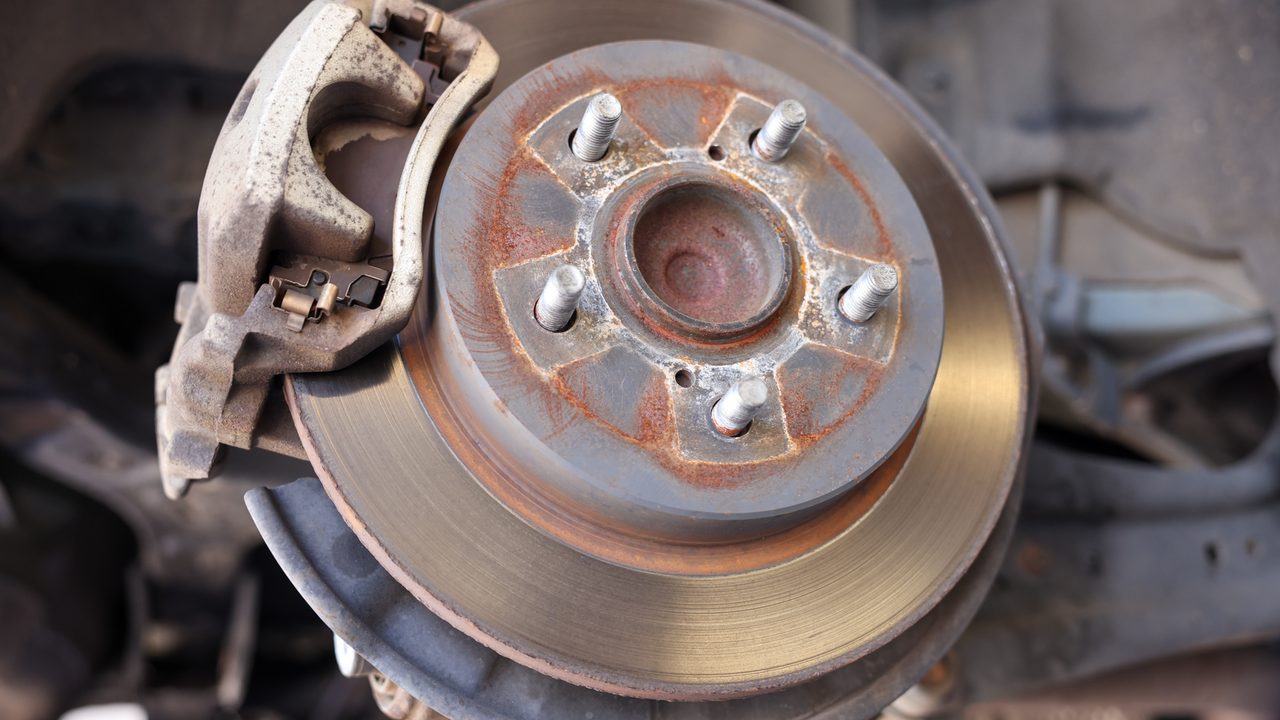
And then there’s the option nobody wants: brakes worn down to bare metal. Once the friction material on a pad is gone, the metal backing plate rides directly on the rotor. That’s a grinding noise when turning Mesa AZ drivers sometimes mistake for a bearing or axle problem, because turning shifts brake bias and can make the sound more or less noticeable depending on which wheel is loaded. This one doesn’t wait — it’s already a safety issue.
The 3 Most Common Causes, Side by Side
The fastest way to narrow down a grinding noise when turning Mesa AZ mechanics diagnose every week is to pay attention to exactly when it happens and what else comes with it. Here’s how the three most common culprits compare:
| Symptom | Wheel Bearing | CV Joint | Worn Brakes |
|---|---|---|---|
| When you hear it | Hums at speed, grinds worse on turns | Clicks or grinds sharply on tight turns | Grinds at any speed, worse on braking |
| Other signs | Wheel wobble, vibration through seat | Grease flung inside wheel, torn boot visible | Squeal before grind, vibration in pedal |
| Gets louder when | Accelerating or turning away from the bad side | Turning sharply, especially at low speed | Applying the brakes |
| Urgency | Moderate — can fail suddenly | Moderate to high — joint can lock up | High — reduced stopping power |
Notice the overlap. A grinding noise when turning Mesa AZ drivers bring in often has more than one thing going on at once, because a car that’s neglected in one area tends to be neglected in others. That’s exactly why we don’t diagnose over the phone — we put the car on a lift, spin the wheels by hand, check for play, and look at what’s actually happening before we tell you what needs to be fixed.
Why Turning Reveals It First
It’s worth spending a moment on why turning specifically is such a reliable trigger, because understanding it helps you describe the problem accurately when you call a shop. When you drive straight, weight sits roughly evenly across both front wheels and each CV joint operates near the middle of its range of motion. The moment you turn the wheel, physics takes over: weight transfers toward the outside wheel, the inside wheel unloads slightly, and the CV joints on both sides swing toward the extreme ends of their articulation range. A wheel bearing with even a small amount of internal wear will tolerate light, even loading for thousands of miles, but the added side-load of a hard turn is often the exact condition that turns a barely-perceptible hum into an unmistakable grind. The same logic applies to a CV joint that’s just starting to dry out — it can move quietly through a small range of motion but complain loudly the moment it’s forced to its limit.
That’s also why a grinding noise when turning Mesa AZ drivers notice on tight, slow-speed turns — like pulling into a driveway or navigating a parking garage — points more toward a CV joint than a bearing. Tight, slow turns push the joint to its steepest angle. A noise that instead shows up mainly at highway speed, regardless of whether you’re turning, leans more toward a wheel bearing, since bearing noise is driven by rotational speed more than steering angle.
Less common causes worth ruling out
- Loose or missing wheel hardware — a lug nut that’s backed off can create a grinding or clunking noise on turns.
- A rock or debris lodged against the rotor or backing plate — common after driving through construction zones or unpaved lots.
- Worn strut mounts or sway bar links — these usually clunk more than grind, but on rough pavement they can sound similar.
- Power steering pump or rack issues — these tend to whine rather than grind, but a failing rack can produce a grinding feel through the wheel itself.
Our Diagnostic Process
When a customer brings us a car with a grinding noise when turning Mesa AZ, we don’t start swapping parts. We start with a process built to find the actual source in one visit.
- Road test. We drive the car through a range of speeds and turn radii to hear exactly when and how the noise presents.
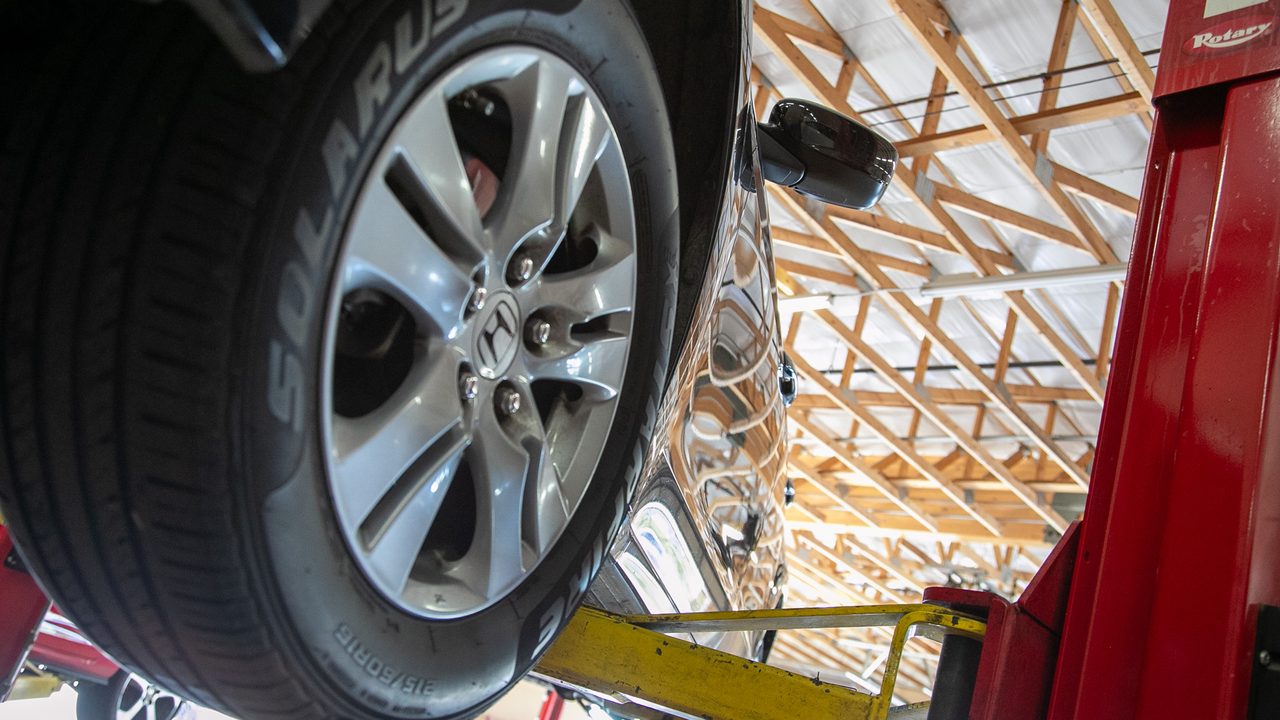
- Lift inspection. With the car in the air and wheels off the ground, we spin each wheel by hand and listen for grinding, roughness, or resistance.
- Wheel bearing play check. We grip each wheel at 12 and 6 o’clock and rock it, checking for the play that signals a worn bearing or loose hub.
- CV boot and joint inspection. We visually inspect both front boots for tears, cracks, or flung grease, then check joint movement through full steering travel.
- Brake inspection. Pads, rotors, and calipers get pulled and measured — not just glanced at through the wheel spokes.
- Suspension and steering check. We check sway bar links, tie rods, and strut mounts to rule out anything that mimics a bearing or CV noise.
- Written diagnosis. You get a clear explanation of what’s actually causing the grinding noise when turning Mesa AZ vehicles like yours experience, in plain language, before any work starts.
- Upfront estimate. No surprise charges — you approve the repair before we touch anything.
Cost & Time
Once we know which part is actually failing, most of these repairs are same-day or next-day jobs. Here’s a general range for what Mesa drivers typically see, though your exact quote depends on vehicle make, model, and what we find on the lift:
- Wheel bearing replacement: commonly $250–$550 per wheel, depending on whether it’s a press-in bearing or a full hub assembly.
- CV axle replacement: commonly $300–$650 per side installed, less if only the boot needs replacing and it’s caught early.
- Brake pad and rotor replacement: commonly $250–$500 per axle, more if calipers are also seized or damaged.
- Diagnostic visit: a proper hands-on inspection typically takes 45–90 minutes, and most repairs above are completed same day once approved.
These are general ranges, not a quote — the only way to know your exact cost is a hands-on look at the vehicle causing the grinding noise when turning Mesa AZ.
When Is It Urgent?
Not every grinding noise means pull over immediately, but some do. Here’s how to tell the difference.
- The grinding gets noticeably louder or changes pitch when you brake — possible metal-on-metal brake contact.
- You feel a vibration or wobble through the steering wheel or seat, especially at highway speed.
- The noise is accompanied by a clunk when the joint articulates — a CV joint that’s about to fail completely can leave you stranded.
- The wheel feels loose, or you notice uneven tire wear on one side of the car.
- The stopping distance feels longer than usual, or the brake pedal feels different than normal.
Common Mistakes Drivers Make
We see the same handful of mistakes over and over with a grinding noise when turning Mesa AZ vehicles are dealing with. The first is assuming a quick spray of lubricant on a squeaky-sounding joint will fix anything — it might mute the sound for a day or two, but it does nothing for a torn boot or a pitted bearing race, and it can mask the noise just long enough for the part to fail without warning. The second is replacing the wrong part based on a guess, usually because the noise is loudest on one side and gets blamed on whatever part is easiest to see, like a rotor, when the actual cause is a hidden CV joint or bearing. The third is waiting for the noise to get “bad enough” to justify a shop visit, which almost always means paying for a more expensive repair than the one you’d have paid for a few weeks earlier — a cracked CV boot caught early is a small fix, while a joint that’s run dry for months usually means the whole axle.
What To Do Right Now
- Note when it happens. Does it grind on right turns, left turns, both, or only under braking? This alone helps narrow the diagnosis.
- Check for visible clues. If you can safely look at the wheel wells, check for grease flung on the inside of a wheel (CV joint) or visible metal shavings near a rotor (brakes).
- Avoid hard, fast turns until it’s inspected — a compromised bearing or joint can fail more suddenly under aggressive steering input.
- Don’t ignore it and hope it goes away. None of the three main causes of a grinding noise when turning Mesa AZ vehicles develop improve on their own; all three get more expensive the longer they run.
- Schedule a hands-on inspection rather than guessing and replacing parts one at a time.
Why Choose Network Automotive
We’ve built our reputation in the East Valley on honest, hands-on diagnosis instead of parts-cannon guessing. When you bring us a grinding noise when turning Mesa AZ, here’s what you get:
- A full lift inspection before any part is ever recommended — see our full list of services.
- Clear, plain-language explanations of what’s actually wrong and why, not just a part number.
- Upfront pricing before work begins — no surprise line items.
- ASE-certified technicians who work on wheel bearings, CV axles, and brake systems every day. Learn more about our shop.
- A locally owned Mesa shop that depends on repeat customers, not one-time sales.
- Current specials and coupons available on our coupons page.
Service Area
We diagnose and repair a grinding noise when turning Mesa AZ drivers bring to our shop from throughout the East Valley, including:
- Mesa — Downtown, Eastmark, Las Sendas, Red Mountain, Dobson Ranch
- Gilbert
- Apache Junction
- Queen Creek
- Tempe
- Chandler
Get Your Grinding Noise When Turning Mesa AZ Vehicle Diagnosed Today
Don’t keep guessing or swapping parts one at a time. Bring your vehicle to Network Automotive in Mesa and get a real, hands-on diagnosis backed by an upfront estimate.
Next step
Want this looked at by someone who does it every day?
Book online at any of our six Arizona shops, or call and talk to a real person. Family owned since 1995.