Car Overheating Repair in Mesa, AZ: Why It Happens, What It Costs, and What to Do Right Now

Car Overheating Repair in Mesa, AZ: Why It Happens, What It Costs, and What to Do Right Now

HomeBlog › Car Overheating Repair Mesa AZ

Car Overheating Repair in Mesa, AZ: Why It Happens, What It Costs, and What to Do Right Now

By Network Automotive Service CenterMesa, AZUpdated May 2026

Mesa summer breaks things. If your temp gauge just climbed into the red on the Loop 202, or you’re sitting on the shoulder watching steam roll out from under your hood, this is the mechanic-written guide to car overheating repair in Mesa — what actually fails in 115°F heat, what it costs to fix, and the one move that turns a $300 repair into a $5,000 engine.

You’re on Southern Avenue. It’s 113°F outside. The temp needle that’s been steady for years is suddenly creeping toward the red zone, and you’re trying to decide: pull over right now, or limp it to the next exit? If you’ve been Googling “car overheating repair Mesa AZ” from a parking lot with the hood up, this is the article you want to be reading.

At Network Automotive Service Center, we’ve been fixing overheating cars for East Valley drivers since 1995. Mesa summers are uniquely brutal on a car’s cooling system — ambient temps that hit 118°F, asphalt that radiates back another 30°F, and stop-and-go traffic that gives your radiator no airflow at idle. Every year between May and October, our bays fill with the same handful of failures. This guide walks you through what actually fails in Arizona heat, what it costs to repair in Mesa in 2026, and most importantly — the one thing you should NOT do when your car overheats (it’s the difference between a $300 thermostat and a $5,000 engine rebuild).

$5,000
That’s the average cost of a head gasket replacement on a modern engine — the most common consequence of driving an overheating car “just a little farther.” Knowing when to pull over saves real money.

The One Thing You Should NOT Do Right Now

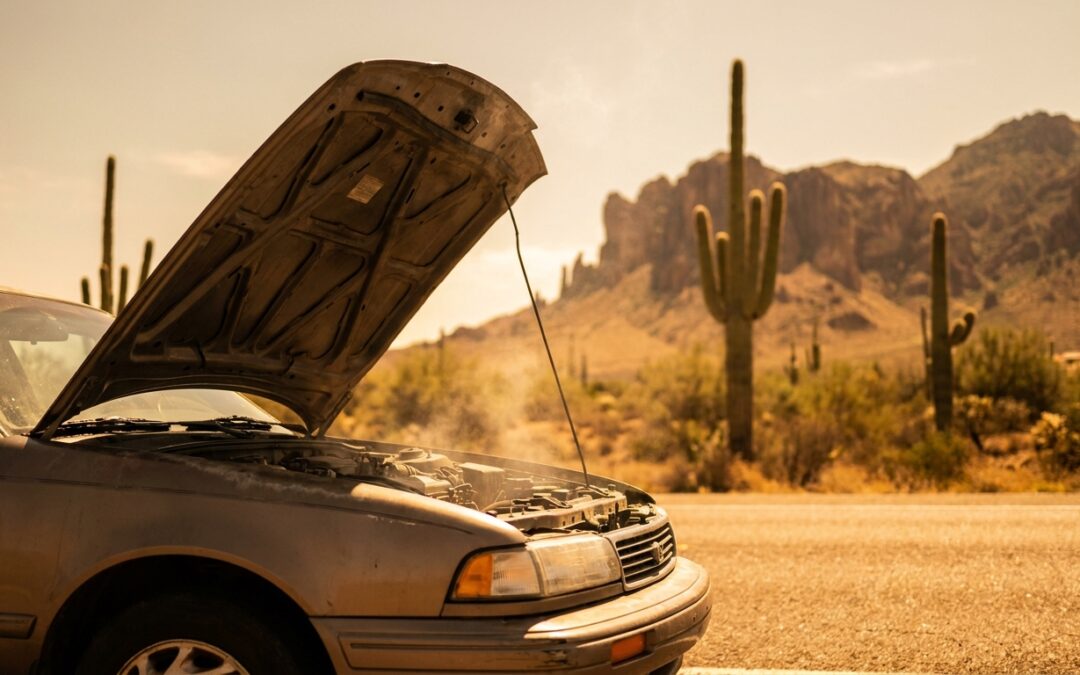
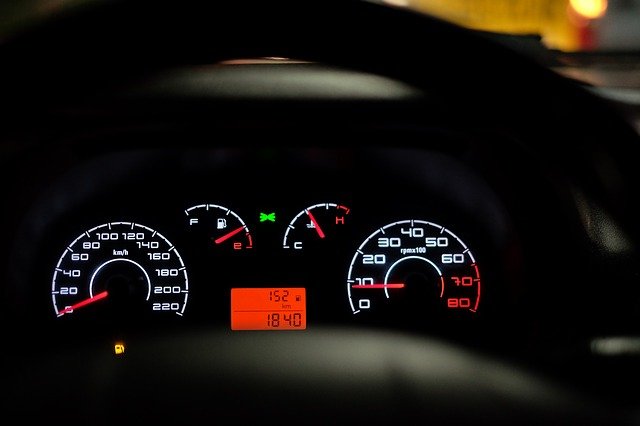
Before anything else: if your temperature gauge is in the red, or you see steam, or the high-temperature warning light is on, pull over and shut the engine off. Not at the next exit. Not at the next gas station. Now.

Here’s why this matters more in Mesa than almost anywhere else: a modern engine runs at roughly 195–220°F coolant temp. When it overheats, internal temps can spike past 280°F in seconds. Aluminum heads warp at around 250°F. Head gaskets blow. Oil cooks. Pistons can seize against cylinder walls. Every additional minute of driving with an overheated engine roughly doubles the cost of the repair.

  • Pull over immediately if temp gauge is in the red or warning light is on
  • Turn off the engine — do not idle, do not “let it cool with the engine running”
  • Turn on the heater to MAX if you must keep moving for safety — the heater core pulls heat OUT of the engine. It’ll be miserable inside but it can buy you a mile or two
  • Do NOT open the radiator cap while the engine is hot. Pressurized coolant will erupt as scalding steam — serious burns
  • Do NOT pour cold water into a hot engine. Thermal shock can crack the block or warp the head instantly
  • Call: (480) 444-0242 — we’ll walk you through whether you can drive in or need a tow

Mesa safety reminder: If you pull over on a Mesa freeway between June and September, get out of the car and stand in shade. A disabled vehicle on asphalt at 115°F outside is 140°F inside within minutes. Bring kids and pets out with you.

Why Cars Overheat in Mesa Heat

Your engine generates enormous heat. The cooling system has one job: get that heat out of the engine and into the air before anything melts. Mesa summer makes that job significantly harder because:

  • Ambient air temp is already 110°+ — the radiator has less “cool” air to dump heat into
  • Stop-and-go traffic at idle means no natural airflow through the radiator — you’re relying entirely on the electric cooling fans
  • Hard A/C usage puts extra load on the engine AND on the cooling system (condenser sits in front of the radiator)
  • Long highway grades (US-60 toward Gold Canyon, the 60 climb out of Mesa toward Globe) raise engine load and heat
  • Aging components that worked fine at 95° ambient fail at 115°
  • Coolant degradation — Arizona heat breaks down old coolant faster than cooler climates

Mesa-specific tip: If your car ran fine all spring and started overheating with the first 105°+ day, it was already running on borrowed time. The hot weather didn’t cause the failure — it exposed a marginal cooling system that couldn’t handle the load. Fix it now before something worse happens.

Free Mesa Cooling System Inspection

Stop guessing. Bring your vehicle to Network Automotive and we’ll pressure-test the cooling system, scan for codes, check fan operation, inspect hoses and the radiator, and test your coolant condition — at no charge.

Book My Free Cooling Check →

The Most Common Overheating Causes We See in Mesa

After three decades of East Valley summer work, here’s the honest ranking of what causes overheating — and what each repair runs in 2026:

Cause How Common Typical Mesa Repair Cost Drive-In Risk
Low coolant / coolant leak Very common $120–$650 Low if caught early
Failed thermostat (stuck closed) Very common $280–$520 Moderate
Failed radiator fan / fan motor Very common in AZ $380–$780 High at idle, low at highway speed
Bad radiator (clogged or leaking) Common $550–$1,200 Moderate
Water pump failure Common $580–$1,400 High
Failed radiator hose (upper or lower) Common $220–$520 High if it bursts
Bad radiator cap Underrated $25–$60 Low
Coolant flush long overdue Maintenance $140–$220 Low
Failed cooling fan relay / module Moderate $220–$580 High at idle
Head gasket failure Worst case $1,800–$3,800 Critical
Cracked head / block Catastrophic $4,500–$8,000+ Tow required

Those are real Mesa 2026 ranges. Your actual number depends on year, make, model, and what the diagnostic finds. The single biggest factor in cost is timing — the same failure caught early costs a fraction of what it costs caught late.

Why fans matter more in Mesa than anywhere else

Most of the country’s cars overheat from coolant leaks or thermostat failure. In Mesa, we see a fourth and equally common cause: cooling fan failure. Why? Because in 75° weather, your car can cool itself at highway speed even with a dead fan — you just get overheating at long red lights. In Mesa summer, a dead fan means the car can’t cool itself at 80 mph either. The fan does 100% of the work. When it dies in July, the car overheats within minutes regardless of speed.

7 Warning Signs Your Car Is About to Overheat in Mesa

  • Temperature gauge runs higher than normal — even within “normal” range, if it’s higher than it used to be, something is changing
  • Coolant low warning light — coolant level dropping with no visible puddle = small leak or burning through the system
  • Sweet, syrupy smell from the engine bay or vents — classic coolant smell, usually means a leak
  • White exhaust smoke that smells sweet — coolant burning in the combustion chamber (head gasket warning)
  • Coolant in your oil (milky chocolate-milkshake look on the dipstick) — head gasket has failed
  • A/C blows warm at red lights but cool on the highway — often a dying fan or low coolant
  • Heater works erratically — air pockets in the cooling system, low coolant, or a clogged heater core

How Network Automotive Diagnoses an Overheating Car in Mesa

  1. Customer interview. When did it start? Idle, highway, towing, A/C on, after fuel-up? Any recent service work? The pattern usually narrows the failure to one of three systems.
  2. Code scan. Engine, transmission, body, ABS — sometimes an unrelated module sees the temperature spike before the gauge does.
  3. Coolant pressure test. We pressurize the cooling system to 15 PSI and watch for leaks at hoses, radiator, water pump, heater core, and head gasket areas. Catches 80% of slow leaks in 10 minutes.
  4. Combustion gas test. If we suspect head gasket, we test for combustion gases dissolved in the coolant — the most definitive head gasket test there is.
  5. Thermostat & fan operation test. Verify thermostat opens at correct temperature, verify both speeds of the electric fan, verify the fan relay / module commands fan on at correct temperature.
  6. Coolant condition test. Strip-test pH, freeze point, and conductivity. AZ heat ages coolant fast — even “not that old” coolant can be acidic and eating water pump seals.
  7. Visual inspection. Radiator fins, hose condition, water pump weep hole, condition of cap and reservoir.
  8. Written diagnostic report. Plain-English summary, exact parts and labor quoted, root cause identified. No guesses.
  9. Repair approval — your call. Want to take the report home? Want a second opinion? Take the time you need.
  10. Verification. After repair, full cooling system bleed, pressure re-test, road test long enough for the thermostat to cycle multiple times. We verify before you pay.
30+
Years serving Mesa. Network Automotive has been family-owned and ASE-certified since 1995 — the East Valley’s trusted name for cooling system, A/C, and Arizona-heat-related repairs.

What Does Overheating Repair Cost in Mesa in 2026?

Real numbers, because you don’t have time to call five shops:

  • Free cooling-system inspection at Network Automotive: $0
  • Cooling-system pressure test & full diagnostic: $120–$180 if no obvious failure found — usually credited toward repair if approved
  • Coolant flush & refill with OEM-spec coolant: $140–$220
  • Thermostat replacement: $280–$520
  • Radiator cap: $25–$60 (and yes, this is sometimes the entire fix)
  • Upper or lower radiator hose: $220–$520
  • Radiator fan / fan motor replacement: $380–$780
  • Radiator replacement: $550–$1,200 including coolant
  • Water pump replacement: $580–$1,400 depending on if it’s timing-belt-driven
  • Head gasket replacement: $1,800–$3,800 on most modern engines
  • Cracked head or block: $4,500–$8,000+ — often the point where engine replacement makes more sense than repair

How long does overheating repair take in Mesa?

Most overheating jobs are same-day. Coolant flush, thermostat, hose, or radiator cap is 60–90 minutes. Radiator replacement is 2–4 hours. Water pump is 3–6 hours depending on engine layout. Fan motor or relay is 60–120 minutes. Head gasket is 1–3 days. We have loaner options for longer jobs and prioritize overheating cases during summer.

Mesa Summer Is Here. Don’t Wait.

If your car overheated even once this season, the underlying problem isn’t going to fix itself. Bring it to Network Automotive for a free cooling-system inspection — we’ll find the root cause before it costs you an engine.

Schedule My Cooling Inspection →

How to Prevent Your Car From Overheating This Mesa Summer

Preventing overheating is much cheaper than fixing it. Here’s what we recommend for every East Valley driver before summer:

  • Coolant flush every 2–3 years in AZ — not the 5+ years some manufacturers suggest. Arizona heat breaks coolant down faster.
  • Pre-summer cooling-system pressure test. Catches slow leaks before they become roadside breakdowns. Free at Network Automotive.
  • Cap check. Radiator caps fail more often than people think — a $25 part can save a $3,000 engine.
  • Visual hose inspection. Squeeze your upper radiator hose. If it’s rock-hard or sponge-soft, replace it.
  • Belt & serpentine belt inspection. A broken belt = no water pump = overheat in 2 minutes.
  • Fan operation test. With engine running and at operating temp, the fan should kick on when A/C engages or coolant temp climbs. Easy to miss until it’s 115° and your car is dying at a stoplight.
  • Don’t ignore a small leak. A drip in your driveway in March is a roadside breakdown in July.

Why Mesa Drivers Trust Network Automotive for Cooling Repairs

  • Family-owned since 1995. Three decades of Mesa summers — we know exactly what fails and when.
  • ASE-certified technicians. Not seasonal hires guessing their way through your engine.
  • Free cooling-system inspection & pressure test. No-pressure, no-upsell, written report.
  • OEM-spec coolant & parts. The wrong coolant chemistry destroys water pump seals in Arizona heat — we use exactly what the manufacturer specifies.
  • 3-year / 36,000-mile nationwide warranty on parts and labor.
  • Written estimates up-front. Zero phone-tag, zero “while we were in there.”
  • Loaner options on longer repairs so your summer doesn’t stop.
  • Priority for overheating cases May through October — we know it’s urgent in Mesa heat.

Read more on the About Network Automotive page, see the full service menu, or browse Mesa service coupons. Already dealing with weak A/C too? See our AC repair Mesa AZ guide.

Proudly Serving Mesa and the Greater East Valley

Network Automotive Service Center handles cooling and overheating repair across:

  • Mesa — East Mesa, West Mesa, Las Sendas, Red Mountain, Dobson Ranch, Alta Mesa, downtown
  • Gilbert — Agritopia, Morrison Ranch, Seville, Power Ranch
  • Queen Creek — Cortina, Ironwood Crossing, San Tan Heights
  • Apache Junction — Superstition, Gold Canyon
  • Prescott — Prescott Valley and surrounding

Most Mesa customers book at our East Mesa shop near Power Road & US-60 for the fastest in-and-out during summer surge season.

Mesa Car Overheating Repair FAQ

What should I do the moment my car overheats in Mesa?

Pull over immediately and shut the engine off — not at the next exit, not at the next gas station, now. Every additional minute of driving with an overheated engine roughly doubles the cost of the repair. Turn on the heater to MAX if you absolutely must move the car a short distance for safety. Do NOT open the radiator cap while hot. Do NOT pour cold water on a hot engine. Call Network Automotive at (480) 444-0242 for guidance.

How much does it cost to fix an overheating car in Mesa?

It depends on the cause. A thermostat is $280–$520. A radiator cap is $25–$60 and sometimes the entire fix. Cooling fan motor is $380–$780. Radiator replacement is $550–$1,200. Water pump is $580–$1,400. Head gasket is $1,800–$3,800. Our free cooling-system inspection tells you exactly which category your vehicle falls into before any work is authorized.

Why do cars overheat more in Mesa than other cities?

Three reasons: ambient air temperatures past 115°F leave less “cool” air for the radiator to dump heat into, asphalt radiates another 30°F, and Mesa stop-and-go traffic means zero natural airflow at idle. Components that work fine at 95° ambient often fail at 115°.

Can I drive my car if the temperature gauge climbs but is not in the red?

Cautiously and briefly. A gauge that runs higher than normal means the cooling system is on the edge. You should schedule service within days, not weeks. Driving in heavy traffic, with A/C blasting, or up grades will push it into the red eventually — usually at the worst possible time.

How long does it take to fix an overheating car in Mesa?

Most repairs are same-day. Coolant flush, thermostat, hose, or cap is 60–90 minutes. Radiator is 2–4 hours. Water pump is 3–6 hours. Fan motor is 60–120 minutes. Head gasket is 1–3 days. We prioritize overheating cases May through October and offer loaners on longer jobs.

Should I flush my coolant before summer in Arizona?

Yes, if it has been more than 2–3 years. Arizona heat breaks coolant down faster than manufacturer recommendations assume. Old coolant becomes acidic and eats water pump seals, radiator end-caps, and heater cores. A $180 flush is the cheapest insurance you can buy before May.

Why is my car overheating only at red lights?

Almost always a cooling fan problem — bad fan motor, bad fan relay, or bad cooling fan module. At highway speed, natural airflow keeps the radiator cool. At a Mesa red light, the fan does 100% of the cooling work. When it fails, you overheat at every long light.

Does Network Automotive warranty cooling system repairs?

Yes. Every cooling system repair is backed by our 3-year / 36,000-mile nationwide warranty on parts and labor at participating NAPA AutoCare shops across the country.

Beat the Mesa Heat — Before It Costs You an Engine

Family-owned in Mesa since 1995, ASE-certified, free cooling-system inspections, and a 3-year nationwide warranty. Don’t wait for the temp gauge to climb again — bring it in now while the fix is still cheap.

AC Repair in Mesa, AZ: Why Your A/C Stopped Cooling and What It Actually Costs to Fix

AC Repair in Mesa, AZ: Why Your A/C Stopped Cooling and What It Actually Costs to Fix

HomeBlog › AC Repair Mesa AZ

AC Repair in Mesa, AZ: Why Your A/C Stopped Cooling — And What It Actually Costs To Fix

By Network Automotive Service CenterMesa, AZUpdated April 2026

Mesa summers don’t negotiate. When your car’s A/C blows warm at a red light on Southern or Power Road, you need a straight answer — not a sales pitch. Here’s the mechanic-written guide to auto A/C repair in Mesa: what really breaks, what it costs in 2026, and how to know if it’s a $180 recharge or a $1,900 compressor.

It’s 112°F on Main Street. You hit the A/C button, the fan roars, and what comes out of the vent feels like a hair dryer pointed at your face. If you’ve been Googling “AC repair Mesa AZ” from a hot steering wheel, you’re in the right place — and you’re not alone. In Mesa, a working car A/C isn’t a luxury. It’s the difference between a safe commute and heat stroke on the Loop 202.

At Network Automotive Service Center, we’ve been fixing auto air conditioning systems for East Valley drivers since 1995. Every summer, from the first 100-degree day in April through the end of October, our bays are full of Mesa cars, trucks, and SUVs that lost their cool. This guide explains exactly what goes wrong, how a proper A/C diagnosis works, what auto A/C repair costs in Mesa today, and how to spot the shops that will sell you a $600 “recharge” when your system actually has a $40 O-ring leak.

73%
of Mesa A/C complaints we see every summer are caused by a slow refrigerant leak — not a failed compressor. A proper diagnosis finds the leak first, so you’re not topping off refrigerant every six weeks.

How Your Car’s A/C Actually Works (In Plain English)

Before we talk about what breaks, it helps to know what’s happening under the hood. Your vehicle’s A/C is a closed loop that moves heat from inside the cabin to outside the car. Every time you push the “MAX A/C” button on a Mesa afternoon, this cycle runs thousands of times per minute:

  1. Compressor — a belt-driven pump that pressurizes refrigerant gas (usually R-134a on older vehicles, R-1234yf on 2015+). This is the single most expensive part of your A/C.
  2. Condenser — a radiator-like heat exchanger at the front of the car where high-pressure refrigerant dumps heat into outside air. Rocks and bugs love to kill these in Arizona.
  3. Receiver/drier or accumulator — filters moisture and debris out of the refrigerant. Must be replaced anytime the system is opened.
  4. Expansion valve or orifice tube — drops pressure sharply, which is the magic step that makes refrigerant get cold.
  5. Evaporator — a small radiator buried in your dash where the now-cold refrigerant absorbs heat from cabin air. The fan blows across it and out your vents.
  6. Blower fan, blend door actuators, cabin filter — the parts that actually deliver that cold air to you.

The refrigerant never runs out on a healthy system — it’s sealed. So when a Mesa driver says “my A/C needs a recharge” every year, what they’re really saying is “I have a leak somewhere and nobody’s found it yet.” That’s the job of a real Mesa AC repair.

Why Arizona Is Especially Brutal on Car A/C

  • Extreme ambient temperatures — a system that cycles fine at 85°F in San Diego can struggle to cool a car at 118°F in Mesa. Every component works harder.
  • Dust and fine grit — Sonoran desert dust sandblasts condenser fins and plugs cabin filters in half the time of a coastal climate.
  • UV exposure — Arizona sun bakes rubber. Most A/C leaks start at O-rings and hose fittings that crack from years of heat.
  • Long idle times — drive-thrus, school pickups, and Mesa traffic mean your compressor runs at low RPM at max load. That’s the worst-case scenario for any A/C.

Mesa-specific tip: If your A/C cools well at 65 mph on US-60 but blows warm sitting at a light at Broadway and Mesa Drive, your condenser fan or cooling fan is probably failing. The condenser needs airflow even when you’re not moving. Don’t let a shop sell you a compressor until the fan is verified working.

Free A/C Performance Check

Bring us your vehicle and we’ll check vent temps, system pressures, and visually inspect the major A/C components at no charge. You’ll leave knowing what’s going on — before anyone quotes a dime of repair work.

Book My Free A/C Check →

The Most Common Causes of A/C Failure in Mesa

After fixing thousands of hot East Valley cars, here’s our honest breakdown of what the problem usually turns out to be — ranked by how often we see it each summer:

Cause How Common Typical Repair Cost (Mesa) Still Drivable?
Refrigerant leak (O-rings, seals, hoses) Very common $180–$650 Yes
Condenser damage (rocks, corrosion) Very common $550–$1,400 Yes
Low refrigerant charge (no leak yet) Common $140–$240 Yes
A/C compressor failure Common $1,100–$2,400 Yes, but hot
Condenser or cooling fan not working Common $280–$780 Yes, but hot at idle
Blend-door actuator (stuck on heat) Common $260–$720 Yes
Cabin filter clogged Common $45–$90 Yes
Evaporator leak (interior) Moderate $900–$2,100 Yes
Expansion valve / orifice tube Moderate $320–$780 Yes
Electrical / control module / pressure switch Less common $180–$900 Varies

Those are real Mesa ranges, not quotes. Your exact cost depends on year, make, model, refrigerant type, and what the diagnostic uncovers. The biggest factor isn’t the parts — it’s whether the shop takes the time to find the actual failure instead of just dumping in refrigerant and hoping.

R-134a vs. R-1234yf: Why Your Neighbor’s Recharge Cost Half of Yours

If your vehicle is a 2015 or newer, it almost certainly uses R-1234yf refrigerant instead of the older R-134a. R-1234yf is a different, more environmentally-friendly gas — and it costs roughly 4–6x more per pound at wholesale. It also requires a separate set of equipment and a technician who’s EPA 609 certified on the newer system. When a “quick-lube” shop quotes you $89 for an A/C recharge, they’re quoting R-134a. A proper R-1234yf recharge in Mesa is typically $240–$380. It’s not a scam — it’s a different refrigerant.

How Network Automotive Diagnoses A/C Problems in Mesa

Here’s exactly what happens when you bring your vehicle to our Mesa shop for AC repair. No mystery, no smoke, no “leave it with us and we’ll call you.”

  1. Customer interview. When did it start? Warm at idle, warm at speed, or both? Any hissing, rattling, or musty smell? Recent repair work or a front-end impact? Half the diagnosis is what you’ve already noticed.
  2. Visual inspection. We check the compressor clutch, belts, condenser condition, cabin filter, and all visible hoses and fittings. In Arizona, we see a LOT of rock-damaged condensers that a thirty-second look reveals.
  3. Vent-temp & system pressure test. With gauges on both the low and high sides, we read actual operating pressures and measure vent-center temperature. On a 100°F Mesa day, a healthy system puts out 38–48°F at the vents. Anything warmer is a failing system.
  4. UV dye + electronic leak detection. If pressures are low, we introduce UV dye and use an electronic sniffer at every fitting, service port, and component seal. Leaks that take weeks to show up with a bare eye are found in minutes.
  5. Blower & airflow check. A cold system with a dying blower fan still feels weak. We verify blower speed on all settings and confirm blend-door actuators are moving correctly.
  6. Written diagnostic report. You get a plain-English summary of what failed, why, and what it takes to repair — with exact parts and labor quoted up-front. No verbal surprises.
  7. Repair approval — your call. We don’t touch anything until you authorize. Want to think about it or get a second opinion? Take the report home.
  8. Verification after repair. We evacuate the system to remove moisture, recharge to the exact manufacturer specification by weight (not by “eyeballing” pressures), run the system 10+ minutes, and re-check vent temps before you pay.
30+
Years serving Mesa and the East Valley. Network Automotive has been family-owned and ASE-certified since 1995. East Mesa, downtown Mesa, Las Sendas, Red Mountain — same mechanics, same ethics, for three decades.

What Does AC Repair Cost in Mesa in 2026?

Straight numbers, because you’ve been quoted enough vague estimates already:

  • Free A/C performance check: vent temps, visual inspection, initial pressure reading — $0 at Network Automotive.
  • Full diagnostic with UV dye + leak detection: typically $89–$180. If you approve the repair with us, this fee is usually credited toward the work.
  • R-134a recharge (evacuate, recharge by weight, leak dye included): $140–$220.
  • R-1234yf recharge (2015+ vehicles): $240–$380 due to refrigerant cost.
  • O-ring, seal, or hose replacement: $180–$650 depending on location.
  • Condenser replacement (complete): $550–$1,400 including refrigerant.
  • Compressor replacement (complete, with drier and expansion valve): $1,100–$2,400 depending on vehicle.
  • Evaporator replacement (dash-out job): $900–$2,100 — labor-intensive but sometimes unavoidable.

How long does a Mesa A/C repair take?

Most A/C repairs in Mesa are same-day. A recharge with leak detection takes 60–90 minutes. An O-ring or simple hose repair is typically 2–3 hours including evacuation and recharge. A condenser replacement runs 3–5 hours. Compressor jobs are usually a full day. Evaporator replacements — the worst-case — can take 1–2 days because we have to pull the dashboard. We’ll tell you up-front exactly which category your vehicle falls into, and we have loaner options for longer jobs.

Cool Air. Honest Price. Same Day.

Stop driving around in a 120°F oven. Bring your vehicle to Network Automotive for a free A/C check, an honest quote, and a fix that actually lasts through the Mesa summer.

Schedule My A/C Repair →

Warning Signs Your A/C Needs Help Right Now

If you’re seeing any of these in Mesa, don’t wait — small A/C problems become expensive A/C problems fast in 115°F heat:

  • Vent air that’s only 10–15 degrees cooler than outside air. A healthy system should cool 40+ degrees below ambient in Mesa heat.
  • Cold at highway speed, warm at idle. Classic sign of a failing condenser fan or overworked, aging compressor.
  • Squealing or grinding from the engine bay when you turn on A/C. Compressor clutch or bearing failure — can seize without warning and break your serpentine belt.
  • Musty or mildew smell from the vents. Clogged cabin filter, dirty evaporator, or a drain that’s plugged with desert dust.
  • Water pooling on the passenger floorboard. The condensate drain is clogged — cheap fix, but if ignored it can rot carpet and damage interior wiring.
  • A/C works, then quits, then works again. Low-pressure cutoff from a slow leak or a failing pressure switch. Not an “it’s fine” situation.
  • Hissing or bubbling from the dash when you shut the car off. Refrigerant moving through a leak. Diagnose before you lose a full charge.

Arizona safety note: A broken A/C in a Mesa summer isn’t just uncomfortable — it’s genuinely dangerous, especially for kids, older adults, and pets. Interior temps in a car with no A/C can pass 140°F at idle on a 110°F day. If your A/C stops cooling during a heat advisory, don’t wait a week for an appointment. Call (480) 444-0242 and we’ll get you in.

What To Do the Moment Your A/C Stops Cooling

  1. Don’t just push the MAX A/C button and leave it. If the system is low on refrigerant, running the compressor dry can damage the clutch and shaft seals. Turn A/C off if it’s blowing warm.
  2. Check your cabin filter. If you can’t remember the last time it was changed, that’s probably 30% of your problem. Most filters live behind the glovebox and take five minutes to swap.
  3. Listen at idle with the hood up. Should hear the compressor clutch click on with A/C engaged. No click = electrical issue or empty system. Loud click followed by a shudder = dying compressor.
  4. Check for obvious damage. Walk around and look at the front of the car. A rock through the condenser is usually visible from the grill.
  5. Do NOT buy a DIY recharge kit from the parts store. They’re loaded with sealer that can permanently destroy a recovery machine — which means every shop in Mesa will either refuse service or charge you an extra $300 to clean the contamination out. It’s the #1 way we see Mesa drivers turn a $180 problem into a $1,800 problem.
  6. Call Network Automotive. (480) 444-0242. We’ll get you on the schedule and tell you over the phone whether to drive in or have us come look.

Why Mesa Drivers Trust Network Automotive for AC Repair

Mesa has no shortage of auto shops. Here’s what makes ours different:

  • Family-owned since 1995. Three decades, five locations across Mesa, Gilbert, Apache Junction, Queen Creek, and Prescott. Same family, same values.
  • ASE-certified technicians with EPA 609 certification on both R-134a and R-1234yf systems.
  • Dedicated A/C recovery machines for BOTH refrigerants. Not every Mesa shop has the equipment to service 2015+ vehicles properly. We do.
  • Charge by weight, not by “eyeball.” Every recharge is to the exact OEM specification. Overcharging is the #1 way DIY and cut-rate shops kill A/C compressors.
  • 3-year / 36,000-mile nationwide warranty on parts and labor — not just 12 months.
  • Written estimates up-front. Zero phone-tag surprises. Zero “while we were in there” add-ons without approval.
  • Free loaner options on longer jobs (condenser, compressor, evaporator work).
  • Thousands of five-star Google and Yelp reviews across our AZ locations — earned, not bought.

Read more about our shop philosophy on the About Network Automotive page, see the full service menu, or browse current Mesa service coupons.

Fleet & Commercial A/C Work in Mesa

If you’re running a fleet of service vans, sales vehicles, or trucks in Mesa, A/C downtime in summer isn’t just uncomfortable — it’s a liability and a crew-safety issue. Network Automotive maintains fleets for Mesa-based contractors, property managers, delivery operators, and municipal accounts. We offer priority scheduling, volume pricing, monthly invoicing, and detailed service records per vehicle. Call Erik directly at (480) 444-0242 to set up a fleet account.

Proudly Serving Mesa and the Greater East Valley

Network Automotive Service Center is the trusted name for auto air conditioning repair across:

  • Mesa — East Mesa, West Mesa, Las Sendas, Red Mountain, Dobson Ranch, Alta Mesa, downtown Main Street corridor
  • Gilbert — Agritopia, Morrison Ranch, Seville, Power Ranch
  • Queen Creek — Cortina, Ironwood Crossing, Pecan Lake, San Tan Heights
  • Apache Junction — Superstition, Gold Canyon
  • Prescott — Prescott Valley and surrounding areas

Most Mesa customers book at our East Mesa location near Power Road & US-60. Queen Creek and San Tan customers often prefer the Queen Creek shop just minutes down Ellsworth.

Mesa AC Repair FAQ

How much does AC repair cost in Mesa?

It depends on the failure. An R-134a recharge with leak detection runs $140–$220 at Network Automotive. An R-1234yf recharge (2015+ vehicles) is $240–$380. An O-ring or hose repair is $180–$650. A condenser is $550–$1,400. A full compressor job is $1,100–$2,400. An evaporator is $900–$2,100. Our free A/C performance check tells you exactly which category your car falls into before any work is authorized. Call (480) 444-0242.

Why is my car A/C cold on the highway but warm at idle?

Classic symptom of a failing condenser fan, cooling fan, or a system that’s critically low on refrigerant. Moving air through the condenser at highway speed can compensate for minor issues, but at idle the system has to rely on the fan alone. Don’t let a shop sell you a compressor before a technician verifies the fans are running and the charge is correct.

Can I just use a DIY recharge can from the parts store?

Please don’t. Most store-bought cans include a “stop-leak” sealer that can permanently contaminate a shop’s recovery machine — which is why many Mesa shops either refuse to service a sealer-contaminated system or charge an extra $300–$500 to purge it. It’s the single most common way we see Mesa drivers turn a $180 repair into a $1,500+ repair.

How long does AC repair take in Mesa?

Most repairs are same-day. A recharge with leak check is 60–90 minutes. An O-ring fix is 2–3 hours. A condenser replacement runs 3–5 hours. Compressor jobs are typically a full day. Evaporator replacement can take 1–2 days because the dashboard has to come out. We give a realistic timeline up-front and offer loaners on longer repairs.

Do I need R-134a or R-1234yf refrigerant?

Vehicles from roughly 2015 onward use R-1234yf. Older vehicles use R-134a. They are NOT interchangeable — the service ports are different and the oils are different. Your underhood A/C label (usually on the hood underside or near the radiator support) will tell you. If a shop quotes you an $89 recharge and you drive a 2018 Ford, either they’re quoting the wrong refrigerant or they don’t have the right equipment.

Why does my A/C smell musty or like mildew?

Moisture buildup on the evaporator coil feeds bacteria and mold inside the HVAC box. Usually the fix is a new cabin filter, a clean-out of the evaporator with an anti-microbial treatment, and clearing the condensate drain. Ignored long enough, it can rot the foam seals around the blend doors, which turns a $90 job into a $600 job.

Does Network Automotive warranty A/C work?

Yes. Every A/C repair is backed by our 3-year / 36,000-mile nationwide warranty on parts and labor. If the issue comes back inside that window, we fix it — at any participating shop across the country. That’s meaningful protection in a state where A/C gets tested six months a year.

Is it safe to drive with a broken A/C in Mesa?

Mechanically, yes — a broken A/C won’t damage your engine. But in Mesa summer, cabin temps above 130°F create real safety risks for children, older adults, pets, and anyone with medical conditions. During heat advisories, a failed A/C becomes an urgent repair, not an optional one. We prioritize A/C emergencies from mid-May through mid-October.

Cool Air, Fair Price, Same Day

Family-owned in Mesa since 1995, ASE-certified, EPA 609 licensed on both refrigerants, and a 3-year nationwide warranty. Get real answers on your A/C — no upsells, no mystery.

Why Does An AC Blow Hot Air?

Why Does An AC Blow Hot Air?

On hot, sunny days, air conditioning keeps us cool, while on chilly nights, it keeps us warm and toasty. However, they sometimes disappoint us. We dread getting in a hot car, cranking the air conditioner, and being met with warm, sticky air. There’s nothing worse, is there? There are so many of us who experience this! As a result, we are left with hefty bills to pay mechanics or to try to repair any damage ourselves by following a haphazard tutorial. If you are struggling with an air conditioner that is blowing hot air, you may need to make an appointment with a Chandler, AZ auto repair shop.

Common Causes

AC systems that blow warm air are generally caused by a lack of refrigerant. A broken fan, electrical issue, condenser, or compressor problem can also cause your AC to blow warm air. But usually, the culprit is leaking coolant.

Chandler, AZ auto repair

What Happens If Your Car is Leaking Refrigerant

A leak in the system will only require a recharge if there is a leak in the refrigerant system. Are you concerned that you may have a leak? Your AC will blow warm air as the first symptom. What are our options for finding the leak? Due to low-pressure areas where your leak might be, it can be quite difficult to locate the leak due to the refrigerant returning to gas. Due to low-pressure areas where your leak might be, it can be quite difficult to locate the leak due to the refrigerant returning to gas.

How Can It Be Fixed?

We can explore two avenues, fortunately. The first option is to have your car serviced by a mechanic. Since they have more experience, they will be able to locate the leak and either repair or replace the parts as needed. The cost of these repairs depends on how severe the leak is. To stop leaks, you can also use an AC leak sealer. Consider these options only if you have a small leak, so keep that in mind. In terms of leak sealers, there are two types to choose from. Your seals will swell when you use the first type, stopping leaks. When the second type reaches the leak, it assembles a solid substance around it, reducing the amount of space occupied by the leak. It is possible to seal leaks at an affordable price with leak sealers. In most cases, they include a nozzle that can be connected directly to the high-pressure port. Use your sealer according to the instructions on the container.

As a result, our AC journey has come to a close. It’s clear that there are a few reasons why your AC is blowing warm air, and all of them need attention in order to restore proper operation. If you are experiencing any of these problems, you can take your vehicle to a Chandler, AZ auto repair shop. We are here to help with all your auto repair needs. Give us a call today to learn more about all the ways we can help you.

Is My Water Pump Going Bad?

Is My Water Pump Going Bad?

If your water pump goes bad in your car, you may experience a variety of different issues. You will need to have it serviced as soon as possible to avoid other issues and to be able to drive your car safely and properly. If you are looking for some signs that your water pump may be the problem, be sure to watch for some of these signs and symptoms that may help you decide what type of problems you have and need services by a Chandler, AZ auto repair shop.

Low Coolant Warning Light

A warning light may appear on the dashboard if your car’s water pump fails. Check engine light, low coolant warning, and overheating warning are just a few examples. If your vehicle has a temperature gauge, it will also climb.

No Heat

Heater systems require hot engine coolant to function properly. Thus, a malfunctioning cooling system, such as a faulty water pump, can render an inoperable heater. Your heater may not blow hot air or it may not turn on at all. Sometimes the air will work and the heat won’t and sometimes neither one will work.

OverheatingChandler, AZ auto repair

It is possible for a water pump to develop leaks, which will cause the coolant level to fall and the engine to overheat. Water pumps that fail internally can also impede coolant circulation, which overheats the engine. The result is the same either way. Water pumps are frequently prone to leaks. It is possible that the leak originates from the water pump itself or its gasket. In such a situation, the engine may overheat and if not repaired or replaced quickly, additional damage could ensue, such as cracked cylinder heads, pushed head gaskets, or burnt pistons. The water pump is more likely to be at fault if the engine temperature gauge runs hot frequently. This issue should be checked by a mechanic and if necessary, the water pump should be replaced.

Leaking Coolant

This causes coolant to leak from the water pump and fall to the ground, usually near the front of your car or right where the motor is located. It is important to have your car, truck, or SUV inspected if you notice a leak of coolant that appears green or sometimes red in color under the center of the vehicle. The most common cause of these leaks is a water pump leak, which can be fixed before it gets worse.

If you are experiencing problems with your car’s water pump or if your car is showing any of these signs and you need to know if there is a serious problem, be sure to think about taking it to a Chandler, AZ auto repair shop. We are happy to help with all your car repair needs. Contact us today to make an appointment to have your car serviced and to get to the bottom of your car’s water pump problems or any other things that may be wrong with it. We are here to help with all your car repair needs.

Things That Can Cause Your Car To Overheat

Things That Can Cause Your Car To Overheat

It’s never good to find out that your car is getting too hot or overheating, so you should always check that the most common causes of overheating are a problem for your car. If you do find out that your car is overheating, take it to a Chandler, AZ auto repair shop for repairs. Here are some of the most common things that can make your car overheat and cause problems for you. If any of these are a problem for you, get your repairs done immediately.

Bad Battery

You may not even consider the fact that your battery could be going bad and causing your car to overheat. A defective battery causes your car to overheat while driving. It is essential to replace your battery after 3 years if it is older than that. To be sure that the battery is reliable for the car, let the mechanic check its condition.

Cracked Radiator

Cars require a radiator to regulate their temperature. It is important to add water and coolant to the radiator when driving to prevent overheating. Avoid underfilling or overfilling the radiator. Overheating might cause leftover water/coolant to spill, so be careful while loosening the cap.

Revving The Engine

Before driving, gently rev your engine. By allowing seamless oil movement throughout the engine, it helps to vibrate some components in the car more effectively. Driving an already heated car isn’t the best solution to stopping a car from overheating. If your engine is already hot, don’t rev it. This can cause the car to overheat quickly and can permanently damage your engine.

Air ConditionerChandler AZ auto repair

What are the chances of an air conditioner overheating a car? Either the air conditioning compressor failed, which increased engine load, or the compressor locked up on the fan belt, which made it difficult for the fan belt to disperse heat from the engine coolant. Therefore, you should turn off the air conditioning when the weather is favorable. As a result, the pressure on the engine will be reduced and the car will cool.

Low Coolant

Overheating a car is caused by low coolant levels? Having a low level of coolant causes overheating. While the coolant steams, the heat that was supposed to be removed from the engine becomes trapped. You should add plenty of coolant to your radiator to ensure it doesn’t crack or cause your car to overheat. If you don’t keep enough coolant in your car it may cause serious problems with your engine and prevent your car from running properly.

If you are worried that your car may be overheating or there may be something that is making your engine run hot, you will need to find out the cause of the problem so you can have it repaired before it causes serious engine damage. A Chandler, AZ auto repair shop will be able to inspect your vehicle and tell you if there are any issues. Give us a call today to get help ensuring your car runs as it should. Tell you if there are any problems, and make the necessary repairs. If you need help with your car, call today to learn more about our services.

Common Radiator Problems

Common Radiator Problems

There are a lot of things that can happen to your car and radiator problems are daily common. If you notice any of these issues, you may need to have your car serviced by a Mesa, AZ auto repair shop. Your radiator helps prevent your engine from overheating and malfunctioning and if something goes wrong, you may not be able to be driven properly. Here are some of the most common radiator problems and reasons why they may need to be repaired.

Blockages

The radiator is made of metal, as are its fins. Usually, this metal is mild steel and is painted thinly. As a result, rust is easy to build up. Initially, corrosion will be devastating to the fins of the radiators. The fins are responsible for increasing the surface area of the veins within the radiator, where coolant flows. When the fins are absent, the coolant will have a much harder time cooling down. If the corrosion gets deeper, it can hit the veins and cause leaks, and given the pressure involved, these leaks will spread quickly.

Freezes

There is more to coolant than water. Ideally, coolants should be replaced on a seasonal basis. During the winter, winter coolant will have a lower freezing point, making it more likely to freeze. For warmer weather, summer coolant will provide warmth to the upper regions of the engine. Simply using water will not only corrode the engine block but also freeze it. Since water freezes and expands, it will corrode the engine block. Instead, they buckle and break, becoming completely ineffective.

BustsMesa, AZ auto repair

This sounds scary, but it is actually very common. Modern-day plastic-capped radiators can be blown off by the pressure built up in a cooling system. The result is an eye-catching display of coolant flying everywhere. There are a number of reasons why this might happen. It’s possible there’s too much coolant in the system, or there could be a problem somewhere down the track. These problems are rare, but they do occur.

Holes

The radiator is located up the front of the car. Therefore, it is directly exposed to road debris. However, we are not talking about big problems here. A stone can puncture a radiator at 70 mph if it hits it with enough force. This could mean disaster and expensive repairs for your car. If the radiator is damaged, you will lose coolant, which will cause the engine to overheat quickly. If it runs hot for too long the engine could suffer.

If you think your radiator may be having issues or if you just want to know about things that could happen to it, keep the above points in mind. If your radiator is experiencing one of these problems, you should take your car to a Mesa, AZ auto repair shop. We can inspect your radiator, tell you if there are any problems, and make the necessary repairs. If you need help with your car, call today to learn more about our services.

Network Automotive Service Center
Privacy Overview

This website uses cookies so that we can provide you with the best user experience possible. Cookie information is stored in your browser and performs functions such as recognising you when you return to our website and helping our team to understand which sections of the website you find most interesting and useful.