Shocks and Struts Replacement in Prescott, AZ: Signs, Costs & Same-Day Service

Shocks and Struts Replacement in Prescott, AZ: Signs, Costs & Same-Day Service

HomeBlog › Shocks and Struts Replacement Prescott AZ

Shocks and Struts Replacement Prescott AZ

By Network Automotive Service CenterPrescott, AZUpdated April 2026

Prescott’s mountain roads and dramatic elevation changes put suspension systems under serious stress. Here’s how to know when your shocks or struts are failing — and what it costs to fix them.

Prescott, Arizona sits at 5,400 feet above sea level, surrounded by winding mountain roads, rocky terrain, and dramatic switchbacks that test your vehicle’s suspension every single day. Whether you’re navigating Thumb Butte Road, dropping down Senator Highway, or hauling gear up Iron Springs Road, your shocks and struts are working overtime compared to driving on flat valley pavement. Add in Arizona’s extreme heat (—which accelerates rubber bushing deterioration—) and it’s no surprise that shocks and struts replacement in Prescott, AZ is one of the most common repairs we handle for local drivers.

The problem is that worn suspension parts don’t always scream for attention. The ride gets gradually rougher, handling gets a little looser, and before you know it, you’re dealing with dangerous stopping distances, accelerated tire wear, and a vehicle that no longer responds predictably when you need it most. This guide will walk you through exactly what to look for, what replacement costs in 2026, and how Network Automotive’s certified technicians handle suspension work for Prescott-area drivers.

20%
Longer stopping distance is common with severely worn shocks and struts — the equivalent of an extra car length at highway speed, according to AAA research on suspension wear and brake performance.

What Are Shocks and Struts — and Why Do They Matter?

Shocks and struts are often confused or used interchangeably, but they serve slightly different roles in your vehicle’s suspension system. Understanding the difference helps you have a more informed conversation when your mechanic diagnoses a problem.

Shock absorbers (commonly just called “shocks”) are standalone hydraulic cylinders that dampen the energy transferred from road irregularities through your springs into the vehicle body. They don’t bear vehicle weight — their job is purely to control motion. Shocks are typically found on the rear axle of many trucks and SUVs, and sometimes on both front and rear of older body-on-frame vehicles.

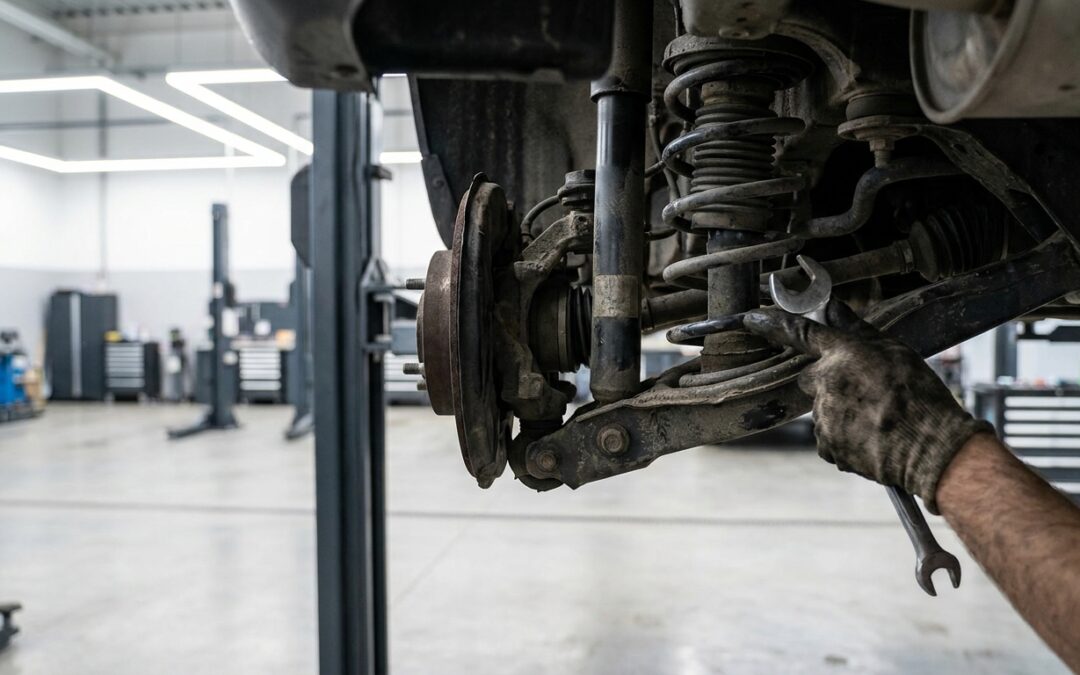
Struts are a structural component that combines the shock absorber with a coil spring into a single assembly. Because they’re integrated into the vehicle’s steering knuckle, struts also affect wheel alignment and steering geometry. Most modern front-wheel-drive cars and many AWD vehicles use struts on the front axle. Replacing them requires more labor than shock replacement and almost always necessitates a wheel alignment afterward.

In Prescott’s driving environment, both types face accelerated wear. The elevation means colder winters with freeze-thaw road damage, while the summers are punishing on rubber seals and bushings. Off-pavement excursions to Watson Lake, the Granite Dells, or Lynx Lake put even well-maintained suspension components through the kind of punishment designed into off-road vehicles. Most manufacturers recommend inspecting shocks and struts every 50,000 miles — but for Prescott drivers, that interval often comes faster.

A quick home test: push down hard on each corner of your vehicle and release. It should bounce back once and settle. If it bounces two or more times, that corner’s shock or strut is likely worn. This “bounce test” takes 30 seconds and can tell you a lot before you ever visit a shop.

Free Suspension Inspection

Not sure if your shocks or struts need replacement? We’ll do a full suspension check at no cost — test drive, visual inspection, bounce test, and written estimate included.

Schedule My Free Inspection

Warning Signs Your Shocks or Struts Are Failing

The challenge with suspension wear is that it happens slowly over thousands of miles. Your brain adapts to the gradual change in ride quality, so you may not notice how bad things have gotten until you ride in a well-maintained vehicle and feel the difference. Here are the six clearest signals that your suspension needs attention:

Symptom What You Feel Most Likely Cause
Bouncy / Floaty Ride Vehicle keeps rocking or bouncing well after hitting a bump instead of settling quickly Worn shock absorbers — no longer damping spring oscillation
Nose-Dive When Braking Front of vehicle dips sharply forward under braking, even in routine stops Blown or weak front struts unable to resist weight transfer
Body Roll in Corners Excessive lean when turning; feels like the vehicle wants to tip outward Worn shocks and/or strut top mounts allowing too much body movement
Clunking or Knocking Metal-on-metal or hollow thud sound over speed bumps, railroad tracks, or rough pavement Worn strut mounts, end links, or jounce bumpers
Uneven Tire Wear Cupped, scalloped, or patchy tread wear pattern visible on inside or outside edges Shocks not keeping tires in consistent contact with the road surface
Oily Residue on Shock Body Dark, oily film or drip visible on the shock absorber casing Blown internal seal — hydraulic fluid leaking out, shock effectively dead

Any one of these symptoms warrants a professional inspection. Two or more is a strong indicator that replacement is overdue. Don’t wait for multiple symptoms to pile up — in Prescott’s mountain terrain, compromised suspension is a genuine safety hazard. Emergency maneuvers on steep grades, tight switchbacks, or gravel shoulders demand that your vehicle respond exactly as expected.

Our Shock & Strut Replacement Process at Network Automotive

When you bring your vehicle in for a suspension inspection at Network Automotive, here’s exactly what happens from drive-in to drive-out:

  1. Test Drive & Initial Assessment — One of our ASE-certified technicians drives your vehicle over varied surfaces to replicate the symptoms you described. We note handling characteristics, noise points, and any pulling or drift before lifting the vehicle.
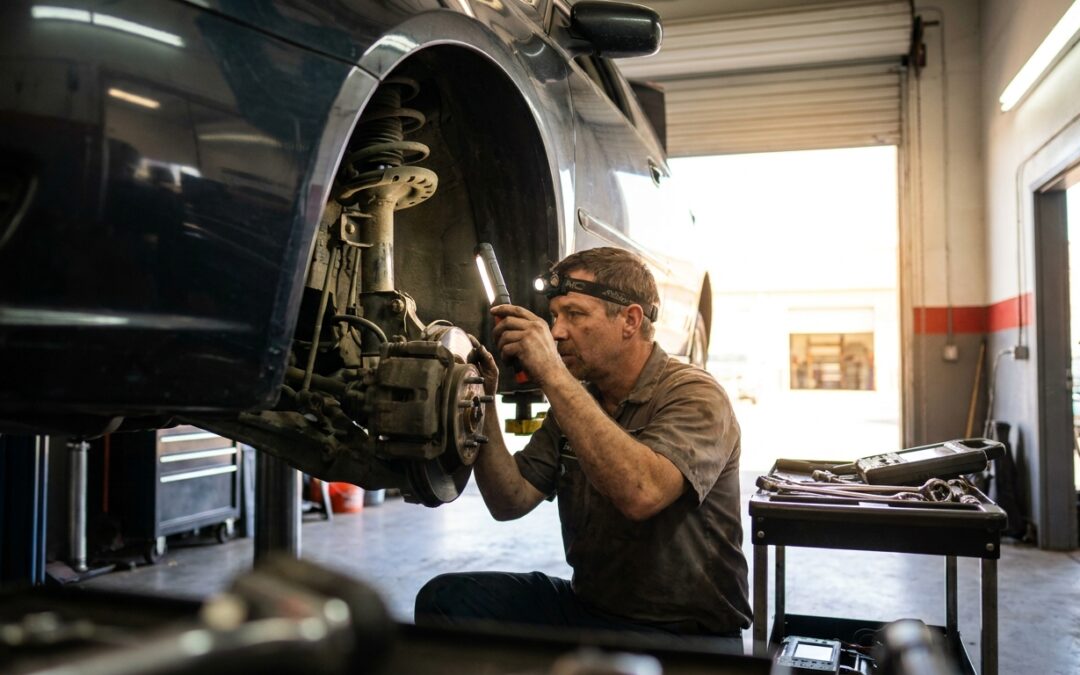
  2. Full Lift Inspection — With the vehicle on the lift and wheels off, we physically inspect every suspension component: shock and strut bodies, mounting hardware, strut top plates and bearings, control arm bushings, ball joints, sway bar links, and tie rods. Nothing gets missed.
  3. Written Estimate Before We Touch Anything — We present you with a complete, itemized estimate and explain exactly what needs to be replaced and why. No surprises. You approve the work before we proceed.
  4. Component Removal & Disassembly — Worn shocks or strut assemblies are removed. On strut jobs, we use a spring compressor to safely disassemble the old unit and transfer any reusable hardware (such as spring seats and bump stops) to the new assembly.
  5. Inspect Related Components — While everything is apart, we check parts we can’t easily see during the initial inspection: CV axle boots, wheel bearing play, brake hardware condition. If something else needs attention, we let you know immediately.
  6. Install New Components to Factory Spec — We use quality replacement parts — OEM or OEM-equivalent — and torque every fastener to manufacturer specifications. Correct torque matters: under-torqued suspension hardware can work loose; over-torqued can damage threads and crush bushings.
  7. Four-Wheel Alignment — Strut replacement always changes wheel alignment angles. We perform a computerized four-wheel alignment after every strut job to restore factory geometry and prevent uneven tire wear.
  8. Road Test & Confirmation — We take the vehicle through the same driving conditions as the initial test drive to confirm the repair is complete and the ride quality is back where it should be. You get a car back that handles the way it was designed to.

Cost & Turnaround Time for Prescott Drivers

Suspension repair costs vary significantly based on vehicle type, whether you need shocks or struts, and how many corners need attention. Here’s a realistic breakdown of what Prescott-area drivers typically pay in 2026:

  • Rear shock absorbers (pair): $180–$380 installed — most trucks, SUVs, and older sedans. Labor is typically 1–1.5 hours. No alignment required for rear shocks on most vehicles.
  • Front strut assembly (pair): $420–$780 installed — includes new strut cartridge, spring, mount, and bearing plate. Alignment required after; included in our quote.
  • Complete strut assembly (both axles): $700–$1,400 depending on vehicle — full four-corner replacement for high-mileage vehicles where rear struts are also worn. Most economical per-corner.
  • Quick Strut or loaded strut assemblies: $100–$200 more per axle but cut labor time and use new spring + hardware — often the better value on vehicles over 100K miles.
  • Four-wheel alignment: Included after strut replacement; $89–$129 as standalone service. Never skip this after strut work.
  • Turnaround time: Rear shocks: 1.5–2.5 hours. Front struts: 2.5–4 hours. Full suspension refresh: 4–6 hours. Same-day service is available for most jobs when you call ahead.

If your vehicle is under 80,000 miles and the original shocks or struts have never been replaced, a single-axle job is often sufficient. If you’re over 100,000 miles or started having issues at the rear after already replacing the front, it’s worth addressing all four corners — the labor savings on a complete job usually offset the additional parts cost.

Get a Same-Day Suspension Quote

Tell us your vehicle and symptoms. We’ll give you a firm price over the phone or schedule a free inspection — no obligation, no pressure.

Get My Free Quote

When Is It Urgent? AZ Safety Warnings

Not every worn shock or strut needs emergency same-day attention — but some situations do. Here are the conditions where driving on compromised suspension becomes genuinely dangerous, especially for Prescott’s mountain terrain:

  • Visible fluid leaking from the shock body — A blown seal means the shock is no longer functioning. There is no “a little bit leaking” — once the hydraulic fluid is out, the component is effectively dead.
  • Vehicle bottoming out over normal road irregularities — If you’re hitting the bump stops on regular road bumps (not off-road obstacles), the shock has lost all its damping capacity.
  • Severe nose-dive causing delayed braking response — On steep Prescott grades, front weight transfer under braking must be controlled by functioning struts. Without them, stopping distance increases unpredictably.
  • Clunking or grinding that changes with steering input — This can indicate a strut bearing plate or top mount that is cracking, which can cause sudden steering loss in extreme cases.
  • Vehicle pulling hard to one side on level road — Combined with suspension wear, this can signal a strut so badly misaligned that a blowout or loss of vehicle control is possible under sudden swerve conditions.
  • Any suspension symptom combined with ABS or stability control warnings — Your vehicle’s electronic safety systems rely on wheel speed sensors that function correctly only when tires maintain proper road contact. Worn shocks can cause enough wheel hop to confuse these systems.
Arizona-Specific Warning: Prescott’s summer heat (regularly above 90°F even at elevation) breaks down polyurethane and rubber bushings faster than temperate climates. Many Prescott drivers notice their rides getting noticeably worse in the spring after the first freezing winter — this is normal wear acceleration from the freeze-thaw cycle compounding summer heat damage. If your vehicle is 6–8 years old and hasn’t had a suspension inspection, schedule one before monsoon season. Wet mountain roads with worn suspension are a dangerous combination.

What to Do Right Now

If you’re reading this because something feels off with your vehicle’s ride, here’s a practical sequence to follow before you book anything:

  1. Do the bounce test — Push down firmly on each corner of your vehicle and let go. Count the bounces before it settles. One bounce and stop is normal. Two or more means that corner needs attention.
  2. Check for fluid on the shock body — Reach your hand behind each rear wheel and feel the shock absorber body. Any oily residue is a red flag. Do the same for the front strut towers if you can access them without the wheel being off.
  3. Inspect your tire tread pattern — Look for cupping (high-low pattern around the circumference) or uneven wear between the inner and outer edges. Either pattern can indicate suspension problems versus a simple inflation issue.
  4. Note when symptoms are worst — Over bumps? During braking? In corners? In cold weather? This information helps the technician isolate the problem faster and saves you diagnostic time.
  5. Call Network Automotive at (480) 444-0242 — Describe what you found and what you’re experiencing. We can often give you a ballpark estimate over the phone and schedule a same-day inspection if the situation is urgent.
  6. Avoid rough roads until inspected — If you’re seeing multiple warning signs, minimize off-pavement driving and avoid high-speed highway runs until a technician confirms the extent of the wear.

Why Prescott Drivers Choose Network Automotive

We know you have options when it comes to suspension repair. Here’s what consistently brings Prescott-area drivers to Network Automotive over the national chain shops and independent garages:

  • ASE-Certified Technicians — Every technician on our suspension team holds current ASE certification in suspension and steering. This isn’t a shop where your car gets handed to whoever’s available — suspension work goes to specialists.
  • Free Suspension Inspection — We don’t charge a diagnostic fee to look at your suspension. Our visual inspection, bounce test, and test drive are complimentary, and you’ll leave with a written estimate before any decision is required.
  • Transparent, Itemized Quotes — We don’t give you a single number and walk away. Every estimate breaks down parts, labor, and any alignment charges so you understand exactly what you’re approving. See our full services list and current coupons.
  • Quality Parts with Warranty — We use OEM and OEM-equivalent parts backed by a parts-and-labor warranty. Cheap shocks from a bargain supplier might save money on day one and cost you again in 18 months. We don’t take that shortcut.
  • Alignment Included After Strut Jobs — Some shops charge alignment as an add-on after every strut replacement. We build it into the strut quote so there are no “by the way” surprises at pickup.
  • Same-Day Service Available — Most single-axle shock and strut jobs can be completed same day when you call ahead. We’ll tell you honestly when that’s possible and when it isn’t. Learn more about our team.
  • Honest Assessment — Not Upselling — If one axle is worn and the other is fine, we tell you to replace one axle. We’re not going to recommend all four corners when only two need attention. Trust is how we build long-term relationships with Prescott-area customers.

Prescott & Surrounding Service Area

Network Automotive serves customers throughout the greater Prescott region and surrounding communities. If you’re driving in from any of these areas, we can help:

  • Prescott — Including downtown, Prescott Lakes, Hassayampa Village, and Forest Trails
  • Prescott Valley — Including Glassford Hill, Viewpoint, and Long Valley areas
  • Dewey-Humboldt — Including Mayer and the Agua Fria River corridor
  • Chino Valley — Including Del Rio Springs and Paulden
  • Skull Valley — Serving ranchers and rural drivers in the Kirkland corridor
  • Congress & Yarnell — Serving drivers coming off Highway 89
  • Cordes Lakes & Black Canyon City — Interstate 17 corridor customers
  • Wickenburg — Via Highway 93 for drivers in the far western service area

Not sure if we can help someone in your area? Call (480) 444-0242 — we’ll tell you straight. We also serve customers in our primary East Valley locations including Mesa, Gilbert, Apache Junction, and Queen Creek.

Prescott Shocks & Struts FAQ

How do I know if my shocks or struts are bad?

The most reliable home test is the bounce test: push down firmly on each corner of your vehicle and let go. If it bounces more than once before settling, that corner’s shock or strut is likely worn. Other signs include a bouncy or floaty ride, nose-diving under braking, body roll in corners, clunking over bumps, uneven tire wear, and visible oily residue on the shock body. Any of these warrant a professional inspection.

How much does shock and strut replacement cost in Prescott, AZ?

Rear shocks typically run $180–$380 installed for a pair on most trucks and SUVs. Front strut assemblies (which include the spring, mount, and bearing plate) usually cost $420–$780 per axle installed, including the required wheel alignment. Full four-corner suspension refreshes range from $700–$1,400 depending on the vehicle. Call (480) 444-0242 for a vehicle-specific quote — we can often give you a number over the phone.

Can I drive on bad shocks and struts?

You can, but it becomes increasingly risky the worse they get. Worn shocks increase stopping distance, reduce tire contact during braking and cornering, and cause handling unpredictability in emergency situations. On Prescott’s mountain grades and winding roads, these risks are amplified. If your shocks are leaking fluid, you should have the vehicle inspected before extended driving. Mild wear can typically wait a few weeks; severe wear should be addressed promptly.

How long do shocks and struts typically last?

Most manufacturers recommend inspection at 50,000 miles and replacement consideration around 75,000–100,000 miles under normal conditions. In Prescott’s environment — extreme heat damaging rubber bushings, freeze-thaw cycles, and mountain road stress — that interval often comes earlier. Trucks used for towing or off-pavement driving typically see suspension wear at 40,000–60,000 miles. Annual visual inspections are the best way to catch wear before it becomes a safety issue.

Do I need to replace shocks and struts in pairs?

Industry best practice is to replace in axle pairs (both front or both rear) even if only one side shows clear symptoms. Mismatched shock dampening — one side firm and one side soft — causes the vehicle to pull and handle unpredictably. Replacing only the worst side sets you up for the same problem in 6–18 months when the other side catches up. Replacing per axle is more cost-effective long-term and keeps your handling balanced.

Do I need an alignment after strut replacement?

Yes, always. Struts are part of the steering knuckle and directly affect camber and caster alignment angles. Removing and reinstalling a strut assembly, even with OEM parts, changes these angles. Driving on misaligned wheels after strut replacement accelerates tire wear and can cause handling pull. We include a four-wheel computerized alignment in every strut replacement quote — it’s not optional, it’s part of the job done correctly.

Does Network Automotive service vehicles in Prescott?

Yes. We serve customers throughout the greater Prescott region, including Prescott Valley, Dewey-Humboldt, Chino Valley, and surrounding areas. Many Prescott-area drivers make the trip to our East Valley locations because of our transparent pricing, free suspension inspections, and same-day availability. Call (480) 444-0242 to confirm we can help with your specific vehicle and schedule an appointment that works for the drive from your area.

How long does shock and strut replacement take?

Rear shock replacement on most trucks and SUVs takes 1.5–2.5 hours. Front strut replacement (both sides) typically takes 2.5–4 hours including the wheel alignment. A full four-corner suspension refresh runs 4–6 hours. Same-day service is available for most single-axle jobs when you call ahead and drop off before 10 AM. We’ll give you a realistic time estimate when you book so you can plan accordingly.

Ready to Fix Your Ride?

Don’t let worn shocks or struts turn Prescott’s mountain roads into a white-knuckle experience. Network Automotive’s certified technicians offer free suspension inspections and same-day service for most jobs. Get a firm quote today.

5 Warning Signs You Need a Wheel Alignment in Gilbert, AZ

5 Warning Signs You Need a Wheel Alignment in Gilbert, AZ

HomeBlog › Wheel Alignment Gilbert AZ

5 Warning Signs You Need a Wheel Alignment in Gilbert, AZ

By Network Automotive Service CenterGilbert, AZUpdated April 2026

Your tires are the most expensive consumable on your car — and nothing eats them alive faster than a vehicle that’s out of alignment. Here are the 5 warning signs every Gilbert driver should know, plus honest 2026 pricing for alignments, what a real alignment actually includes, and why Arizona roads chew up alignments faster than almost anywhere in the country.

You’re cruising down Val Vista with your hands loose on the wheel — and you notice the car is drifting a little to the right. You correct. It drifts again. Or maybe your steering wheel sits crooked even though you’re going straight down Gilbert Road. Or your new tires are already feathered and uneven after 18,000 miles. If any of that sounds like your car, you’re almost certainly due for a wheel alignment in Gilbert AZ — and putting it off is how $120 turns into $1,400 worth of chewed-up tires.

At Network Automotive Service Center, we’ve been aligning Gilbert vehicles since 1995 — Camrys, F-150s, Wranglers, Model 3s, diesel work trucks, lifted Tacomas, you name it. Below are the five warning signs we see most often, an honest breakdown of what an alignment costs in Gilbert in 2026, what a real alignment includes (and what cheap shops skip), and exactly how our process works.

27%
of passenger vehicles on the road are driving with at least one wheel measurably out of alignment. In Gilbert, where pothole season, curb hits, and AZ heat beat up suspensions, the real number is higher. Most drivers have no idea until the tires tell them.

The 5 Warning Signs You Need a Wheel Alignment

You don’t need a dashboard light for this one. Your car is telling you — loudly — if you know what to look for. Here are the five signs Gilbert drivers bring us every week:

1. Your Car Pulls or Drifts to One Side

Drive down a flat, straight stretch of road like Greenfield south of Queen Creek Road. Loosen your grip on the wheel (don’t let go — just relax it). If the car drifts left or right within a few seconds, the alignment is off. A small drift can be caused by road crown (most roads tilt slightly toward the shoulder for drainage), so the real test is whether the pull is consistent in both directions on the same stretch of road. Consistent pull = alignment problem. It’s the #1 symptom we see at our Gilbert customers, and on AZ asphalt it usually means the toe or camber is out of spec.

2. Your Steering Wheel Is Crooked When Driving Straight

Look at the center of your steering wheel next time you’re going straight down the 202 or Williams Field Road. If the logo or horn pad is rotated 5, 10, or 15 degrees off-center, your wheels are pointed straight but the steering rack thinks they’re turned. This almost always means the toe setting is out of spec — usually after a curb strike, a pothole, or a suspension component that has settled and shifted.

3. Uneven or “Feathered” Tire Wear

Walk around your car and run your fingers across the tread of each tire — both directions. If you feel sharp edges on one side of the tread blocks but smooth ones on the other, that’s feathered wear and it’s caused by incorrect toe. Other patterns to watch for in Gilbert:

  • Inside edge of front tires worn bald: negative camber is excessive, usually from worn control arm bushings or a hit curb.
  • Outside edge worn: positive camber or toe issue. Common on vehicles that have been lowered.
  • Center of the tire worn, edges fine: overinflation — not alignment. Drop the PSI.
  • Both outer edges worn evenly, center fine: underinflation. Check the sticker in your door jamb.
  • Cupping / scalloping (wavy wear): worn shocks or struts letting the tire bounce — alignment won’t fix this alone, but it often accompanies an alignment issue.

4. Steering Feels Loose, Wandering, or “Twitchy” at Highway Speed

On the Loop 202 or US-60, does your car feel like it’s constantly looking for the lane center? Do you find yourself making tiny steering corrections every two seconds? That’s classic toe-out or a caster setting that’s out of spec. A properly aligned vehicle should track straight with minimal input. If your hands are working overtime just to stay in your lane, you’re burning fuel and tires.

5. New Tires Wearing Out Way Too Fast

A decent set of all-season tires in Gilbert should give you 45,000–60,000 miles if the vehicle is aligned. If your last set was bald at 25,000 or 30,000 miles — especially if the wear was uneven — the alignment was almost certainly part of the problem. Tires are the single most expensive wear item on your vehicle. Protecting a $1,200 set with a $120 alignment is the simplest math in automotive maintenance.

Gilbert-specific reality check: Power Road, Val Vista, Higley, and Recker all have sections with patched cracks and expansion joints that hit your suspension every single day. Add in monsoon potholes, curb strikes in Santan Village parking lots, and 115°F summers that soften rubber bushings — and Gilbert drivers typically need an alignment every 15,000–25,000 miles, not “every couple of years.”

Free Alignment Check in Gilbert

Bring your car to Network Automotive and we’ll put it on the alignment rack and scan the current specs at no charge. You’ll leave with a printout showing exactly where each wheel sits — no pressure, no upsell.

Book My Free Alignment Check →

What a Wheel Alignment Actually Is (Plain English)

When a shop says they’re “aligning your car,” what they’re really doing is adjusting three angles on each wheel to match the manufacturer’s spec. Those three angles are:

  • Toe — viewed from above, are the wheels pointed straight ahead, inward (toe-in), or outward (toe-out)? The #1 cause of feathered tire wear.
  • Camber — viewed from the front, does the tire tilt inward (negative) or outward (positive) at the top? Excessive camber wears out one side of the tire quickly.
  • Caster — viewed from the side, the angle of the steering axis. Affects steering return and straight-line stability, not usually tire wear.

A four-wheel alignment measures and adjusts all four corners. A thrust-angle or “two-wheel” alignment adjusts the front only but still measures the rear for reference. On any modern vehicle — front-wheel drive, all-wheel drive, or a pickup — a proper four-wheel alignment is what you actually want. A front-only alignment on a car whose rear thrust angle is off just makes the steering wheel crooked again within a few weeks.

What’s a “Thrust Angle” and Why Does It Matter?

Imagine pushing a shopping cart with a rear wheel that’s locked slightly sideways. The cart wants to crab-walk diagonally instead of going straight. That’s thrust angle — the direction the rear axle is actually pointing. On many vehicles rear toe is adjustable; on some older trucks it isn’t. Either way, a good shop measures it and either corrects it or aligns the front wheels to match. Skipping this step is why so many “cheap alignments” don’t hold.

What Does a Wheel Alignment Cost in Gilbert in 2026?

Straight numbers, because the price range out there is wild:

  • Free alignment check (on-rack measurement, printout showing current specs): $0 at Network Automotive. You’ll know before you pay a dime whether you even need the service.
  • Standard four-wheel alignment (most cars, SUVs, small trucks): $109–$149.
  • Thrust-angle alignment (fronts only, non-adjustable rear): $79–$99.
  • Heavy-duty or 4×4 alignment (full-size trucks, lifted vehicles, duallies): $149–$229.
  • Alignment + 1-year warranty (unlimited realignments for 12 months if specs shift): typically $30–$50 extra. Worth it for drivers who hit AZ potholes regularly.

Watch out for $49 alignment specials — they almost always skip the rear measurement, skip adjusting caster (or don’t have the equipment to), and skip verifying tire pressure and ride height before the alignment. If the ride height isn’t right, all the numbers you just “corrected” are wrong again as soon as you leave.

How long does an alignment take?

For a standard passenger car or SUV, most Gilbert alignments are done in 60–90 minutes. Lifted trucks, adjustable suspensions, and vehicles needing parts replaced before alignment (see below) can take 2–3 hours or require a follow-up visit.

How Network Automotive Aligns a Vehicle in Gilbert

Here’s exactly what happens when you bring your vehicle to our shop. This is what a real alignment looks like — not a quick-lube “rack and ship”:

  1. Pre-check inspection. Before the car touches the rack, we inspect tire condition, tire pressure (set to door-jamb spec), wheel bearings, tie rods, ball joints, control arm bushings, sway bar links, and ride height. Alignment is the last step, not the first. Worn parts must be replaced first or the numbers won’t hold.
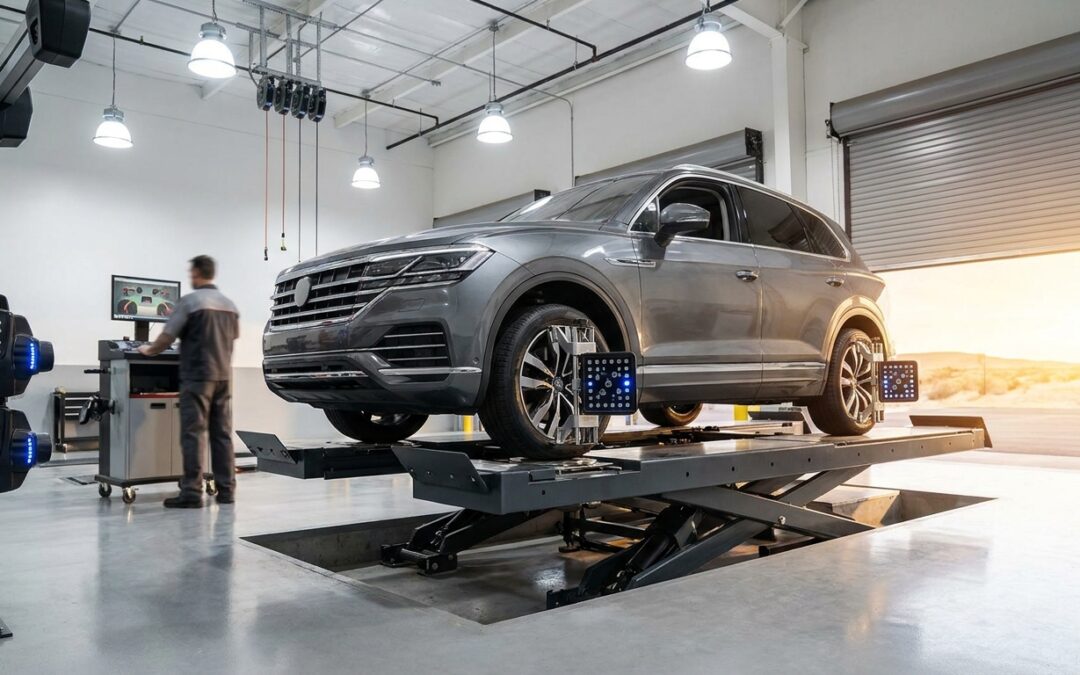
  2. On-rack measurement. Laser or camera-based targets clamp to each wheel. The alignment computer reads toe, camber, caster, thrust angle, and ride height on all four corners simultaneously.
  3. Before-printout review. We show you where each corner sits vs. the manufacturer’s specs. Green = in spec, yellow = borderline, red = out. You see this before we adjust anything.
  4. Adjustments. Toe is adjusted via the tie rod ends. Camber and caster are adjusted via eccentric cams, adjustable upper control arms, or shims — depending on your vehicle. Some vehicles require aftermarket adjustment kits if the factory range isn’t enough (common on lifted Tacomas, Jeep Wranglers, and 4Runners).
  5. Road test + re-measure. Quick drive to settle the suspension, then back on the rack to verify the numbers still read in spec under load.
  6. Centered steering wheel. We center the steering wheel as a final adjustment — many cheap alignments skip this and leave your wheel crooked. Not ours.
  7. After-printout & warranty. You leave with a printed report showing the final specs on all four wheels, stamped with the date. Every Network Automotive alignment is backed by our 3-year / 36,000-mile nationwide warranty.
30+
Years aligning East Valley vehicles. Network Automotive has been family-owned and ASE-certified since 1995. Gilbert, Mesa, Apache Junction, Queen Creek, Prescott — same hands-on technicians, same ethics, for three decades.

How Often Should a Gilbert Driver Get an Alignment?

The old rule used to be “every two years or every 30,000 miles.” That was written for a country that doesn’t include Arizona. Here’s what we actually recommend Gilbert customers:

  • Every tire rotation (every 5,000–7,500 miles): ask for a free alignment check. Takes 10 minutes on the rack.
  • Every 15,000–25,000 miles: a full alignment — especially if you daily-drive Power Road, Val Vista, or the 202.
  • Every time you buy new tires: non-negotiable. New tires on a bad alignment are a $1,200 mistake.
  • After any curb strike, pothole hit, or fender bender: even a minor impact can shift alignment. Get it checked.
  • After any suspension or steering work: struts, ball joints, tie rods, control arms, lift or leveling kits — always realign.

Arizona reality check: The combination of desert heat, pothole season after monsoon rains, and a lot of stop-and-go driving on arterials like Gilbert Road and Warner means Gilbert alignments drift faster than alignments in other climates. If you haven’t had a check in more than 18 months, there’s a good chance at least one corner is out of spec.

Save Your Tires. Save Your Money.

A $120 alignment can add 20,000 miles to your next tire set. Come in for a free alignment check at our Gilbert-area shop — see the printout, then decide.

Schedule My Free Alignment Check →

When Alignment Alone Isn’t Enough: Parts That Need to Be Replaced First

An alignment adjusts angles — it doesn’t fix worn parts. If the following are worn, the numbers won’t hold even after a perfect alignment, because the parts are physically loose. An honest Gilbert shop will find these during the pre-check:

Part What It Does Symptoms When Worn Typical Mesa/Gilbert Cost
Outer tie rod ends Connects steering rack to wheel Looseness, alignment won’t hold, uneven tire wear $180–$420 per side
Inner tie rods Same, inner portion of steering Clunk on turns, steering play $240–$520 per side
Ball joints (upper/lower) Pivot for steering knuckle Clunking over bumps, tire pulls, wobble $260–$780 per side
Control arm bushings Cushion suspension movement Clunks, camber drift, poor handling $220–$650 per side
Struts / shocks Damp suspension motion Bouncy ride, cupping tire wear $380–$1,400 per axle
Sway bar end links Connects sway bar to suspension Clunk over speed bumps, loose feel $140–$320 per side
Wheel bearings Let the wheel spin smoothly Humming or growling that changes with turns $320–$780 per wheel

We always show you the worn part, explain why it needs to be replaced before aligning, and give you a written estimate. You decide. No surprise add-ons.

Why Gilbert Drivers Choose Network Automotive for Alignments

There are plenty of “quick alignment” shops around Santan Village and the Gilbert auto corridor. Here’s what makes ours different:

  • Family-owned since 1995. Three decades, five locations across Gilbert, Mesa, Apache Junction, Queen Creek, and Prescott. Same family, same values.
  • Full four-wheel laser alignment equipment calibrated regularly — not a 1990s rack that reads “close enough.”
  • Mandatory pre-check inspection before every alignment — no aligning onto worn parts.
  • Centered-steering-wheel guarantee. Your wheel sits straight when you leave. If it doesn’t, bring it back.
  • 3-year / 36,000-mile nationwide warranty on parts and labor — including alignment.
  • Honest pre-check reports. If you don’t need an alignment, we tell you. We’d rather earn a repeat customer than a one-time $120.
  • Lifted truck & 4×4 specialists with the adjustment kits most shops don’t stock.
  • Free loaner options for longer repairs where alignment is the final step.

Read more about our philosophy on the About Network Automotive page, see the full service menu, or browse current Gilbert service coupons.

A Word on Lifted Trucks, Jeeps, and Aftermarket Suspensions

Gilbert and the East Valley have more lifted Tacomas, Wranglers, F-250s, and 4Runners per square mile than just about anywhere else in the U.S. If you’ve lifted or leveled your truck, factory alignment specs no longer apply — and most factory adjustment ranges don’t have enough travel to correct the new geometry. That means aftermarket parts: adjustable upper control arms, camber bolts, offset ball joints, or bushing kits. Network Automotive has done thousands of lifted-truck alignments and we stock or can source the right parts for Toyota, Ford, Ram, GM, and Jeep platforms. We’ll tell you honestly whether your lift needs parts before the alignment will hold.

Proudly Serving Gilbert and the East Valley

Network Automotive is the trusted name for wheel alignment across:

  • Gilbert — Agritopia, Morrison Ranch, Seville, Power Ranch, Santan, The Islands
  • Mesa — East Mesa, Las Sendas, Red Mountain, Dobson Ranch
  • Queen Creek — Ironwood Crossing, Cortina, San Tan Heights, Pecan Lake
  • Apache Junction — Superstition, Gold Canyon
  • Prescott — Prescott Valley and surrounding

Most Gilbert customers book at our East Mesa shop just up Power Road, or the Queen Creek location down Ellsworth — both are minutes from Gilbert’s borders.

Gilbert Wheel Alignment FAQ

How much does a wheel alignment cost in Gilbert AZ?

A standard four-wheel alignment runs $109–$149 at Network Automotive. Heavy-duty or lifted-truck alignments run $149–$229. A free on-rack alignment check is always available so you know where your specs sit before any work is authorized. Call (480) 444-0242 for pricing on your specific vehicle.

How often should I get an alignment in Gilbert?

Most Gilbert drivers need an alignment every 15,000–25,000 miles because of AZ potholes, heat, and arterial road conditions. We recommend a free alignment check at every tire rotation and a full alignment every time you buy new tires, after any curb strike, or after suspension work. If it’s been more than 18 months, get it checked.

What are the main signs my car needs an alignment?

The five most common signs: (1) the car pulls or drifts to one side, (2) the steering wheel is crooked when driving straight, (3) uneven or feathered tire wear, (4) loose or wandering steering at highway speed, and (5) new tires wearing out in under 30,000 miles. Any one of these is enough to bring it in.

How long does a wheel alignment take?

Most standard passenger cars and SUVs are done in 60–90 minutes. Lifted trucks, vehicles needing aftermarket adjustment parts, or vehicles that need tie rod / ball joint / bushing replacement before alignment can take 2–3 hours or a follow-up visit.

Will an alignment fix my vibration or steering wheel shake?

Usually no — vibrations are most often a tire balance problem, not alignment. A shake at highway speed that smooths out when you slow down is classic wheel-imbalance. A wobble that gets worse when you brake is typically warped rotors. An alignment corrects pulling and tire wear, not vibration. We can balance, align, and inspect all in one visit.

Do you align lifted trucks and 4x4s?

Yes — lifted trucks and Jeeps are a specialty. Factory adjustment ranges usually aren’t wide enough for a lifted Tacoma, Wrangler, F-250, or 4Runner, so we use aftermarket adjustable upper control arms, camber bolts, offset ball joints, or bushing kits. We’ll tell you honestly if your lift needs parts before the alignment will hold.

Why does my alignment keep drifting out?

Two reasons: (1) worn suspension parts (tie rod ends, ball joints, control arm bushings) that weren’t replaced before the last alignment, or (2) an “alignment” that didn’t actually measure or adjust the rear thrust angle. A proper four-wheel alignment on healthy parts should hold for 15,000+ miles of normal Gilbert driving.

Does Network Automotive warranty the alignment?

Yes. Every alignment is backed by our 3-year / 36,000-mile nationwide warranty on parts and labor. We also offer a 1-year unlimited-realignment add-on ($30–$50) for customers who hit a lot of Gilbert potholes — unlimited re-checks and re-adjustments for 12 months.

Straight Steering. Long-Lasting Tires.

Family-owned in the East Valley since 1995, ASE-certified, full four-wheel laser alignment equipment, and a 3-year nationwide warranty. Get a free alignment check in Gilbert — printout, no pressure.

What Causes A Tire To Show Wires?

What Causes A Tire To Show Wires?

The cords or wires inside the inner liner of your tire will become visible if your tires have treadwear. A poor alignment may cause uneven wear if your wires are showing. There is also the possibility that your tires are out of balance. The cords will prevent your tires from functioning properly and fully. Furthermore, there is a risk of a blowout. You can tell if your tires are worn out if the wires are visible. You will also need to retire immediately. You may need to replace your tires if the tread wears out excessively. You can make an appointment with an auto repair shop Gilbert, AZ to have your car inspected to find out the problem and make sure it’s safe to drive.

Prolonged Usage

There is no such thing as an eternal product. It is impossible for products to last forever, and tires are no exception. There will be wear on the tread of all tires over time. It means that the tires must last around five to six years or 50 miles. It is necessary to analyze some factors.

Alignment Issues

Your tires might not be aligned properly, and your balancing might be off. Different types of wear can result from it.

Camber Wear

If the tires are viewed from the front, their camber is their tilt. Consider driving a tire that tilts inward. The type of camber will determine what type of edge you will see on the tires. Thus, it shows the specific edge depending on the type of camber.

Frequent Overinflationauto repair shop Gilbert, AZ

In addition to stiffening your tire, overinflation will also make it harder. Consequently, the vehicle’s weight will run in the middle of the tires. This results in an uneven center wear pattern as the central portion of the tread wears out much faster than the edges. You can find tools to help you ensure your tires are inflated.

Frequent Underinflation

As a result of underinflation, the sidewall edges of the tire won’t be in maximum contact with the road. As a result, the tire will push towards the center. If your tires do not have enough air in them they won’t wear evenly and they could make more contact than necessary with the road. This can result in the wires sticking out. Always check to make sure your tires are inflated correctly.

The wires on your tires can be dangerous to drive on if they are visible conditions. So a shredded tire or a worn tire will reduce the ability or the efficiency of the braking power of your vehicle. Hydroplaning will likely occur, as well as traction loss, punctures that can be repaired quickly, blowouts, and air pressure loss. If you are noticing that the wires are sticking out of your tires, you should stop driving it. It can be dangerous and could result in a flat tire. If you need to have your tires or car service, you should make an appointment with an auto repair shop Gilbert, AZ

Should My Car Be Vibrating?

Should My Car Be Vibrating?

When you are driving your vehicle there are certain things you don’t want to see or feel, one of those things is vibration. If your car is vibrating severely. It may not be safe to drive. You may want to have it checked out by a Chandler, AZ auto repair shop. There are many different things that could cause a car to vibrate. The sooner you find the problem, the sooner you can find the solution and the safer your vehicle will be while you are traveling.

Wheel problem

Wheel bearings, ball joints, or the ends of defective connecting rods can cause the steering wheel to vibrate while driving. If the wheel alignment issues improve, the car may also shake. If this problem persists, check the balance of the vehicle. Wheel problems should not be underestimated If you are having wheel problems the best thing you can do is have them fixed immediately. If your wheels are off-balance or if they are loose, it could cause you to be in an accident. Balancing your wheels is an easy repair that a shop can do in no time.

Breaking

If the steering wheel vibrates when braking, it may be due to a brake rotor problem. The rotor is a round metal disc and the wear of the rotor can cause the vehicle to move. In addition, damage to the brake calipers and pads can cause the steering wheel and brake pedal to wobble. Your brakes are extremely important and you don’t want to drive your car if you can’t stop it properly. It could be dangerous for you and your passengers, it could also put other people on the road in danger.

Motor

Chandler, AZ auto repair shopIn the event of failure, some engine components may cause the vehicle to vibrate. The usual suspects are spark plugs and air filters. If you have problems, check the spark plug terminal and replace it if you haven’t in a long time. When the air filter is clogged, the car may vibrate, so check the car’s air filter. Motor issues can be serious, and if you don’t have them fixed quickly they could get worse and cause even more severe problems down the road. You could end up having to buy expensive parts or even rebuild the engine. If you think your motor may be vibrating be sure to get it checked.

When you notice your car is vibrating, there could be a number of different things that are causing it. The above are just a few of those things. You shouldn’t drive your car if you think it’s not safe but you can make arrangements to have the car inspected and repaired by a qualified Chandler, AZ auto repair shop. You can give us a call to make an appointment to have your car fixed at your earliest convenience. Don’t hesitate to ask for help. We have a mechanic who will get your vehicle back on the road in no time.

Tips For Cleaning Your Tires From A Chandler, AZ Auto Repair Shop

Tips For Cleaning Your Tires From A Chandler, AZ Auto Repair Shop

Clean tires do more than make your car look sharp in the driveway. The time you spend washing your wheels and tires is also the best opportunity most drivers ever get to actually look at them up close, and in Arizona, where heat and sun punish rubber year-round, those few minutes of attention can catch problems before they become blowouts. Here is how to clean your tires the right way, what to avoid, and what to look for while you are down there, from a Chandler, AZ auto repair shop that inspects tires every single day.

Chandler, AZ auto repair shop

Why Tire Cleaning Is Worth Your Time

Tires collect more grime than any other part of the car: brake dust, road tar, oils from the pavement, and the fine desert dust that coats everything in the Valley. Brake dust in particular is worth removing regularly, because it contains metallic particles that can stain and slowly eat into wheel finishes when left baking in the sun.

Beyond appearance, there is a practical benefit. Dirt hides problems. A layer of brown dust can conceal sidewall cracking, embedded nails, uneven wear, and slow-leak stains. Cleaning forces you to get close to each tire, and that is when drivers notice things they would otherwise miss for months.

How to Clean Your Tires the Right Way

You do not need expensive products, just a sensible process:

  • Wash tires and wheels first, before the rest of the car, so you are not splashing brake dust onto clean paint.
  • Use a dedicated brush and bucket. Keep tire brushes and wash water separate from what touches your paint, since grit from the wheels will scratch the body.
  • Work one wheel at a time. In Arizona heat, cleaners dry fast and leave residue. Rinse each wheel before moving to the next, and work in the shade if you can.
  • Rinse thoroughly. Leftover cleaner attracts dust and can leave streaks down the wheel face.
  • Dry the wheels to prevent water spots, which form quickly with hard water and desert sun.

Products to Use and Products to Avoid

Mild car wash soap and a stiff tire brush handle most jobs. For heavy brake dust, a purpose-made wheel cleaner works well, but read the label and make sure it is safe for your wheel finish, since some strong cleaners can damage certain coatings.

Be thoughtful with tire dressings, the products that give tires that dark shine. Water-based dressings are generally the safer choice. Some solvent-heavy products can accelerate drying of the rubber with repeated use, which is the last thing a tire in the Arizona sun needs. And never apply any dressing to the tread itself, only the sidewall. Slippery tread is a safety hazard.

What to Look For While You Clean

This is where tire cleaning earns its keep. With each wheel, take thirty seconds to inspect:

  • Sidewall cracking. Fine cracks in the rubber, common on Valley cars that park outside, mean the tire is aging out even if the tread is deep.
  • Tread depth and wear pattern. Wear on one edge suggests alignment issues. Wear in the center or on both edges points to inflation problems.
  • Embedded objects. Nails and screws often ride in a tire for weeks before causing a flat. Finding one early means a simple repair instead of a roadside emergency.
  • Bulges or bubbles. A bulge in the sidewall signals internal damage, and that tire needs professional attention promptly.

If anything you find concerns you, our wheels and tires articles can help you understand what you are seeing, or just call us at (480) 444-0242 and describe it.

Finish With a Pressure Check

Since you are already at each wheel, check the pressure. Arizona’s big temperature swings move tire pressure around more than most drivers realize, and both underinflation and overinflation cause faster wear and worse handling. The correct pressure is on the sticker inside the driver’s door jamb, not on the tire sidewall. Checking monthly, ideally in the morning before the heat builds, keeps your tires wearing evenly and your fuel economy where it should be.

How Often Should You Clean and Inspect Your Tires?

For most Valley drivers, a monthly tire cleaning paired with a pressure check hits the sweet spot. It is frequent enough to catch problems early, and it builds a routine you will actually keep. If your car parks outside in the sun, lean toward more frequent quick inspections even if you skip the full wash, because UV exposure is the main enemy of tire rubber in the desert. After any long road trip, a drive on rough or debris-strewn roads, or a monsoon storm, give the tires a quick once-over as well.

Do Not Forget the Spare

The most neglected tire on any car is the one in the trunk. Spare tires lose pressure slowly over months, and a flat spare discovered on the roadside is no spare at all. A few times a year, check the spare’s pressure and condition, and make sure the jack and tools are present and functional. If your car uses an inflator kit instead of a spare, check the kit’s sealant expiration date. Five minutes of attention means the backup plan actually works the day you need it.

While you are in the trunk, confirm you know where the wheel lock key lives if your car has locking lug nuts. A missing lock key is one of the most common reasons a simple roadside tire change turns into a tow, and it is a frustrating discovery to make in the summer sun on the shoulder of the freeway.

When to Bring in a Professional

Cleaning and inspecting are jobs any owner can do. But if you spot uneven wear, sidewall damage, persistent pressure loss, or vibration at speed, it is time for a professional look. Those symptoms usually trace back to alignment, balance, suspension wear, or tire damage that needs proper equipment to diagnose. Network Automotive Service Center has been family-owned since 1995, serving Chandler and the East Valley. See the full list of our services and call (480) 444-0242 to schedule a tire inspection. Clean tires look great, but safe tires are the real goal.

3 Ways A Chandler, AZ Auto Repair Shop Can Make Your Car Ride More Comfortable

3 Ways A Chandler, AZ Auto Repair Shop Can Make Your Car Ride More Comfortable

When you are trying to get a more comfortable car ride and you are wondering what is making it so bumpy or difficult to drive, there could be a number of things that are causing the issues. If you need to get some help with your car repairs, consider taking it to a Chandler, AZ auto repair shop. Here are some of the things you can watch for that could mean here are some serious issues going on with your car.

Tire Problems

Tires are generally the principal guilty party to explore when your vehicle’s movement feels off. Rough rides can be either because of the tire arrangement, pneumatic stress, or even the tires being improperly gotten. Very frequently, somebody will replace a tire and not understand the tire isn’t set against the back circle solidly. When they fix the nuts on the tire, they may believe it’s gotten, just to discover that the vehicle wobbles, vibrates, or shakes when moving. Regardless of whether there is a slight development, over the long haul this will negatively affect the tire, brakes, plate, and various different segments.

Suspension Problems

The suspension is the thing that keeps your tires in touch with the street, and considering your tires both cow and stop you, your suspension framework is somewhat the overlooked yet truly great individual of the auto world. In the event that something in your suspension has given out, you should see some exceptional contrasts in how the vehicle the two feels and handles. The vehicle may lean intensely aside, bob here and there various occasions prior to settling, or you can feel the shock of rolling over potholes, controls, and knocks. In the event that your suspension is giving you inconvenience, there are a couple of significant parts which should give you concern.

Transmissions Problems

Chandler, AZ auto repair shopA great many people fear these three words with regards to some kind of problem with their transmission. This can cost you anyplace from two or three hundred dollars to a couple thousand. The expense typically relies upon how rapidly you can tell your transmission needs adjusting and when you really take it in for administration. If your transmission goes bad your car will not be able to shift properly and eventually you may not be able to drive it anymore.

Numerous individuals may see a slight issue and let it persevere over months, even years, until at last it gives out completely. A shiny new transmission can cost however much a modest trade-in vehicle, so it’s obviously better to have it taken a gander at almost immediately by a Chandler, AZ auto repair at whatever point you acquire your vehicle for upkeep just to watch out for it. Call Network Automotive Service Center for help with all your car repair needs. We are happy to help with all your car repair needs and to help you have a more comfortable ride.

Network Automotive Service Center
Privacy Overview

This website uses cookies so that we can provide you with the best user experience possible. Cookie information is stored in your browser and performs functions such as recognising you when you return to our website and helping our team to understand which sections of the website you find most interesting and useful.