Car AC Repair Apache Junction AZ: 2026 Costs & Same-Day Fix

Car AC Repair Apache Junction AZ: 2026 Costs & Same-Day Fix

HomeBlog › Car AC Repair Apache Junction AZ

Car AC Repair in Apache Junction, AZ

By Network Automotive Service CenterApache Junction, AZUpdated July 2026

Blowing hot air in 110-degree heat? Here is what is actually wrong, what real car AC repair costs in Apache Junction in 2026, and how to get cold air back the same day.

There is a specific kind of panic that only happens in an Arizona summer. You climb into a car that has been baking in a parking lot, you turn the AC to max, and the vents blow warm air across your face. In Apache Junction, where afternoon highs sit well past 110 degrees for weeks at a time, a broken air conditioner is not an inconvenience. It is a genuine safety problem, and it needs honest, fast car AC repair from a shop that will not upsell you a compressor you do not need.

Network Automotive has been fixing air conditioning on cars, trucks, and diesels for East Valley drivers for years, and we see the same failures roll through the bay every June, July, and August. The good news is that most AC problems are cheaper and simpler to fix than people fear. The bad news is that the desert heat is brutal on AC parts, so ignoring a small issue in May often turns into a much bigger repair by August. This guide walks you through exactly what breaks, what it costs to fix in 2026, and how to stop guessing and get cold air back.

70%
of the “my AC is broken” cars we see in the summer just need a proper leak diagnosis and recharge, not a full compressor. A real diagnosis saves you from overpaying for parts you do not need.

Why Your Car’s AC Stopped Cooling in the Arizona Heat

Your car’s air conditioning is a sealed loop. A compressor pressurizes refrigerant, that refrigerant sheds heat through the condenser at the front of the car, then expands and gets cold inside the evaporator behind your dashboard, and a blower fan pushes that cold air into the cabin. When any single link in that chain fails, you feel it instantly as warm air from the vents.

In Apache Junction and the surrounding Superstition foothills, three things gang up on your AC. First, heat. Refrigerant systems run at much higher pressures when it is 115 degrees outside, which stresses hoses, seals, and the compressor. Second, dust. Fine desert dust and monsoon grit pack into the condenser fins and choke off airflow, so the system cannot dump heat the way it should. Third, age. Rubber O-rings and seals dry out and shrink in low humidity, and that is where the slow refrigerant leaks start.

Because the whole thing is a sealed system, low refrigerant almost always means there is a leak somewhere. This is the single most important thing to understand: an AC that needs “a recharge” every summer does not need more refrigerant, it needs the leak found and sealed. A shop that just tops you off and sends you on your way is selling you a fix that will fail again in weeks. That is why every AC job at Network Automotive starts with a real pressure and leak diagnosis, not a can of refrigerant.

A/C Cooling Check

Not sure if it is a quick recharge or something bigger? We will pressure-test your system and tell you exactly what is wrong before you spend a dime on parts.

Claim Your A/C Check

The Most Common Car AC Problems We See in Apache Junction

When a car rolls in blowing warm, it is almost always one of a handful of culprits. Here is what actually fails, why it happens in our climate, and roughly what each repair runs. Your exact price depends on your year, make, and model, and we always confirm it with you before any work begins.

Problem What Causes It Typical Repair Cost
Low refrigerant / slow leak Dried O-rings and seals, worn hoses, tiny condenser leaks from road debris $150 to $350 (leak find + recharge)
Failed AC compressor Age, heat stress, running the system low on refrigerant for too long $800 to $1,800
Clogged or leaking condenser Rock strikes on the freeway, packed desert dust, corrosion $500 to $1,100
Bad blower motor or resistor Dust and heat wearing out the fan motor or its speed control $250 to $550
Evaporator leak Corrosion inside the dash unit, one of the more labor-heavy fixes $900 to $1,600
Electrical / relay fault Blown fuse, failed AC relay, wiring, or a pressure switch cutting the compressor off $120 to $450

Notice how wide that range is. That is exactly why a proper diagnosis matters so much. Two cars that both “blow hot” can need a $180 seal-and-recharge or a $1,500 compressor, and there is no way to know which without putting gauges on the system. Anyone who quotes you a compressor over the phone without seeing the car is guessing, and in this business guessing gets expensive.

If your AC blows cold at highway speed but warm at a stoplight, your condenser fans or airflow are usually the problem, not the compressor. That is a much cheaper fix, and it is a great example of why a real diagnosis pays for itself.

Our Car A/C Repair Process

We keep it straightforward and transparent. No mystery, no pressure, no parts thrown at the wall to see what sticks. Here is exactly how an AC job goes at Network Automotive.

  1. Listen first. We ask when it started, whether it is warm all the time or only at idle, and what you have already noticed. Your description narrows the diagnosis fast.
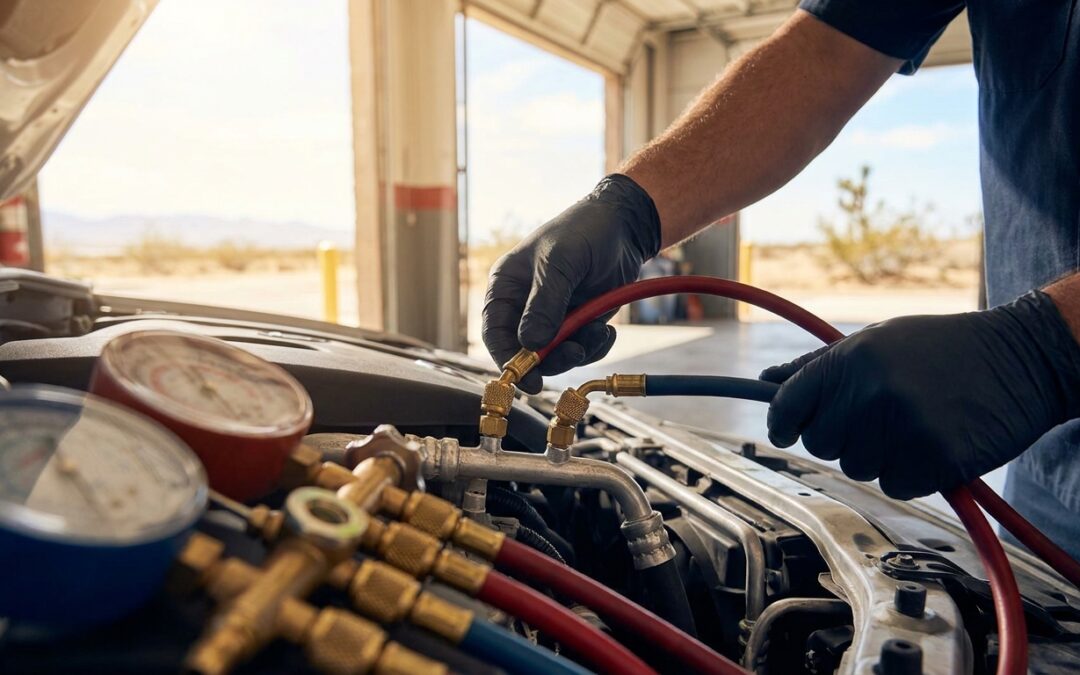
  2. Hook up the gauges. We connect a manifold gauge set to read high-side and low-side pressures. Those two numbers tell a trained tech a huge amount about what is happening inside the sealed system.
  3. Find the leak, not just the symptom. If the system is low, we use UV dye or an electronic leak detector to pinpoint exactly where refrigerant is escaping so we fix the cause.
  4. Inspect the whole system. Compressor clutch, condenser, hoses, cabin air filter, blower motor, and cooling fans all get checked so nothing gets missed.
  5. Give you a written estimate. You get a clear breakdown of what is wrong and what it costs before we touch a wrench. You decide.
  6. Evacuate and recharge correctly. After the repair we pull the system into a vacuum, verify it holds, then recharge to the manufacturer’s exact specification. Precision matters here.
  7. Verify cold air. We measure vent temperature and confirm the system is cooling the way it should before the car leaves.

What Car AC Repair Costs in Apache Junction (2026)

Nobody likes surprise pricing, so here is the honest picture for 2026. These are typical ranges for the East Valley. Your final number depends on your specific vehicle and which parts are involved, and we confirm everything with you up front.

  • AC diagnosis: $89 to $150, and it is credited toward the repair if you move forward with us.
  • Leak find and recharge: $150 to $350 depending on refrigerant type and how much labor the leak repair takes.
  • Compressor replacement: $800 to $1,800 including parts, labor, and a full system recharge.
  • Condenser replacement: $500 to $1,100 depending on access and vehicle.
  • Blower motor or resistor: $250 to $550.
  • Cabin air filter: $40 to $90, and a clogged one is a surprisingly common reason for weak airflow.

One note on refrigerant. Newer vehicles use R-1234yf refrigerant, which costs several times more than the older R-134a. If your car takes the newer type, a recharge naturally runs higher, and that is not a markup, it is the cost of the refrigerant itself. We will always tell you which system your car has and why the price is what it is.

Stop Guessing, Start Cooling

Get a firm, written estimate before any work happens. Same-day service is available on most AC repairs when you call early.

Book My A/C Repair

When Is an AC Problem Urgent?

Some AC issues can wait a week. Others should not wait a day, both for your safety and because a small problem can wreck an expensive part. Get your car looked at right away if you notice any of these red flags.

  • Air is fully hot with the AC on max, especially with kids, elderly passengers, or pets in the car during a heat wave.
  • A loud grinding, screeching, or rattling noise when you switch the AC on, which often means the compressor is failing.
  • A sweet or chemical smell from the vents, a possible sign of a refrigerant or coolant leak.
  • The AC clutch is rapidly clicking on and off, which usually means the system is dangerously low on refrigerant.
  • Water pooling on the passenger floorboard, which points to a blocked AC drain.

Arizona heat warning: Running a compressor that is low on refrigerant is one of the fastest ways to destroy it. The refrigerant carries the oil that lubricates the compressor, so when it runs low, the compressor runs dry and grinds itself apart. What could have been a $200 recharge becomes a $1,500 compressor. If your AC clutch is clicking or the air is barely cool, turn it off and get it checked before you burn up the compressor.

What To Do Right Now If Your AC Quit

If you are reading this in a hot car with a broken AC, here is the smart move, in order.

  1. Turn the AC off if it is only blowing hot. Running a failing system can turn a small repair into a big one. Roll the windows down and drive with airflow instead.
  2. Check the simple stuff. Make sure the AC button is actually on, the temperature is set to cold, and the fan is running. It sounds obvious, but a bumped setting fools people every summer.
  3. Note when it fails. Warm only at idle, warm all the time, or warm after 20 minutes of driving are three different problems. Telling us which one helps us diagnose faster.
  4. Do not just buy a recharge can. Over-the-counter refrigerant with stop-leak can gum up your system and make the real repair more expensive.
  5. Call us or book online. Most AC repairs can be handled same-day if you reach out early in the day. Call (480) 444-0242 or use the AC check button on this page.

Why Apache Junction Drivers Choose Network Automotive

There is no shortage of places to get your car looked at, so here is why local drivers keep coming back to us for air conditioning work.

  • We diagnose before we sell. You get a real leak and pressure test, not a phone quote for a compressor you might not need.
  • ASE-certified technicians who work on everything from daily commuters to diesel trucks.
  • Honest, written estimates so you always approve the price before any work starts.
  • Same-day AC service on most repairs when you call early in the day.
  • A shop that stands behind its work. Learn more about our team and how we do business.
  • Real savings. Check our current service coupons before you come in.

Our Apache Junction Service Area

We proudly serve drivers throughout Apache Junction and the surrounding East Valley, including:

  • Apache Junction and the Superstition foothills
  • Gold Canyon and Superstition Mountain
  • Mesa and east Mesa
  • Queen Creek and San Tan Valley
  • Gilbert and Chandler

Whether you are near the Superstition Springs corridor or out toward Gold Canyon, we are an easy drive for fast, honest car AC repair.

Apache Junction Car AC Repair FAQ

How much does car AC repair cost in Apache Junction?

It depends entirely on what is wrong. A leak find and recharge typically runs $150 to $350, while a full compressor replacement runs $800 to $1,800 including parts, labor, and a recharge. The only way to know your real number is a proper diagnosis, which costs $89 to $150 and is credited toward the repair if you move forward with us.

Why does my AC blow cold while driving but warm at a stoplight?

That pattern almost always points to airflow across the condenser rather than the compressor. At speed, air rushes through the front of the car and cools the refrigerant. At idle, your electric cooling fans have to do that job, so a weak or failed fan shows up as warm air only when you stop. It is usually a much cheaper fix than a compressor.

Can you fix my AC the same day?

In most cases, yes. Leak repairs, recharges, blower motors, and many compressor jobs can be completed same-day if you call early in the day so we have time to source parts. Call (480) 444-0242 first thing and we will do our best to get you cooling before you head home.

Is it bad to keep running my AC when it only blows hot?

Yes, it can be. If the system is low on refrigerant, the compressor is also low on the oil that refrigerant carries, so running it makes the compressor grind itself apart. That turns a small recharge into an expensive compressor replacement. If your air is hot or the AC clutch is clicking on and off, shut it off and get it checked.

Should I just buy a recharge can from the parts store?

We strongly recommend against it. Those cans mask the real problem, which is almost always a leak, and many contain a stop-leak additive that can clog your AC components and make the professional repair harder and pricier. A proper leak diagnosis fixes the cause instead of hiding it for a few weeks.

What refrigerant does my car use, and does it matter for price?

Vehicles from roughly 2015 onward often use R-1234yf, which costs several times more than the older R-134a found in older cars. If your vehicle takes the newer refrigerant, a recharge naturally costs more, and that difference is the refrigerant itself, not a markup. We will always tell you which system you have.

Why does my AC keep needing a recharge every summer?

Because it has a leak. Air conditioning is a sealed system, so it should never lose refrigerant under normal use. If you need a top-off every year, there is a small leak, usually at a dried-out O-ring, hose, or condenser fitting. Finding and sealing that leak once is cheaper over time than paying to recharge it every season.

Do you work on truck and diesel AC too?

Absolutely. Our technicians service air conditioning on cars, SUVs, work trucks, and diesels. AC systems on heavier vehicles follow the same principles, and our team handles them all. See our full list of services or call us to confirm your specific vehicle.

Get Cold Air Back Today

Do not sweat through another Apache Junction afternoon. Network Automotive will pinpoint exactly what is wrong, give you an honest written estimate, and get your AC blowing cold again, often the same day.


AC Repair Gilbert AZ: Don’t Overpay (2026 Prices) [$89+]

AC Repair Gilbert AZ: Don’t Overpay (2026 Prices) [$89+]

HomeBlog › AC Repair Gilbert AZ

AC RepairGilbert AZ: 2026 Costs, Signs & Same-Day Diagnosis

By Network Automotive Service CenterGilbert, AZUpdated July 2026

Real 2026 pricing, the warning signs a technician actually looks for, and what a same-day AC repair Gilbert AZ diagnosis can save you before a weak vent turns into a car that’s unbearable to drive in July.

If your vents are blowing warm, weak, or nothing at all, you’re probably searching for AC repair Gilbert AZ because sitting in a 115-degree parking lot with no cold air is not something you can put off. That instinct is right. Car AC systems rarely die instantly — they lose a little performance for weeks before they quit completely, and by the time it’s obvious something’s wrong, you’re usually already sweating through your commute on the San Tan or the 202.

Gilbert’s climate is uniquely hard on automotive AC systems. Refrigerant lines, seals, and compressor clutches are engineered to handle heat, but months of triple-digit ambient temperatures combined with a hot engine bay push every component in the system past what most manufacturers assume in their maintenance schedules. That’s the single biggest reason we see more AC repair Gilbert AZ visits between May and September than any other stretch of the year — and why waiting until August to get a system checked almost always costs more than catching it in spring.

82%
Of the “no cold air” calls we get in Gilbert during summer trace back to a slow refrigerant leak, not a failed compressor. An $89 diagnostic could have caught the leak years before it became a $1,850 compressor job.

What’s Happening Inside Your AC System

Your car’s AC is a sealed pressure system built around exact refrigerant charge and exact clearances. The compressor pressurizes refrigerant gas, the condenser (mounted right in front of your radiator) cools it into a liquid, the expansion valve or orifice tube drops its pressure so it can absorb heat, and the evaporator inside your dash uses that cold liquid to chill the air blowing through your vents. When the charge is correct and every seal is intact, the system just works. When even one O-ring or hose starts leaking, everything downstream suffers.

Refrigerant loss is the number one enemy in Gilbert. A system doesn’t need a dramatic leak to fail — it can lose a fraction of an ounce a year through a slightly porous hose or an O-ring that’s dried out from years of underhood heat, and you won’t notice anything until the charge drops low enough that the compressor can’t build proper pressure. Once that happens, you get weak airflow, air that’s cool but not cold, or a compressor that cycles on and off rapidly trying to protect itself. In a Gilbert summer, a system that’s already running low on charge can go from “a little warm” to “blowing hot air” within days, because the ambient heat load leaves almost no margin for error.

The compressor itself fails differently — usually a worn clutch, a seized internal bearing, or a clutch coil that’s no longer engaging — but the same rule applies: refrigerant charge and component wear are the two variables that decide whether you’re looking at a $150 recharge or a $1,850+ compressor replacement. This is why an accurate diagnosis matters more than almost any other repair category in the summer. Guessing wrong on an AC issue, or simply adding refrigerant without finding the leak, is one of the most common (and most expensive) mistakes we see drivers make before they come to us.

We hear the same story constantly from Gilbert customers: the air felt “not quite as cold” for a few weeks, they assumed it would sort itself out, and then one 110-degree afternoon it just stopped. AC repair Gilbert AZ almost never starts as an emergency — it starts as a subtle change in how cold the air feels at idle versus highway speed. Trusting that first instinct, rather than waiting for the system to fail completely, is the single best way to keep a repair small and affordable.

According to fueleconomy.gov’s vehicle maintenance guidelines, following manufacturer service intervals for climate control components is one of the most effective ways to catch small refrigerant leaks before they become bigger mechanical failures. Those intervals assume moderate climates, though — in Gilbert, we generally recommend a yearly AC performance check regardless of mileage.

Cabin air filters play a bigger role in this than most drivers expect. A clogged filter doesn’t just make the air smell musty — it restricts airflow across the evaporator core, which can make a perfectly healthy AC system feel weak even though the refrigerant charge and compressor are fine. In Gilbert’s dust and pollen conditions, cabin filters clog faster than the factory-recommended interval assumes, and it’s one of the first things we check because it’s the cheapest possible explanation for weak airflow. We’d rather tell you it’s a $30 filter than sell you a diagnostic you didn’t need.

Not Sure What’s Wrong?

Get an AC performance check at Network Automotive before you spend a dollar on repairs. We’ll tell you straight whether it’s an $89 fix or something bigger.

Book My AC Diagnostic →

Common Causes & How AC Repair Works

Most of the AC repair Gilbert AZ jobs that come through our bay fall into a handful of repeatable categories. Knowing which one you’re dealing with changes the cost by hundreds or thousands of dollars, which is exactly why we start every job with a real diagnostic instead of a guess or a quick top-off can.

Symptom Likely Cause Typical Fix
Air is warm or not cold enough Low refrigerant from a slow leak Leak detection, seal/hose repair, recharge
No air movement from vents Failed blower motor or resistor Blower motor or resistor replacement
Compressor cycles on/off rapidly Low charge or failing pressure switch Leak repair, switch replacement, recharge
Loud squeal or clicking from under the hood Worn compressor clutch or bad belt Clutch or belt replacement
Musty smell from vents Mold/bacteria on evaporator core Evaporator cleaning, cabin filter replacement
AC works only at highway speed Failing condenser fan Condenser fan motor replacement

The compressor clutch and pressure switches control when the AC system engages and how hard it works. On many of the vehicles we service — Ford F-150s, Honda CR-Vs, Toyota Camrys, and Chevy Silverados are common around Gilbert — a failing clutch relay or pressure switch is genuinely one of the more affordable fixes, and one we can usually confirm the same day with a manifold gauge set and a UV dye leak check.

Compressor failure — a seized internal bearing or worn-out clutch — is the more expensive category, and it’s usually the result of years of low refrigerant forcing the compressor to run without adequate lubrication, since the oil that lubricates it travels through the system dissolved in the refrigerant itself. This is also where the repair-vs-replace conversation becomes real, and it’s something we walk through with every customer before any work begins, not after.

One thing we won’t do is push a full compressor replacement when the actual fix is a $180 hose or O-ring. Every AC repair Gilbert AZ estimate we write breaks out the exact part that’s leaking or failing, why we believe that’s the cause, and what happens if you choose to wait. That transparency is the difference between a shop you trust once and one you keep coming back to for a decade.

If your AC blows cold for the first few minutes and then slowly warms up, that’s a classic sign of low refrigerant — not a dead compressor. Get it checked before you pay for a bigger repair than you actually need.

Our Diagnostic & Repair Process

Every AC repair Gilbert AZ visit at Network Automotive follows the same process, whether the fix ends up being an $89 recharge or a full compressor replacement.

  1. Listen first. We ask exactly when the symptom happens — cold start, idle, highway speed, only in the afternoon — because the pattern narrows down the cause before we even open the hood.
  2. Check system pressures. Manifold gauges tell us in minutes whether the system is low, overcharged, or has a blockage — the fastest way to rule things in or out.
  3. UV dye & electronic leak detection. If pressures point to a leak, we find the exact location instead of guessing at which hose or seal is failing.
  4. Inspect the compressor clutch and belt. A quick visual and audible check catches worn clutches, slipping belts, and bad bearings early.
  5. Test the blower motor and cabin controls. Weak airflow isn’t always a refrigerant issue — sometimes it’s electrical, and we rule that out here.
  6. Written estimate, no surprises. You get a clear breakdown of parts, labor, and timeline before we touch anything beyond diagnostics.
  7. Repair. From recharge to hose repair to compressor replacement, the work is done in-house with OEM or OEM-equivalent parts.
  8. Verification test. We don’t hand the keys back until we’ve confirmed vent temperature and system pressure are correct under real driving conditions.

Cost & Time: What AC Repair Actually Costs in Gilbert

Here’s the honest range we quote for AC repair Gilbert AZ, based on what we actually charge in our shop in 2026 — not a national average pulled from somewhere else in the country.

  • AC performance diagnostic: $89–$129, about 30–45 minutes
  • Refrigerant recharge (leak-free system): $150–$350, typically same-day
  • Hose or O-ring leak repair + recharge: $250–$550, usually same-day
  • Blower motor or resistor replacement: $220–$480, same-day
  • Condenser fan motor replacement: $280–$480, same-day
  • Condenser replacement: $650–$1,200, typically 1 day
  • Compressor replacement: $900–$1,850, usually 1 day
  • Evaporator core replacement: $1,100–$1,900, 1–2 days

Two variables move these numbers more than anything else: how far the refrigerant charge has dropped before it’s caught, and whether the vehicle is a common domestic/Japanese model (parts readily available) or a lower-volume import (parts take longer, cost more). We quote exact numbers after diagnosis, every time — the ranges above are there so you’re never walking in blind.

Financing is available on larger AC repair Gilbert AZ jobs, and every repair — big or small — carries the same 24-month / 24,000-mile nationwide warranty. That warranty matters more than most customers realize: it means a compressor we install today is still covered if it acts up two summers and two states away.

We also see current service coupons make a real difference on AC visits, especially on diagnostics and recharges scheduled outside of peak July and August demand. If you can plan an AC check in spring rather than waiting for the first 110-degree week, you’ll usually get in faster and catch small leaks before they turn into stranded-in-a-parking-lot problems.

Get A Real Number, Not A Guess

AC performance check, written estimate before any work starts, and financing options available on larger repairs.

Get My Free Estimate →

When Is It Urgent? Safety & Warning Signs

Not every AC symptom means pull over immediately, but a few are worth treating as urgent when you’re dealing with AC repair Gilbert AZ in Arizona heat.

  • No airflow at all from any vent, at any fan speed
  • Burning or chemical smell from the vents or under the hood
  • Loud grinding or squealing from the compressor area
  • Visible refrigerant oil residue or a hissing sound near AC lines
  • Steam or unusual smell combined with an overheating warning light
  • Kids, elderly passengers, or pets regularly riding in the vehicle with no working AC
Arizona heat makes this worse, fast. A cabin with no working AC can climb well past 140°F within minutes on a Gilbert summer afternoon, and a compressor that’s already low on refrigerant can seize completely the first time it’s asked to work hard on a 115-degree day. If you’re seeing any red-flag symptom above during Gilbert’s hot months, don’t wait for a scheduled appointment — get it looked at same-day.

What To Do Right Now

  1. Turn the AC off if you hear grinding or smell burning. Continuing to run a failing compressor almost always turns an affordable repair into a full replacement.
  2. Note when the air stopped being cold. Gradual weakening vs. sudden failure points to two very different causes and helps us diagnose faster.
  3. Call or book online. Tell us the exact symptom and when it happens; that detail speeds up your diagnostic appointment.
  4. Get an AC diagnostic. Every AC repair Gilbert AZ visit starts with us testing pressures, checking for leaks, and giving you a written number before any repair work begins.
  5. Approve only what you need. We’ll always tell you if a cheaper fix is a real option before recommending a bigger repair.

Why Choose Network Automotive

Gilbert drivers have a lot of options for AC repair. Here’s why customers keep choosing Network Automotive for AC repair Gilbert AZ instead of a dealership or a chain shop.

  • AC performance check and written estimate before any work starts
  • 24-month / 24,000-mile nationwide warranty on AC repairs
  • ASE-certified technicians experienced with domestic, Japanese, and diesel climate control systems
  • Same-day diagnostics on most leak, clutch, and blower motor issues
  • Honest repair-vs-replace guidance — we tell you when a recharge beats a compressor swap, and when it doesn’t
  • See our full AC and cooling system services, learn more about our shop, or check current service coupons before you book

Service Area

We handle AC repair Gilbert AZ and throughout the surrounding East Valley communities, including neighborhoods around the Heritage District, Val Vista Lakes, Power Ranch, and the SanTan Village corridor. If you’re not sure whether your address falls inside our service radius, call us — we’ll tell you straight, and if we can’t help directly we’ll point you toward someone who can.

Drivers commuting between Gilbert and neighboring East Valley cities for work often ask whether it matters where they get AC repair done if they’re driving across multiple service areas every day. It doesn’t — our nationwide warranty travels with the vehicle, not the zip code, so a repair completed at our Gilbert-area bay is covered whether you’re commuting to Mesa, running errands in Queen Creek, or driving up to Prescott for the weekend.

  • Gilbert
  • Mesa & East Mesa
  • Queen Creek & San Tan Valley
  • Apache Junction
  • Chandler
  • Prescott

Gilbert AC Repair FAQ

How much does AC repair cost in Gilbert, AZ?

It depends entirely on what’s wrong. A diagnostic runs $89–$129, a refrigerant recharge with a small leak repair is typically $250–$550, and a full compressor replacement lands between $900 and $1,850. We give you an exact number after a real diagnostic, never a guess.

What are the warning signs my car AC needs repair?

Air that’s cool but not cold, weak airflow, a compressor that cycles rapidly, a burning or musty smell, or a squealing noise when the AC is on are the most common early signs. Catching any of these early is almost always cheaper than waiting until the system fails completely.

Can I just add refrigerant myself with a store-bought can?

You can, but it rarely fixes the actual problem. If your system has a leak, adding refrigerant just delays the failure and can mask symptoms that make diagnosis harder later. A proper recharge always follows a pressure test and leak check, not a guess.

Why does my AC blow cold at first and then warm up?

This is a textbook sign of low refrigerant, usually from a slow leak in a hose, O-ring, or seal. The system can build enough pressure briefly but can’t sustain it. A leak check and recharge is almost always the fix, not a compressor replacement.

Should I repair my AC compressor or replace it?

It depends on the extent of internal wear and the age/value of the vehicle. If the issue is a clutch, relay, or seal, repair is almost always the better value. If there’s internal mechanical failure on an older vehicle, full replacement can sometimes make more financial sense. We walk through both options with real numbers before you decide.

Does Network Automotive warranty AC repairs?

Yes. Every AC repair we perform is backed by a 24-month / 24,000-mile nationwide warranty on parts and labor, so you’re covered even if you’re driving well outside Gilbert.

How long does AC repair take?

A diagnostic, recharge, or blower motor replacement is often same-day. Condenser or evaporator work usually takes 1–2 days depending on parts availability for your specific vehicle.

Does Arizona heat really make AC problems worse?

Yes, significantly. High ambient temperatures push a marginal system past its limit fast, and a compressor already running low on refrigerant can seize the first time it’s asked to work hard on a 110+ degree day. This is a major reason AC repair Gilbert AZ visits spike every summer.

Get A Straight Answer On Your AC

Performance check, written estimate, and a 24-month / 24,000-mile warranty on every repair. Don’t let an $89 fix turn into a $1,850 one.


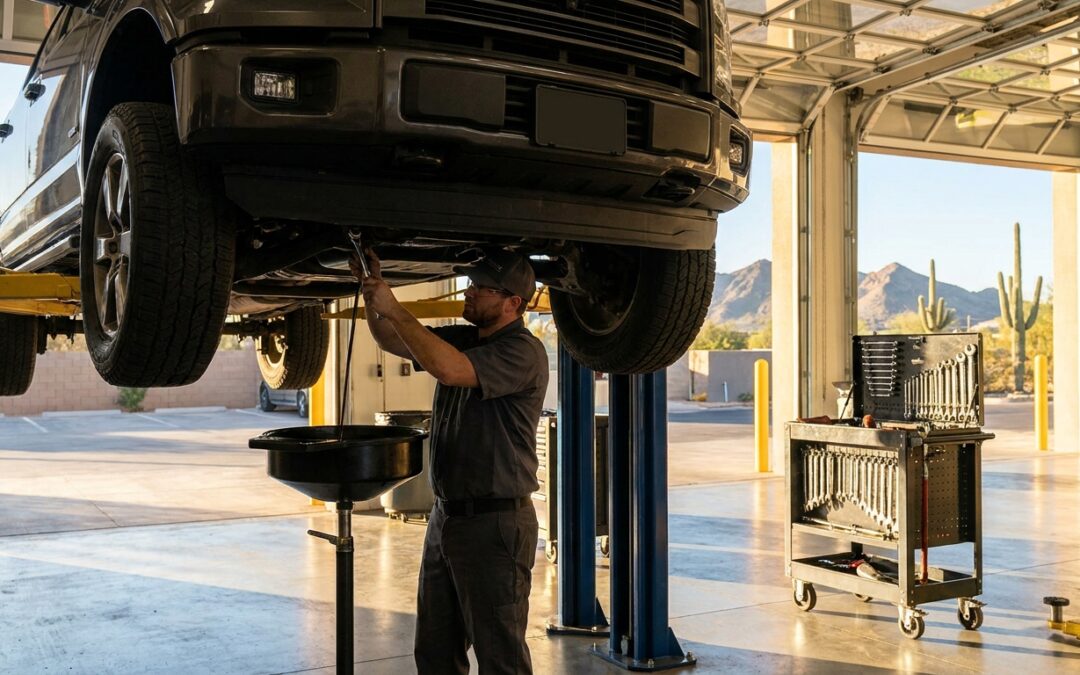
Oil Change Apache Junction AZ: What It Actually Costs (and Why Skipping It Costs More)

Oil Change Apache Junction AZ: What It Actually Costs (and Why Skipping It Costs More)

HomeBlog › Oil Change Apache Junction AZ

Oil Change Apache Junction AZ: What It Actually Costs (and Why Skipping It Costs More)

By Network Automotive Service CenterApache Junction, AZUpdated July 2026

Real 2026 prices, honest advice on conventional vs. synthetic, and why Arizona heat makes oil changes in Apache Junction more urgent than the sticker on your windshield admits.

You glance at the sticker on your windshield, do the math, and realize you’re about 2,000 miles past due. Maybe the oil-change light has been on for a week. If you’ve been searching “oil change Apache Junction AZ” trying to figure out what it should actually cost and whether you can put it off one more paycheck, here’s the honest answer from a shop that’s been doing this in the East Valley since 1995: don’t wait. Superstition-area heat is brutal on motor oil, and the price of an oil change is nothing compared to the price of the engine damage that follows when you skip too many.

At Network Automotive Service Center, an oil change in Apache Junction is one of the most common services we perform — and also one of the most commonly rushed or mis-priced by quick-lube chains that push whatever oil is cheapest that week. This guide walks through what a proper oil change actually involves, what conventional vs. synthetic really costs here in 2026, how often your vehicle actually needs one in triple-digit heat, and the warning signs that mean you’ve already waited too long.

115°F
Summer asphalt and under-hood temperatures in Apache Junction can push conventional oil past its breakdown point in as little as 3,000 miles — long before the 5,000–7,500 mile interval printed on a generic oil-change sticker.

What Actually Happens During a Real Oil Change

A quality oil change Apache Junction AZ drivers can count on is more than draining a pan and pouring in new oil. At Network Automotive, every oil change includes draining the old oil completely (including letting it fully warm and drip out, not just a quick 30-second drain), replacing the oil filter with an OEM-spec filter, refilling with the correct weight and formulation of oil for your engine, and resetting the oil-life monitor. We also perform a full multi-point inspection while your vehicle is already up on the lift — checking belts, hoses, brake wear, tire pressure and tread, battery terminals, and fluid levels.

That last part matters more than most drivers realize. Because we’re already underneath your vehicle, catching a worn serpentine belt or a leaking hose during a routine oil change is how we prevent a $150 fix from turning into a $1,500 tow-truck call on the Superstition Freeway. Quick-lube chains that rush you through in nine minutes rarely do a real inspection — they’re incentivized to get you out the door and upsell a wiper blade on the way.

Common Oil Change Upsells to Watch For

Because oil changes are high-volume, low-ticket services, some shops make up the margin with upsells that aren’t always necessary. Here’s what to watch for before you approve extra work at any Apache Junction oil change stop:

  • “Engine flush” on every visit: Rarely needed unless you’re recovering from severe neglect or sludge buildup — not a routine add-on.
  • Fuel injector cleaning at every oil change: Useful occasionally, not something your engine needs every 5,000 miles.
  • Pushing synthetic when your manual specifies conventional: Sometimes worthwhile for extra protection, but should be your choice, not an automatic upcharge.
  • Vague “shop fees” or disposal charges that weren’t quoted before you agreed to service.
  • Scare-tactic language about your engine “about to fail” without showing you the actual oil, filter, or part in question.

A trustworthy shop will show you the dirty filter, the color of your old oil, or a photo of a worn belt before asking you to pay for anything beyond the oil change itself. If a shop can’t show you the evidence, that’s a red flag worth remembering for your next oil change in Apache Junction.

Free Oil Change Price Check

Tell us your vehicle and oil type and we’ll give you an honest, upfront price — no surprise fees, no pressure to upgrade.

Get My Price →

Conventional vs. Synthetic vs. High-Mileage: What’s Right for Your Vehicle

“Which oil do I actually need?” is the question we field more than any other on every oil change Apache Junction AZ appointment. The honest answer depends on your engine, mileage, and how hard Arizona heat is working against you. Here’s the real breakdown, with 2026 Apache Junction pricing:

Oil Type Best For Change Interval (AZ Heat) Price (Apache Junction)
Conventional Older, simpler engines; budget-conscious daily drivers 3,000–4,000 mi $45–$65
Full Synthetic Most modern engines, turbocharged vehicles, extreme heat 6,000–7,500 mi $80–$120
Synthetic Blend Middle ground for higher-mileage daily drivers 5,000–6,000 mi $65–$90
High-Mileage Formula Vehicles over 75,000 miles; seal conditioners included 5,000–6,000 mi $75–$110
Diesel Oil Change Diesel trucks, work vehicles, towing 5,000–7,500 mi $120–$220

Those are the real 2026 ranges for an oil change Apache Junction AZ drivers should expect — not quotes, since your exact price depends on year, make, model, and oil capacity. But here’s the thing most quick-lube chains won’t tell you: if your owner’s manual specifies full synthetic, using conventional oil to save $30 can void your powertrain warranty and accelerate wear in a way that costs far more down the road. We’ll always tell you straight what your specific engine needs — not just whatever’s cheapest to push that day.

Why Arizona Heat Changes the Math

Motor oil breaks down faster at high sustained temperatures. An engine that’s rated for a 7,500-mile synthetic interval in a mild climate is realistically better served at 5,000–6,000 miles once you’re regularly seeing 110°F+ days and parking on asphalt that can hit 150°F+ at the surface. Apache Junction, Gold Canyon, and Superstition-area drivers who stick to the manufacturer’s “ideal climate” interval printed in the manual are often pushing their oil well past its real protective life.

It isn’t just the oil itself — heat also accelerates wear on the rubber and plastic components an oil change brings us close to: serpentine belts, hoses, and drive belt tensioners all age faster under desert sun and engine bay heat. That’s part of why we treat the multi-point inspection as a real inspection and not a rubber stamp; catching a heat-cracked hose during a routine oil change is far cheaper than a roadside breakdown on the Superstition Freeway in July.

Our Oil Change Process at Network Automotive

Here’s exactly what happens when you book an oil change Apache Junction AZ drivers can rely on — no upsell script, just the real workflow our ASE-certified techs follow every time:

  1. Vehicle intake & mileage check. We pull your service history (if you’re a returning customer) and confirm the manufacturer-recommended oil weight and type for your exact engine.
  2. Full drain. We let the oil fully warm and drain completely — not a rushed 30-second dump — so you’re not paying for oil that’s still sitting in the pan.
  3. Filter replacement. OEM-spec oil filter, every time. No generic off-brand filters that restrict flow or fail early.
  4. Correct refill. Exact oil weight and volume for your engine, checked against manufacturer spec — overfilling or underfilling both cause damage.
  5. 36-point multi-point inspection. Belts, hoses, brakes, battery, tires, fluids, and more — while you’re already up on the lift, at no extra charge.
  6. Oil-life monitor reset. So your dashboard accurately tracks your next interval instead of nagging you early or late.
  7. Written summary. You get a plain-English rundown of anything we noticed during the inspection, with photos if something needs attention — no pressure, your call on what to fix and when.
  8. Road-ready check. We double-check for leaks and confirm oil level one more time before you drive off.

Ask to see your old filter and oil color. Any shop worth returning to will show you what came out of your engine, not just tell you it “looked bad.” It takes ten seconds and tells you a lot about how thorough the service actually was.

30+
Years serving the East Valley. Network Automotive has been family-owned and ASE-certified since 1995. Apache Junction, Mesa, Gilbert, Queen Creek, Prescott — same trucks, same families, same mechanics, for three decades.

Oil Change Apache Junction AZ: What It Costs Today

Straight numbers for an oil change Apache Junction AZ vehicles need in 2026, no bait-and-switch quote that turns into $40 more once you’re in the chair:

  • Conventional oil change: $45–$65, includes filter and multi-point inspection.
  • Full synthetic oil change: $80–$120 depending on engine capacity and filter type.
  • Synthetic blend: $65–$90, a middle-ground option for higher-mileage daily drivers.
  • Diesel oil change: $120–$220, reflecting higher oil capacity and filter cost.
  • Add-ons like cabin air filters, wiper blades, or coolant top-offs are always quoted separately and never added without your OK.

Compare that to the cost of skipping oil changes: a sludged engine from neglected maintenance can mean a $4,000–$8,000 engine replacement. A $90 synthetic oil change is one of the cheapest insurance policies you can buy for a vehicle that costs $30,000+ to replace.

Questions to Ask Before You Book an Oil Change

  • Is the filter and inspection included in the quoted price, or extra?
  • What oil weight and type does my specific engine require?
  • Will you show me the old oil and filter before I leave?
  • Is there a warranty on the work if something leaks afterward?
  • What’s your actual wait time right now — not the advertised one?

How long does it take?

Most oil changes at our Apache Junction-area locations are completed in 30–45 minutes, including the multi-point inspection. No appointment is required for routine oil changes, though scheduling ahead means less waiting, especially on Saturdays.

Stop Overpaying for Guesswork

Get an honest, upfront oil change price for your exact vehicle — and a free 36-point inspection while you wait.

Book My Oil Change →

Warning Signs You’ve Waited Too Long

An overdue oil change Apache Junction AZ vehicles put off doesn’t always announce itself with a dashboard light. Watch for these signs that your engine is already running on borrowed time:

  • Oil-change or check-engine light on: Don’t clear it and keep driving — get it looked at within days, not weeks.
  • Louder engine noise or ticking at startup: Often the first sign oil has broken down and isn’t protecting moving parts properly.
  • Dark, gritty oil on the dipstick: Fresh oil is amber and translucent. Black, gritty oil means it’s well past its protective life.
  • Burning oil smell in the cabin: Can indicate a leak onto a hot engine component — get it inspected same day.
  • More than 2,000 miles past your sticker date in summer: In Apache Junction heat, this is when oil breakdown accelerates fastest.

A note on Arizona summer heat: Sustained 110°F+ days put extra thermal stress on motor oil, especially in stop-and-go traffic on Idaho Road or US-60. Vehicles that tow, haul, or idle frequently in traffic should lean toward the shorter end of any interval range — and never stretch a conventional oil change interval past 4,000 miles in peak summer.

Overdue for an Oil Change Apache Junction AZ? Do This Now

  1. Check your dipstick. Dark, gritty, or low oil means don’t put it off any longer.
  2. Note your last oil-change date and mileage. This helps us recommend the right interval going forward.
  3. Listen for new engine noise. Ticking, knocking, or louder-than-normal idle is a sign to get in this week, not next month.
  4. Avoid long highway trips or towing until you’ve had the oil checked if you’re significantly overdue.
  5. Call Network Automotive. (480) 444-0242 — we’ll get you a same-day or next-day slot and give you an honest price over the phone.

Why Apache Junction Drivers Trust Network Automotive

There’s no shortage of quick-lube chains along US-60 offering a cheap oil change Apache Junction AZ drivers might be tempted by. Here’s what’s actually different when you choose Network Automotive for your next oil change Apache Junction AZ appointment:

  • Family-owned since 1995. Three decades, five+ locations across Mesa, Gilbert, Apache Junction, Queen Creek, and Prescott.
  • ASE-certified technicians — not a rotating cast of minimum-wage quick-lube staff.
  • Real 36-point inspection included with every oil change, not a rushed glance.
  • 24-month / 24,000-mile nationwide warranty on parts and labor for any repair work we perform.
  • Upfront, written pricing — the price we quote is the price you pay, no surprise disposal fees tacked on at checkout.
  • Correct oil for your engine, every time — we never substitute conventional for synthetic to save money without telling you.
  • The same honest oil change Apache Junction AZ neighbors have trusted for decades — not a corporate quick-lube chain that changes ownership every few years.

See our full service menu, learn more about Network Automotive, or check current oil change coupons before you book.

Oil Change Apache Junction AZ: Service Area

Network Automotive Service Center is the trusted choice for an oil change Apache Junction AZ drivers can count on across:

  • Apache Junction — including Superstition, Gold Canyon, and surrounding communities
  • Mesa — East Mesa, Las Sendas, Red Mountain, downtown
  • Gilbert — Agritopia, Morrison Ranch, Seville, Power Ranch
  • Queen Creek — Cortina, Pecan Lake, Ironwood Crossing, San Tan Heights
  • Prescott — Prescott Valley and surrounding areas

Coming from the Apache Junction area? Visit our Apache Junction location page for hours and directions, or use our online appointment scheduler to pick the nearest shop.

Whether you’re commuting into Mesa on US-60, hauling a trailer out toward Gold Canyon, or just trying to keep a daily driver running through another Arizona summer, an oil change is the cheapest and easiest way to protect the investment you’ve already made in your vehicle. Our Apache Junction-area customers range from single daily commuters to fleet accounts running multiple work trucks — and every one of them gets the same honest pricing and real inspection, whether it’s their first oil change with us or their fiftieth.

Apache Junction Oil Change FAQ

How much does an oil change Apache Junction AZ cost?

An oil change Apache Junction AZ drivers get at Network Automotive runs $45–$65 for conventional, $80–$120 for full synthetic, and $120–$220 for diesel, all including a filter and free 36-point inspection. Your exact price depends on your vehicle’s engine size and oil capacity. Call (480) 444-0242 for a quote on your specific vehicle.

How often do I really need an oil change in Arizona heat?

Sooner than the sticker often suggests. Conventional oil should be changed every 3,000–4,000 miles in Apache Junction’s summer heat, while full synthetic can typically stretch to 6,000–7,500 miles. Vehicles that tow, idle frequently in traffic, or see heavy summer driving should lean toward the shorter end of that range.

Do I really need synthetic oil, or is conventional fine?

If your owner’s manual specifies full synthetic, using conventional oil can void your powertrain warranty and cause faster wear, especially in Arizona heat. Older, simpler engines without a manufacturer synthetic requirement can often run safely on conventional oil at shorter intervals. We’ll tell you honestly what your specific engine needs.

What’s included in your oil change besides the oil itself?

Every oil change at Network Automotive includes an OEM-spec oil filter, a full drain (not a rushed partial drain), a free 36-point multi-point inspection covering belts, hoses, brakes, battery, tires, and fluids, and an oil-life monitor reset — all at no extra charge.

Can a delayed oil change really damage my engine?

Yes. Oil that’s broken down from heat and mileage loses its ability to lubricate and cool moving parts. Over time this leads to sludge buildup, accelerated wear on bearings and camshafts, and in severe cases, complete engine failure — turning a $90 oil change into a $4,000–$8,000 engine replacement.

Do you offer high-mileage oil for older vehicles?

Yes. High-mileage oil formulas include seal conditioners that help reduce leaks and burn-off in engines over 75,000 miles, typically priced at $75–$110 in Apache Junction. We’ll recommend it if it’s a good fit for your specific vehicle’s mileage and condition.

Do I need an appointment for an oil change?

No appointment is required for a routine oil change — we accept walk-ins at all our East Valley locations. That said, scheduling ahead through our online booking page means less wait time, especially on Saturday mornings.

What if you find something else wrong during the inspection?

We’ll show you photos and explain it in plain English — nothing gets fixed without your approval. If you do choose to have us handle it, the repair is backed by our 24-month / 24,000-mile nationwide warranty on parts and labor.

Can I bring my own oil or filter to save money?

We source OEM-spec filters and quality oil directly, and our quoted prices already reflect competitive parts costs, so bringing your own rarely saves money and can complicate warranty coverage if something goes wrong. If you have a specific brand preference, ask — we’re happy to talk through options before we start.

Oil Change Apache Junction AZ: Get an Honest Price Today

Family-owned in the East Valley since 1995, ASE-certified technicians, a free 36-point inspection with every visit, and a 24-month / 24,000-mile nationwide warranty on repairs. Bring us your vehicle for your next oil change Apache Junction AZ appointment — we’ll take care of the rest.

AZ Emissions Test Failure Repair in Mesa: What Failed, What It Costs, and How to Pass Next Time

AZ Emissions Test Failure Repair in Mesa: What Failed, What It Costs, and How to Pass Next Time

HomeBlog › AZ Emissions Test Failure Repair Mesa AZ

AZ Emissions Test Failure Repair in Mesa: What Failed, What It Costs, and How to Pass Next Time

By Network Automotive Service CenterMesa, AZUpdated June 2026

You drove out of the AZ emissions station with a failed slip and a registration deadline ticking. Now what? This is the mechanic-written guide to AZ emissions test failure repair in Mesa — what each failure code actually means, what it costs to fix, why a code clear right before the re-test usually fails, and how to pass on your next try without spending more than you have to.

It usually goes like this: you pulled into the AZ emissions test station at Apache Trail or Country Club Drive, paid your fee, sat through the test, and got handed a failure slip. Maybe the check engine light was on. Maybe a readiness monitor wasn’t set. Maybe your tailpipe numbers were over the limit. Either way, your registration is on hold and you’ve got about 30 days to figure this out. If you’ve been Googling “AZ emissions test failure repair Mesa AZ” from a parking lot with a failed slip in your hand, you’re in the right place.

At Network Automotive Service Center, we’ve been helping East Valley drivers pass AZ emissions since 1995. The Maricopa County emissions program has changed several times over the years, but the basic reality stays the same: a failed emissions test means something specific is broken or not yet verified by the vehicle’s onboard computer. This guide walks you through every common failure type, what it actually costs to fix in Mesa in 2026, why “clearing the code” before retesting almost never works, and the readiness-monitor drive cycle expertise that gets you a pass on the first re-test instead of the third.

2x
The number of times a typical “cleared the code and re-tested” vehicle fails before passing — because the onboard readiness monitors haven’t completed yet. We get you to one trip in instead of three.

How AZ Emissions Testing Actually Works in 2026

Arizona’s vehicle emissions program is run by ADEQ (Arizona Department of Environmental Quality) and applies to vehicles registered in Maricopa County (Phoenix metro, including Mesa, Gilbert, Chandler, Queen Creek, Tempe, Scottsdale) and parts of Pinal County (including Apache Junction, San Tan Valley areas).

  • Gas vehicles 1981 and newer: OBD-II test (the computer is queried)
  • Gas vehicles 1980 and older: tailpipe test only
  • Diesel vehicles 1967 and newer (under 8,500 lbs GVWR): opacity test
  • Vehicles 5 model years old or newer: exempt
  • Some hybrids and EVs: partial or full exemption
  • Test frequency: typically every 2 years at registration renewal
  • Test cost: $13.50 (gas OBD-II) to $25.50+ (older vehicles / opacity)
  • Re-test: first re-test typically free if completed within 60 days at the same station

The Three Ways Your Vehicle Can Fail an AZ Emissions Test

  1. Check engine light is on. Automatic failure regardless of what the code is. Even a $30 gas cap code fails you.
  2. Readiness monitors not complete. Your OBD-II computer has 8–11 self-test “monitors” (oxygen, catalyst, EVAP, EGR, secondary air, etc.). The state allows 2 incomplete on 1996–2000 vehicles and 1 incomplete on 2001+ vehicles. More than that = automatic failure.
  3. Stored DTCs (diagnostic trouble codes) in the emissions-related computer modules, even if the CEL isn’t currently on. Some codes will fail you while “pending.”
  4. Tailpipe / opacity numbers above limit (older gas vehicles or diesels) — HC, CO, NOx, or smoke opacity over state thresholds.

Mesa emissions tip: The single most common reason East Valley drivers fail their re-test is that they (or their mechanic) cleared the check engine light right before re-testing — without driving the vehicle long enough for the readiness monitors to complete. The CEL is off, so they think they’re fine. The state computer queries the monitors, sees them incomplete, and fails them. Solution: never test within 100 miles of a code clear.

AZ Emissions Pre-Test & Quote

Bring us your failed emissions slip and your vehicle. We’ll scan all modules, read freeze-frame data, identify root cause, and give you a written estimate to pass your next test on the first try.

Book My Emissions Diagnosis →

The Most Common AZ Emissions Failure Codes (and Real Repair Costs)

Real Mesa numbers based on thousands of emissions repairs over the years:

Code(s) What It Means Typical Mesa Repair Cost
P0420 / P0430 Catalyst efficiency below threshold (failing catalytic converter) $1,200–$3,800
P0440 / P0441 / P0442 / P0455 / P0456 EVAP system leak (gas cap, purge valve, hose) $25 (gas cap) to $620 (purge solenoid)
P0171 / P0174 System too lean (vacuum leak, MAF, fuel pressure) $220–$680
P0172 / P0175 System too rich (injectors, MAF, fuel pressure) $280–$780
P0300–P0312 Random or cylinder-specific misfire $180–$900 (plugs / coils)
P0401 / P0402 / P0403 EGR flow incorrect / EGR system fault $320–$1,200
P0128 Coolant temp below thermostat regulation $280–$520
P0135 / P0141 / P0155 / P0161 O2 sensor heater circuit / O2 sensor failure $220–$520 per sensor
P0411 / P0413 / P0415 Secondary air injection (mostly older Audi/VW/BMW) $480–$1,800
P0496 / P0497 EVAP flow during non-purge $320–$680
P0700 / P0720 Transmission codes affecting emissions monitor $220–$1,400
Multiple codes / multiple failed monitors Usually 2 or more underlying issues Quoted in writing

Pre-1996 vehicles or those that fail on tailpipe numbers can be very different — if you’re driving an older vehicle, an in-person diagnosis is essential because the failure modes don’t map cleanly to OBD-II codes.

Readiness Monitors: Why “Clearing The Code” Usually Fails You

This is the single most misunderstood part of AZ emissions testing. Even mechanics get it wrong. Here’s the deal:

Your vehicle’s OBD-II computer runs continuous self-tests called “readiness monitors” on the emissions systems. There are typically 8–11 of them (depending on vehicle):

  • Misfire monitor
  • Fuel system monitor
  • Comprehensive components monitor
  • Catalyst monitor
  • Heated catalyst monitor
  • EVAP system monitor
  • Secondary air monitor
  • O2 sensor monitor
  • O2 sensor heater monitor
  • EGR system monitor
  • A/C system monitor (older vehicles)

When the battery is disconnected, or codes are cleared with a scanner, every monitor resets to “not ready”. They’ll only re-set after the vehicle completes specific operating conditions:

  • Cold start (engine fully cooled, ambient temp considered)
  • Specific idle time after start
  • Specific drive cycle — usually a combination of city stop-and-go AND sustained highway speed at consistent throttle
  • Fuel level between roughly 1/4 and 3/4 tank (for EVAP monitor)
  • Multiple cold-start cycles over 2–5 days for some monitors

If you clear the code in the morning, drive to the test station 10 minutes later, and test — you’ll fail. The state will say “monitors incomplete.” Most vehicles need 50–200 miles of mixed driving over 1–5 days after a code clear before all monitors set. We program drive cycles for customers as part of our emissions repair process.

How Network Automotive Handles AZ Emissions Failure Repair

  1. Bring us the failure slip. The slip itself often shows exactly which codes failed, plus tailpipe numbers if applicable.
  2. Full multi-module code scan. We pull codes from engine, transmission, body, and ABS modules — not just emissions codes, because related codes elsewhere often explain why an emissions code stored.
  3. Freeze-frame data review. What the engine was doing when the code stored is often the diagnostic clue.
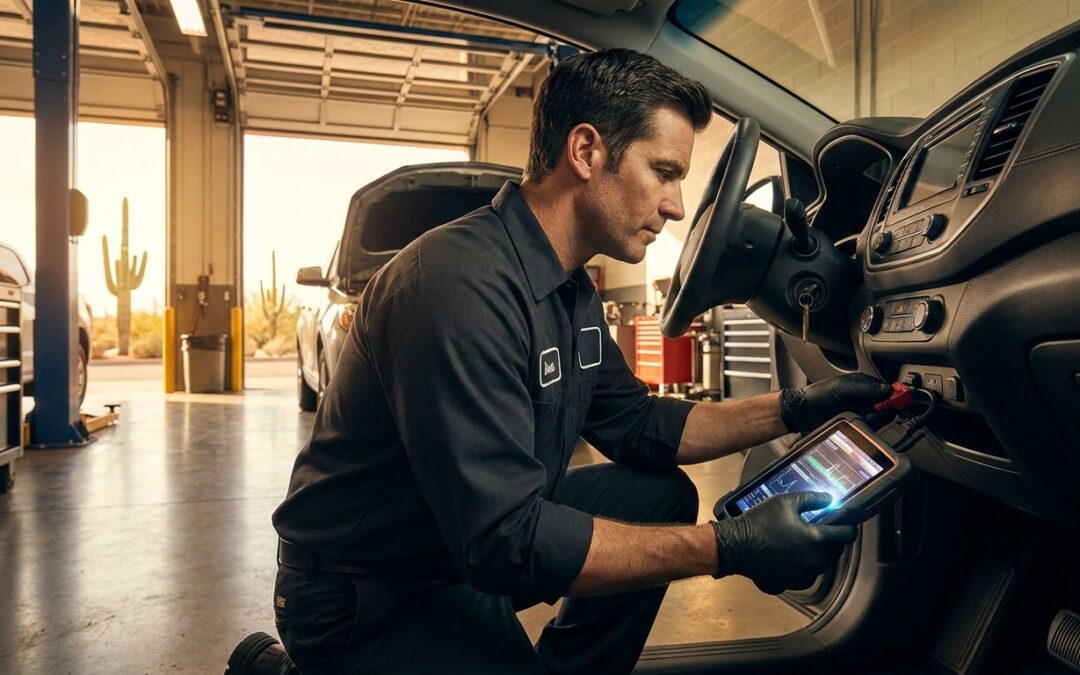
  4. Live data analysis. Engine running, we watch fuel trims, O2 sensor activity, MAF readings, misfire counters, EGR command vs. position. This is where dealer-grade scan tools earn their keep.
  5. Component testing. Smoke machine for EVAP leaks. Multimeter for sensor circuits. Bi-directional commands for solenoids and valves. Real diagnosis, not just guessing.
  6. Written estimate. Itemized parts and labor. We tell you up-front if it’s one fix or multiple. No surprises.
  7. Repair authorization. Your call — we don’t touch the vehicle until you approve.
  8. Repair with quality parts. OEM-spec sensors, EPA-compliant catalytic converters, real EGR valves — not bargain-bin parts that throw codes again in months.
  9. Drive cycle. This is the step almost every shop skips. We drive your vehicle through a properly-engineered drive cycle to set all required readiness monitors.
  10. Pre-test scan. Before you go to the emissions station, we run a final scan and confirm all required monitors are set and no codes are stored or pending.
  11. You pass the re-test on the first try. Or come back and we sort it — we stand behind every emissions repair.
30+
Years passing Mesa drivers through AZ emissions. Network Automotive has been family-owned and ASE-certified since 1995 — the East Valley shop most often recommended for emissions repair.

What Does AZ Emissions Repair Cost in Mesa in 2026?

  • Emissions diagnostic and code scan when you bring us your failure slip: Diagnostic fee applies, quoted upfront
  • Full emissions diagnostic with smoke test and component testing (when the initial scan isn’t conclusive): $120–$220, typically credited toward repair
  • Gas cap replacement (P0455/P0457): $25–$80
  • Single O2 sensor replacement: $220–$520
  • EVAP purge or vent valve: $280–$620
  • EGR valve / DPFE sensor: $320–$1,200
  • Thermostat (P0128): $280–$520
  • Misfire repair (plugs / coils / wires): $220–$900
  • Vacuum leak repair: $120–$600
  • Catalytic converter (P0420 / P0430): $1,200–$3,800
  • Secondary air injection repair (luxury European mostly): $480–$1,800
  • Drive cycle service only (vehicle already repaired, monitors need setting): $80–$140
  • Pre-test scan only before you go to the emissions station: Diagnostic fee applies, quoted upfront

How long does emissions repair take in Mesa?

Most repairs are same-day or next-day. The longest part of the process is often the drive cycle to set readiness monitors — depending on what was fixed, that can take 1–3 days of mixed driving (we either do it for you or guide you through it). Plan on 3–5 days end-to-end from the failed test to the re-test pass.

Pass on the First Re-Test, Not the Third

Most emissions repair customers fail their re-test once or twice before passing — usually because monitors weren’t ready. Network Automotive’s drive-cycle expertise gets you through on the first try.

Schedule My Emissions Repair →

What If You Can’t Afford the Repair?

Arizona has a repair waiver program for low-income drivers who can’t afford emissions repairs. Here’s how it works:

  • Repair cost cap: $200 for 1980 and older, $450 for 1981–1995, $750 for 1996 and newer
  • You must spend the cap amount on emissions-related repair at a licensed AZ emissions repair facility
  • Documentation matters — written estimates and itemized invoices required
  • If repaired and still failing after spending the cap, you can apply for a waiver to register the vehicle anyway
  • One waiver per vehicle every 2 years maximum
  • Network Automotive provides waiver-ready documentation when applicable

This isn’t free registration — you’ll still need to actually spend the repair cap amount, and you’ll need to apply for the waiver through ADEQ. But it’s a real option for drivers in a tight spot.

Why Mesa Drivers Trust Network Automotive for Emissions Repair

  • Family-owned since 1995. Thousands of East Valley emissions repairs through every iteration of the AZ program.
  • Diagnostic fee applies, quoted upfront. Bring us the slip, get a written quote.
  • Dealer-grade scan tools across all major brands. Autel MaxiSYS, Snap-on Zeus, OEM-specific tools.
  • Drive-cycle expertise. Almost no shop in Mesa actually services drive cycles — we do, and it’s why our customers pass on the first try.
  • EPA & CARB-compliant parts. Including catalytic converters.
  • Waiver-ready documentation if you qualify for the AZ repair waiver program.
  • 24-month / 24,000-mile nationwide warranty on parts and labor.
  • Pre-test scan available — bring us your repaired vehicle before re-testing and we’ll confirm readiness.
  • Written estimates up-front. No phone-tag, no “while we were in there.”

Read more on the About Network Automotive page, see the full service menu, or browse Mesa service coupons. Failed with a P0420 / P0430? See our catalytic converter replacement guide. Check engine light caused the failure? See our CEL diagnostic guide.

Proudly Serving Mesa and the Greater East Valley

Network Automotive Service Center handles AZ emissions repair across:

  • Mesa — East Mesa, West Mesa, Las Sendas, Red Mountain, Dobson Ranch, Alta Mesa, downtown corridor
  • Gilbert — Agritopia, Morrison Ranch, Seville, Power Ranch
  • Queen Creek — Cortina, Ironwood Crossing, San Tan Heights
  • Apache Junction — Superstition, Gold Canyon
  • San Tan Valley — via the Queen Creek shop
  • Chandler, Tempe — convenient to our East Mesa shop

Most emissions customers book at our East Mesa shop near Power Road & US-60 — close to the Apache Trail and Country Club emissions stations.

Mesa AZ Emissions Failure Repair FAQ

How much does AZ emissions repair cost in Mesa?

It depends on what failed. Gas cap is $25–$80. EVAP system $280–$620. O2 sensor $220–$520. EGR $320–$1,200. Misfire repair $220–$900. Catalytic converter $1,200–$3,800. Our emissions diagnostic with your failure slip tells you exactly what failed and what it costs before any work is authorized. Call (480) 444-0242.

Why did my vehicle fail emissions if the check engine light isn’t on?

Two most likely reasons: (1) readiness monitors aren’t complete — the OBD-II self-tests need to run before the state computer will pass the vehicle, and they reset every time the battery is disconnected or codes are cleared. (2) Stored or pending codes that haven’t triggered the CEL yet. Both fail an AZ test even with the dashboard light off.

Why does my vehicle keep failing the re-test after the mechanic fixed it?

Almost always because the mechanic cleared the codes too close to the re-test and the readiness monitors haven’t had time to complete. The state needs to see 7–10 monitors all reading “ready” before they’ll pass the vehicle. After a code clear, most vehicles need 50–200 miles of mixed driving over 1–5 days before all monitors set. Network Automotive specifically runs drive cycles as part of the repair process.

How long does it take to pass AZ emissions after a repair?

Most repairs are same-day or next-day. The drive cycle to set readiness monitors typically takes 1–3 days of mixed driving. End-to-end, plan on 3–5 days from failed test to passed re-test if everything goes smoothly. We do a pre-test scan before you go to confirm you’re ready.

Can I clear the check engine light and just drive carefully to pass?

No — this is the #1 reason East Valley drivers fail their re-test. Clearing the CEL resets all readiness monitors to “not ready,” and the state will fail you for incomplete monitors even if the dashboard light is off. The fix is to actually repair the issue, then complete a proper drive cycle so monitors set legitimately.

What is the AZ emissions repair waiver?

Arizona offers a waiver for low-income drivers who can’t afford emissions repairs. Repair cost caps are $200 (pre-1980), $450 (1981–1995), and $750 (1996+). If you’ve spent the cap amount at a licensed AZ emissions repair shop and the vehicle still fails, you can apply for a waiver through ADEQ to register the vehicle. Network Automotive provides waiver-ready documentation when applicable.

Does my hybrid or EV need emissions testing in Arizona?

Pure EVs are exempt. Hybrids vary — most newer hybrids are exempt or partial-exempt, but some older or plug-in hybrid models still need OBD-II testing. Check with ADEQ or your registration renewal notice for your specific vehicle.

Does Network Automotive warranty emissions repairs?

Yes. Every emissions repair is backed by our 24-month / 24,000-mile nationwide warranty on parts and labor at participating NAPA AutoCare shops across the country.

Pass AZ Emissions on the First Re-Test

Failure slip? Bring it to us. Diagnostic, written estimate, real repairs with quality parts, drive-cycle expertise so your monitors set before re-testing. 24-month / 24,000-mile nationwide warranty. Family-owned in Mesa since 1995.

Catalytic Converter Replacement in Mesa, AZ: Theft, Insurance, Costs, and How to Get Back on the Road

Catalytic Converter Replacement in Mesa, AZ: Theft, Insurance, Costs, and How to Get Back on the Road

HomeBlog › Catalytic Converter Replacement Mesa AZ

Catalytic Converter Replacement in Mesa, AZ: Theft, Repair Costs, Insurance, and How to Get Back on the Road Fast

By Network Automotive Service CenterMesa, AZUpdated May 2026

Walked outside and your truck sounds like a Harley? You almost certainly lost a catalytic converter to overnight theft — Arizona ranks among the top three states in the country for cat theft. This is the mechanic-written guide to catalytic converter replacement in Mesa: what was stolen, what it costs to replace, how the insurance claim works, the legal stuff most shops won’t tell you, and how to make sure it doesn’t happen again.

It usually goes like this: you walk out to your driveway in Mesa at 6:30 AM, hit the start button, and the truck roars to life sounding like a tractor. Loud, rough, deafening. You crawl under to look and there’s a clean, bright-cut section of exhaust pipe where the catalytic converter used to be. Or sometimes you didn’t notice for a few days because your car was already a little loud. Either way, your morning just got expensive. If you’ve been Googling “catalytic converter replacement Mesa AZ” from a driveway, a Walmart parking lot, or your insurance agent’s phone tree, this guide walks you through everything that comes next.

At Network Automotive Service Center, we’ve been replacing catalytic converters for East Valley drivers since 1995 — and in the last 4 years specifically, we’ve seen an explosion of theft-related jobs. Arizona ranks among the top three states for catalytic converter theft per capita; Mesa, Gilbert, and Queen Creek are all heavy-volume hotspots. This article explains the real costs in 2026, what insurance does and doesn’t cover, the legal situation in AZ, and how to protect yourself going forward.

$1,800+
Average Mesa catalytic converter replacement cost when stolen. Trucks and SUVs with multiple cats can hit $4,500+. Insurance often covers it minus your deductible — but only if you have comprehensive coverage and file fast.

What Just Happened? Theft vs. Failure

There are two reasons you’re reading this article. They have very different cost ranges and very different processes:

1. Stolen catalytic converter (most common in Mesa)

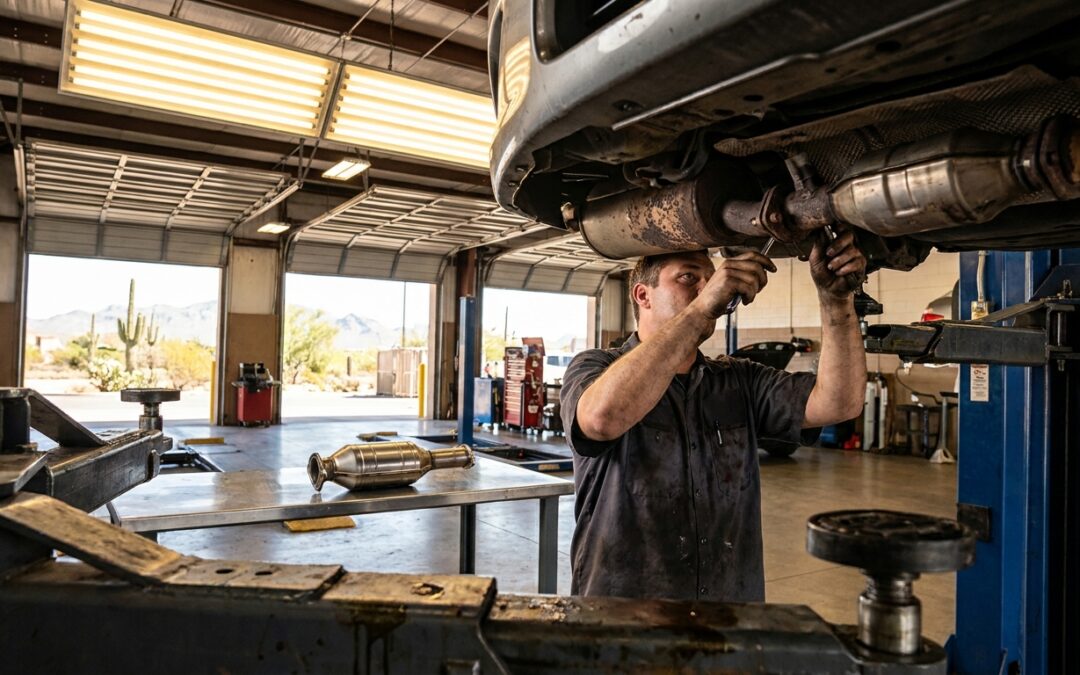
Thieves slide under your vehicle — usually overnight, usually in a quiet driveway or parking lot — and cut the cat out with a reciprocating saw in 60–120 seconds. The cat itself is worth $50–$400 in raw metals (platinum, palladium, rhodium) at a scrap yard, but the damage they leave behind costs you ten times that to repair.

How to tell it was stolen:

  • Vehicle suddenly sounds extremely loud at startup — like a race car or a tractor
  • Visible clean-cut sections of exhaust pipe missing under the vehicle
  • Pieces of cut exhaust pipe possibly left on the ground
  • Check engine light typically comes on (P0420 / P0430 code) within a few miles
  • Sudden loss of fuel economy and power

2. Failed catalytic converter (slow death)

The cat fails internally from age, overheating, contaminated fuel, oil burning, coolant entering the exhaust (head gasket), or simply having lived too long. The vehicle stays quiet but throws a check engine light, fails AZ emissions, loses power, and gets bad MPG.

How to tell it failed naturally:

  • Check engine light with P0420 (Bank 1) or P0430 (Bank 2) — catalyst efficiency below threshold
  • Failed AZ emissions test
  • Rotten egg smell from the exhaust
  • Sluggish acceleration, especially on hills
  • Vehicle volume sounds normal (cat is still physically there, just not working)

Free Mesa Catalytic Converter Assessment

Bring your vehicle in — we’ll confirm whether it’s theft or failure, give you a written estimate, document everything for your insurance claim, and walk you through what happens next. No charge.

Book My Free Assessment →

What Does Catalytic Converter Replacement Cost in Mesa in 2026?

Real Mesa numbers. The wide range is because some vehicles have one cat, some have two, some have four (V8 with downstream cats), and emissions-compliant cats vary enormously in cost by make and model:

Vehicle Type Cats Stolen / Needed Mesa Replacement Cost
Compact car (Civic, Corolla, Camry) 1 cat $1,200–$2,200
Mid-size sedan / crossover 1–2 cats $1,500–$2,800
Most full-size SUVs (Tahoe, Suburban) 2 cats $2,400–$3,800
Pickup trucks (F-150, Silverado, RAM 1500) 2 cats $2,200–$4,200
Heavy-duty trucks (F-250/350, RAM 2500/3500) 1–2 cats + diesel DPF $2,800–$5,500
Hybrid vehicles (Prius is a #1 theft target) 1 cat (expensive OEM) $2,500–$3,800
Toyota Tacoma / 4Runner (top theft targets) 2 cats $2,400–$3,800
European luxury (BMW, Mercedes, Audi) 2–4 cats $3,200–$6,500

Add to that any related exhaust components the thief damaged on the way out: O2 sensors ($180–$420 each), flex pipes, oxygen sensor wiring, exhaust hangers, and sometimes heat shields. Most theft jobs also include a 4-wheel alignment check because the thief usually jacks the vehicle at a non-jacking point.

Aftermarket vs. OEM Catalytic Converters in Arizona

This is where shops get sketchy. Aftermarket catalytic converters are not all legal in Arizona. Here’s the breakdown:

  • OEM (factory) cats — always legal, always pass AZ emissions, always the most expensive ($800–$2,500 each)
  • EPA-compliant aftermarket cats — legal in 47 states (NOT California, NOT Colorado, NOT New York). Acceptable in AZ.
  • CARB-compliant aftermarket cats — legal everywhere, slightly more expensive than EPA, often the smart middle ground if your vehicle is newer or higher-mileage
  • “Universal” cats — the cheapest option but often won’t pass AZ emissions long-term, may trigger P0420 codes within months. Avoid for daily drivers.

Always ask which type of catalytic converter a shop is quoting you. The price difference between universal ($150) and OEM-equivalent EPA-compliant ($600–$900) is enormous, but so is the difference in how long it lasts and whether your car passes emissions next year.

Insurance Claims for Stolen Catalytic Converters in Mesa

If you have comprehensive coverage on your auto insurance, catalytic converter theft is usually covered — minus your deductible. If you have liability-only coverage, it’s not.

Here’s how the claim process typically works in Mesa:

  1. File a police report immediately. Most insurance companies require it. Mesa PD non-emergency: (480) 644-2211. Some companies will let you file online if you can’t get to the precinct.
  2. Photograph the damage. Take multiple photos from underneath showing the cut exhaust ends, the missing cat section, and any tire/jacking marks.
  3. Call your insurance company. File the claim. Get a claim number.
  4. Tow to a shop (or drive carefully). Most insurers prefer their preferred shop network — but you have the right to choose any shop in Arizona. Network Automotive accepts most insurance work directly.
  5. Shop provides written estimate. Including parts, labor, alignment if needed, and any related damaged components.
  6. Insurance adjuster reviews. Sometimes in person, sometimes via photos. They may push back on aftermarket vs. OEM — you can usually request OEM if you want it.
  7. Repair authorized. Insurance pays the shop directly minus your deductible (typically $500–$1,000).
  8. You pay deductible at pickup. Many drivers walk out paying only $500–$1,000 out of pocket on a $3,000+ repair.

Mesa insurance tip: You are NOT required to use your insurance company’s preferred shop. Arizona law gives you the right to choose any licensed shop. If your insurer pushes you toward a shop you don’t want, you can decline. Network Automotive works directly with all major Arizona insurers and handles the paperwork on your behalf.

  • Federally illegal: driving without a catalytic converter on a road vehicle violates the Clean Air Act. Maximum federal fine is $2,500 per occurrence.
  • Arizona-level: ARS § 49-571.01 and emissions requirements apply — vehicle cannot legally pass AZ emissions without functioning cats
  • Enforcement reality: short-term enforcement of catless driving is rare. DPS won’t pull you over for being loud, but a major traffic stop can result in a citation
  • Insurance reality: if you have a wreck while driving without a cat, your liability claim may be compromised
  • Registration reality: the moment you need to renew registration, AZ emissions will fail you. You cannot register a vehicle without cats.

Bottom line: you can drive briefly to a shop, but driving for weeks without a cat is a real legal and registration risk in Arizona.

Stolen Cat? Insurance? We Handle Both.

Network Automotive Mesa: free written assessment for your insurance claim, direct billing to most carriers, EPA/CARB-compliant cats in stock for most vehicles, 24-month / 24,000-mile nationwide warranty. Same-week service in most cases.

Schedule My Cat Replacement →

Which Vehicles Are Most Targeted in Mesa?

Thieves target vehicles where the cat sits high (easy access), contains more precious metal, and the vehicle is commonly found unattended. The Mesa hit list:

  1. Toyota Prius — #1 nationally and in AZ. Contains roughly 2x the precious metals of most cats. Cat replacement is expensive ($2,500–$3,800).
  2. Toyota Tacoma & 4Runner — high ground clearance, two cats, common in Mesa.
  3. Honda Element & CR-V — same as above.
  4. Ford F-150 / F-250 / F-350 — lifted trucks are especially easy access.
  5. Chevy / GMC pickups (Silverado, Sierra, Tahoe, Suburban) — same.
  6. Box trucks, work vans, U-Haul-style commercial vehicles — high clearance, often parked overnight, contractors and fleet vehicles.
  7. Mitsubishi Outlander, Subaru Forester / Outback — mid-volume targets.

How Network Automotive Replaces a Catalytic Converter in Mesa

  1. Initial assessment. Photographic inspection of damage, confirm theft vs. failure, check for collateral damage (O2 sensors, wiring, hangers, flex pipe, heat shields).
  2. Code scan. Pull stored and pending codes. Verify other systems weren’t affected.
  3. Written estimate. Itemized parts and labor, including EPA-compliant vs. OEM options. Insurance-friendly format.
  4. Insurance coordination. If you’re filing a claim, we coordinate directly with the adjuster, including photos, parts numbers, and labor breakdowns.
  5. Parts ordering. Most common applications in stock or available same-day to next-day from regional warehouse.
  6. Installation. Removal of damaged components, fabrication and welding where needed, new gaskets, new hangers, new O2 sensors if damaged or recommended.
  7. Anti-theft cage / shield installation if requested — we offer aftermarket cat shields that add a significant theft deterrent.
  8. Code reset and emissions readiness drive cycle. Critical for AZ emissions — readiness monitors must reset before you take it to the test station.
  9. Verification road test. Confirm no leaks, no codes, normal engine performance.
30+
Years serving Mesa. Network Automotive has been family-owned and ASE-certified since 1995 — one of the East Valley’s most experienced shops on catalytic converter and emissions work.

How to Prevent Catalytic Converter Theft in Mesa

  • Park in a garage when possible. The single biggest deterrent. Cat thieves don’t hit garaged vehicles.
  • Park in well-lit areas with foot traffic. Driveway with motion lighting, parking lot near building entrances, near security cameras.
  • Install a catalytic converter shield / cage. Aftermarket cages from MillerCAT, CatStrap, or vehicle-specific manufacturers. We install them in Mesa. Adds 5–15 minutes to a thief’s job — usually enough to send them elsewhere.
  • Get your VIN etched on the cat. Some Mesa PD events and Network Automotive offer cat-etching services. Stolen etched cats are useless to scrap yards that comply with state law.
  • Add a car alarm with tilt sensor. Detects the vehicle being jacked up.
  • Park nose-first into your garage or against a wall. Makes it harder for thieves to access from underneath.
  • Use a steel cable lock running through the exhaust system — cheap deterrent
  • For Prius, Tacoma, and 4Runner owners: seriously consider a cat shield. Your vehicle is on every Mesa theft hot list.

Why Mesa Drivers Trust Network Automotive for Catalytic Converter Work

  • Family-owned since 1995. Three decades of East Valley emissions and exhaust work.
  • Free assessment with written insurance-ready estimate. No charge whether you proceed or shop around.
  • Direct insurance billing for most major carriers (State Farm, Geico, Progressive, Allstate, USAA, Farmers, etc.).
  • EPA & CARB-compliant cats in stock for most common applications.
  • OEM cats available when you want them — we don’t push the cheapest option.
  • Cat shield installation for theft-target vehicles — ask about it.
  • 24-month / 24,000-mile nationwide warranty on parts and labor.
  • Emissions readiness drive-cycle expertise so your vehicle passes AZ emissions on the first try.
  • Same-week service on most replacement jobs.

Read more on the About Network Automotive page, see the full service menu, or browse current Mesa service coupons. Stored a P0420 code along with the noise? See our check engine light diagnostic guide.

Proudly Serving Mesa and the Greater East Valley

Network Automotive Service Center handles catalytic converter replacement and theft repair across:

  • Mesa — East Mesa, West Mesa, Las Sendas, Red Mountain, Dobson Ranch, Alta Mesa, downtown corridor
  • Gilbert — Agritopia, Morrison Ranch, Seville, Power Ranch
  • Queen Creek — Cortina, Ironwood Crossing, San Tan Heights
  • Apache Junction — Superstition, Gold Canyon
  • San Tan Valley — via the Queen Creek shop
  • Prescott — Prescott Valley and surrounding

Most Mesa customers book at our East Mesa shop near Power Road & US-60 — fastest in-and-out for catalytic converter work and emissions readiness drive cycles.

Mesa Catalytic Converter Replacement FAQ

How much does catalytic converter replacement cost in Mesa?

It depends on the vehicle and how many cats were stolen or failed. Compact cars typically run $1,200–$2,200. Mid-size sedans and crossovers $1,500–$2,800. Most pickups $2,200–$4,200. HD diesel trucks $2,800–$5,500. Prius and Toyota Tacoma (top theft targets) $2,400–$3,800. Add $180–$420 for each damaged O2 sensor. Free assessment with insurance-ready written estimate at Network Automotive. Call (480) 444-0242.

Will my insurance cover catalytic converter theft in Arizona?

If you have comprehensive coverage, yes — minus your deductible (typically $500–$1,000). If you have liability-only, no. File a police report first (Mesa PD non-emergency: 480-644-2211), photograph the damage, then call your insurance company. Network Automotive handles direct billing with most major carriers and provides insurance-ready written estimates at no charge.

Is it illegal to drive without a catalytic converter in Arizona?

Yes — both federally (Clean Air Act, up to $2,500 fine per occurrence) and at the state level for emissions compliance. Short-term enforcement (a traffic stop just because you’re loud) is rare, but you cannot pass AZ emissions or register the vehicle without cats. Drive directly to a shop — do not drive long-term.

How long does catalytic converter replacement take in Mesa?

Most replacements take 2–4 hours of actual shop time. Including parts ordering (when not in stock), insurance authorization, and emissions readiness drive cycle, most customers are back on the road within 2–5 business days. Same-week service is typical at Network Automotive for common applications.

OEM, EPA-compliant, or universal catalytic converter — what should I choose?

For an Arizona daily driver, EPA-compliant aftermarket is the smart middle ground — legal in AZ, will pass emissions, lasts the life of the vehicle, costs significantly less than OEM. Insurance often covers OEM if you request it. Avoid “universal” cats — they’re the cheapest but often fail AZ emissions within months and trigger P0420 codes.

How can I prevent catalytic converter theft in Mesa?

Park in a garage when possible (single biggest deterrent). If you can’t, install a cat shield or cage — aftermarket steel cages add 5–15 minutes to a thief’s job and they typically move on to an easier target. Park in well-lit areas with cameras. Etch your VIN on the cat. Get a tilt-sensor car alarm. For Prius, Tacoma, and 4Runner owners specifically, install a cat shield — your vehicle is on every theft hot list.

What’s the difference between a stolen cat and a failed cat?

A stolen cat = vehicle suddenly extremely loud, visible cut exhaust pipe under the vehicle, sometimes pieces left on the ground. A failed cat = vehicle sounds normal, check engine light with P0420 or P0430 code, failed AZ emissions, rotten egg smell, sluggish acceleration. Both cost similar to replace, but the insurance and process are completely different.

Does Network Automotive warranty catalytic converter work?

Yes. Every catalytic converter replacement is backed by a 24-month / 24,000-mile nationwide warranty on parts and labor at participating NAPA AutoCare shops across the country.

Lost a Cat to Theft? We’ll Handle Everything.

Free insurance-ready assessment, direct billing with most carriers, EPA/CARB-compliant cats in stock, cat shield installation, 24-month / 24,000-mile nationwide warranty. Family-owned in Mesa since 1995.

Network Automotive Service Center
Privacy Overview

This website uses cookies so that we can provide you with the best user experience possible. Cookie information is stored in your browser and performs functions such as recognising you when you return to our website and helping our team to understand which sections of the website you find most interesting and useful.