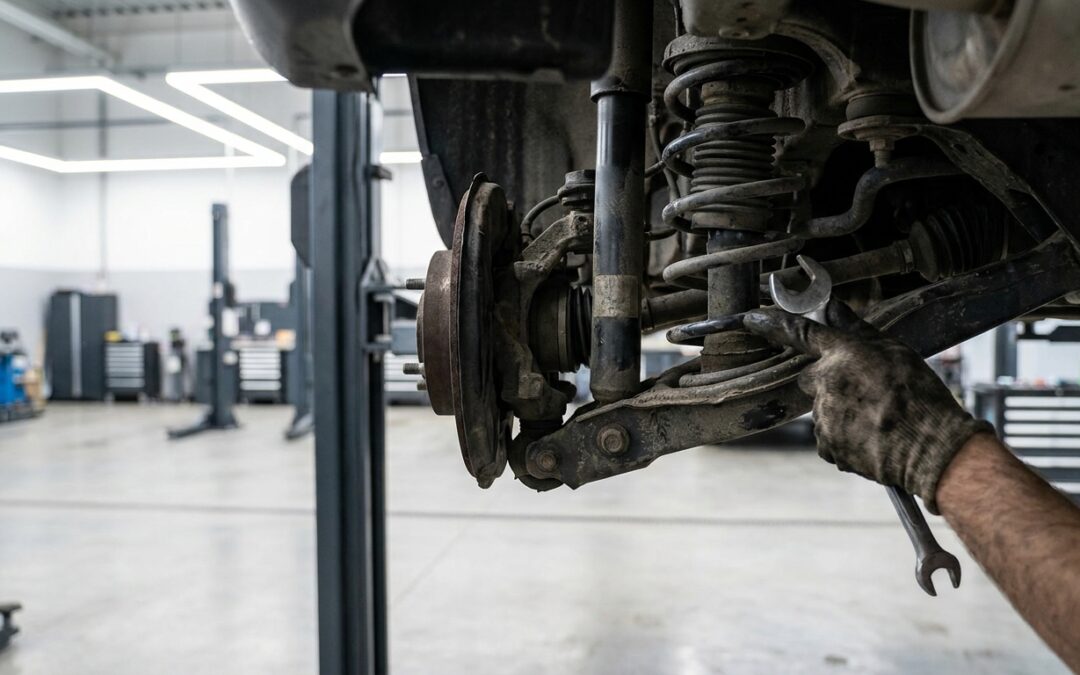
Don’t Overpay for Suspension Repair Gilbert AZ (2026 Prices)

Don’t Overpay for Suspension Repair Gilbert AZ (2026 Prices)

HomeBlog › Suspension Repair Gilbert AZ

Suspension Repair Gilbert AZ: Signs, Causes & Honest Fixes

By Network Automotive Service CenterGilbert, AZUpdated August 2026

If your Gilbert commute has turned into a bouncy, clunking, nose-diving mess, you need suspension repair Gilbert AZ drivers can actually trust — here’s what’s wrong, what it costs, and how to fix it right the first time.

Every pothole on Val Vista, every speed bump in a Gilbert neighborhood parking lot, every hard stop at Greenfield and Warner — your suspension absorbs all of it, thousands of times a year. When shocks, struts, control arms, or bushings wear out, you don’t just lose comfort. You lose braking distance, steering precision, and tire life. Suspension repair Gilbert AZ drivers search for usually starts the same way: a bounce that won’t settle, a clunk over bumps, or a car that dips hard under braking. None of those are cosmetic problems. They’re safety problems, and in a town where 105-degree asphalt and sun-baked rubber bushings are a daily reality, they get worse fast if ignored.

Most drivers don’t think about their suspension until it’s already loud, sloppy, or visibly leaking. That’s a mistake, because suspension wear rarely happens all at once. It creeps in over tens of thousands of miles as rubber bushings dry out, seals weep a little fluid at a time, and ball joints develop just enough play to change how the car handles a lane change on the 202 or a quick stop behind a school bus on Val Vista Drive. By the time you notice the bounce or the clunk, the components involved have usually been degrading for months. The good news is that suspension problems are almost always fixable without replacing the whole system — a proper inspection tells you which corner, which part, and how urgent it actually is, instead of leaving you to guess or pay for parts that were never the problem.

50%
Braking distance can increase by up to 50% on worn shocks and struts, according to independent suspension industry testing — that’s the difference between stopping short of a crosswalk on Baseline Road and not stopping in time.

What Suspension Repair Actually Means

Suspension repair Gilbert AZ shops handle isn’t one part — it’s a system. Your vehicle’s suspension is the network of shocks or struts, springs, control arms, bushings, sway bar links, and ball joints that keeps the tires planted on the road and the cabin isolated from every crack and expansion joint on the 202 or Elliot Road. When any one of those components wears out, the whole system compensates poorly: the ride gets harsh or floaty, the car pulls or wanders, and your tires start wearing unevenly because the suspension geometry is no longer holding them where the engineers intended.

In Gilbert specifically, two things accelerate suspension wear faster than in cooler climates. First, the heat. Rubber bushings and boots dry out and crack years earlier under constant 100°F-plus summers than they would in a temperate state, and a cracked boot lets grit into a ball joint or tie rod that’s supposed to stay sealed. Second, the mix of smooth arterial roads (Gilbert Road, Higley) and rougher residential stretches means suspension components take repeated small hits that add up quietly, so a lot of drivers don’t notice the wear until it’s advanced. Proper suspension repair Gilbert AZ drivers can rely on starts with an inspection that identifies exactly which component or components are failing, not a guess.

It also matters how a car is driven day to day. A vehicle that mostly sees smooth commuter miles on Val Vista or the 202 will wear its suspension differently than one that regularly hauls a trailer, hits speed bumps in retail parking lots at full speed, or gets driven on the rougher, less-maintained stretches near construction zones as Gilbert continues to grow. None of that means you’re doing anything wrong — it just means the right inspection interval and the right repair plan depends on your specific car and how you actually use it, not a generic mileage chart pulled from a manual.

Free Suspension Inspection

Bouncing, clunking, or pulling to one side? We’ll put your car on the lift, check every shock, strut, and bushing, and tell you exactly what’s worn — no guesswork, no upsell.

Get My Free Inspection

Common Causes & How It Works

Most suspension repair Gilbert AZ jobs trace back to one of a handful of causes: age and mileage (shocks and struts are wear items, typically good for 50,000–70,000 miles), heat-accelerated rubber degradation, pothole or curb impact damage, and leaking seals that let hydraulic fluid escape a shock or strut so it can no longer dampen movement. Here’s how the most common failure points compare:

Component What It Does Typical Warning Sign
Shocks / Struts Dampen bounce after bumps, control body roll Bouncy ride, nose dives under braking, visible fluid leak
Control Arms & Bushings Connect wheel assembly to frame, allow controlled movement Clunking over bumps, vague or loose steering
Ball Joints Pivot point letting wheels turn and suspension move Clunking when turning, uneven tire wear, steering wander
Sway Bar Links Reduce body lean in corners Rattling or knocking on rough roads, especially turning
Coil Springs Support vehicle weight, absorb major impacts Car sits noticeably lower on one corner, harsh ride

A worn shock rarely fails alone for long. Once one corner starts bouncing instead of absorbing, the tire on that corner loses consistent contact with the road, which accelerates uneven tread wear and can throw off your alignment. That’s why a good diagnostic doesn’t stop at “yep, it’s the shocks” — it checks the whole chain so you’re not back in the shop three months later for the bushing that was already going bad next door.

Before we ever recommend suspension repair Gilbert AZ customers should pay for, we let tire wear patterns tell a lot of this story. Feathering across the tread often points to a toe alignment issue that’s frequently tied to a worn tie rod or control arm bushing. Wear concentrated on the inside or outside edge of one tire, but not its opposite-side match, usually means that corner’s suspension geometry has shifted from a worn or damaged component. Cupping, a scalloped wear pattern around the tire, is a classic sign of a shock or strut that’s no longer damping properly. None of these are things you have to diagnose yourself, but if you’ve noticed odd wear on one or two tires, mention it when you call — it helps us know where to look first.

Bounce test at home: Push down firmly on one corner of your car and let go. A healthy shock or strut lets the car settle back to level in one bounce. If that corner keeps bobbing up and down two or three times before it settles, that shock or strut is worn and it’s time to get it inspected properly.

Our Process

We built our suspension repair Gilbert AZ diagnostic around the same logic every time, so you get a consistent, honest answer whether your car is bouncing, clunking, or pulling. Here’s exactly what happens when you bring your car in:

  1. Road test & intake. We ask what you’re feeling — bounce, clunk, pull, dive — and where it happens, then take a short test drive to confirm it.
  2. Lift inspection. Every shock, strut, bushing, ball joint, sway bar link, and spring gets a hands-on check for play, leaks, cracks, and corrosion.
  3. Bounce test & leak check. We push each corner of the car to see how it recovers, and check every shock and strut body for fluid weeping.
  4. Tire wear pattern review. Uneven wear tells us which corner is compensating and often points straight to the failing component.
  5. Written estimate, no surprises. You get a plain-language breakdown of what’s worn, what’s still good, and what it costs before we touch anything.
  6. Repair with quality parts. We replace only what’s actually failed, in pairs where the manufacturer recommends it for even handling.
  7. Alignment check. Suspension work changes ride geometry — we verify (and correct if needed) so your new parts wear evenly.
  8. Final road test. We confirm the bounce, clunk, or pull is gone before you drive off.

Cost & Time

Suspension repair Gilbert AZ cost depends entirely on which components are worn and how many corners are affected. A single strut replacement is a different job than a full set of control arms. What we can tell you without seeing your car: most single-component jobs (one pair of shocks or struts, one set of sway bar links) are done same-day, and we’ll never recommend replacing parts that test out as still good.

A few factors that move the number one way or the other: how many corners of the car need work, whether the part is a common stock item we already stock versus something that has to be sourced for a less common model, and whether the job also needs a post-repair alignment. We factor all of that into a single written estimate, so what you approve is what you pay — no add-on surprises once the car is already on the lift. If a technician finds something else worn while they’re in there, like a boot that’s cracked but not yet leaking, we’ll show it to you and let you decide whether to handle it now or keep an eye on it, rather than adding it to the bill without asking.

  • Most shock or strut pairs: same-day service, typically 2–3 hours on the lift
  • Control arm or ball joint replacement: usually same-day, occasionally next-day if a part has to be sourced
  • Free written estimate before any suspension repair Gilbert AZ work begins — you approve the price first
  • Only worn components replaced — we show you the old part
  • Post-repair alignment check included in the estimate when suspension geometry is affected

Get an Honest Suspension Estimate

Tell us what your car is doing and we’ll give you a real, written estimate — not a ballpark guess over the phone.

Request My Estimate

When Is It Urgent?

Some suspension repair Gilbert AZ symptoms can wait a week or two for an appointment. Others mean you shouldn’t be driving the car until it’s inspected. The difference usually comes down to whether the symptom is affecting your ability to steer or stop, versus just how comfortable the ride feels. A slightly bouncier ride on the highway can typically wait for a scheduled appointment. A loud clunk on every single bump, a corner that’s visibly lower than the rest, or steering that feels loose in your hands should not wait.

  • Loud clunk or bang over every bump, not just occasional ones
  • Visible fluid leaking or weeping down a shock or strut body
  • Car sits noticeably lower on one corner than the others
  • Steering feels loose, vague, or wanders on the highway
  • Excessive nose-dive or hard braking distance increase
  • Clunking specifically when turning the wheel (often a ball joint or sway bar link)
Arizona heat warning: Rubber bushings, boots, and seals degrade significantly faster under sustained 100°F-plus heat and constant UV exposure than in milder climates. A bushing or boot that would last years in a cooler state can crack and let contamination into a joint within a much shorter window here. If your car is over 60,000 miles and you haven’t had suspension components inspected, get it checked before the next monsoon season’s rough, flooded roads stress already-brittle parts.

What To Do Right Now

You don’t need to diagnose the exact part yourself before calling us for suspension repair Gilbert AZ — that’s what the inspection is for. But a few minutes of paying attention to how the car is actually behaving will help us get you the right answer faster and gives you a baseline to compare against once the repair is done.

  1. Note exactly what you’re feeling (bounce, clunk, pull, dive) and when it happens (over bumps, turning, braking).
  2. Check for visibly uneven tire wear on one or more corners, which often points to the affected component.
  3. Avoid ignoring a clunk that gets louder or more frequent — that’s a component getting closer to failure, not settling in.
  4. Call or book a free inspection so we can put the car on a lift and confirm before you spend a dollar.
  5. Get a written estimate before any repair so there are no surprises.

Why Choose Network Automotive

Suspension repair Gilbert AZ work is one of those repairs where trust matters as much as the wrench turning. It’s easy for a shop to tell you that you need four new struts, two control arms, and a sway bar kit when really you needed one part. We show you the worn component on the lift before we recommend replacing it, and we explain in plain language why it matters for how your car drives and stops — not just that it “should probably be replaced.”

  • Free, honest inspection — we show you the worn part, not just tell you about it
  • We only replace what’s actually failed, confirmed on the lift
  • Same-day suspension repair Gilbert AZ service on most single-component jobs
  • Local Gilbert-area shop that also handles your full range of auto repair services, so your suspension fix doesn’t mean a second stop somewhere else
  • Read more about our team and approach on our About page
  • Check current service coupons before you book

Service Area

We provide suspension repair Gilbert AZ drivers trust, plus service across the surrounding East Valley. Whether you’re commuting from Power Ranch down Higley every morning, running errands around the Heritage District, or driving in from a neighboring city for the day, our shop is an easy stop for a suspension inspection without derailing your whole schedule. We serve:

  • Downtown Gilbert & Heritage District
  • Val Vista Lakes & Val Vista Classic
  • Power Ranch & Higley area
  • Seville & Cortina neighborhoods
  • Mesa
  • Chandler
  • Queen Creek
  • Apache Junction

Gilbert Suspension Repair FAQ

How do I know if I need suspension repair Gilbert AZ drivers rely on?

The clearest signs are a bouncy ride that doesn’t settle after a bump, clunking noises over rough pavement or when turning, the car pulling to one side, or noticeably harder braking with more nose-dive than usual. Uneven tire wear is another strong indicator. If you’re feeling any of these, a free inspection on the lift will confirm exactly which component is worn.

How much does suspension repair Gilbert AZ cost?

Cost depends on which parts need replacing and how many corners are affected — a single strut job is priced differently than a full control arm or ball joint replacement. We give a free, written estimate after inspecting your specific vehicle so you know the real number before agreeing to any work.

Do worn shocks or struts actually affect braking?

Yes. Shocks and struts keep your tires in consistent contact with the road under braking. When they’re worn, the car dives forward and the tires can momentarily lose optimal grip, which extends stopping distance. This is one of the most overlooked safety issues tied to suspension wear.

Why does Arizona heat cause suspension problems faster?

Rubber bushings, boots, and seals break down faster under constant high heat and UV exposure than they do in cooler climates. Cracked bushings and boots let dirt and moisture into joints that are supposed to stay sealed, accelerating wear on ball joints, control arm bushings, and sway bar links.

Can I just replace one shock or strut instead of the pair?

We generally recommend replacing shocks or struts in pairs (both fronts or both rears together) because mismatched damping side-to-side can cause uneven handling and accelerated wear on the new part. We’ll always explain the reasoning for your specific vehicle before you decide.

Will suspension repair fix my car pulling to one side?

It can, if the pull is caused by a worn component like a control arm bushing, ball joint, or uneven spring sag. However, pulling can also be caused by alignment or tire issues alone, or by uneven tire pressure. Our inspection checks all three so we fix the actual cause instead of guessing and charging you for a part that was never the problem.

Does Network Automotive work on all makes and models in Gilbert?

Yes. We service suspension systems on domestic and import cars, trucks, and SUVs, from daily commuter sedans to work trucks that see rougher roads. If you’re not sure whether we can handle your specific make and model, give us a call and we’ll let you know before you drive over.

How long does suspension repair Gilbert AZ take?

Most single-component jobs, like a pair of shocks or struts, are completed same-day, typically within a few hours on the lift. More involved jobs, such as multiple control arms or a part that needs to be sourced, may take until the next day. We’ll give you a realistic timeline with your estimate.

Is a clunking noise over bumps always a suspension problem?

Clunking is most often a suspension or steering component — a worn bushing, ball joint, sway bar link, or strut mount — but it can occasionally come from exhaust hangers or other underbody parts. A lift inspection isolates the exact source instead of leaving you guessing.

Stop Driving on Worn Suspension

A free inspection tells you exactly what’s worn and what it costs to fix — no pressure, no guessing. Book your suspension check today.
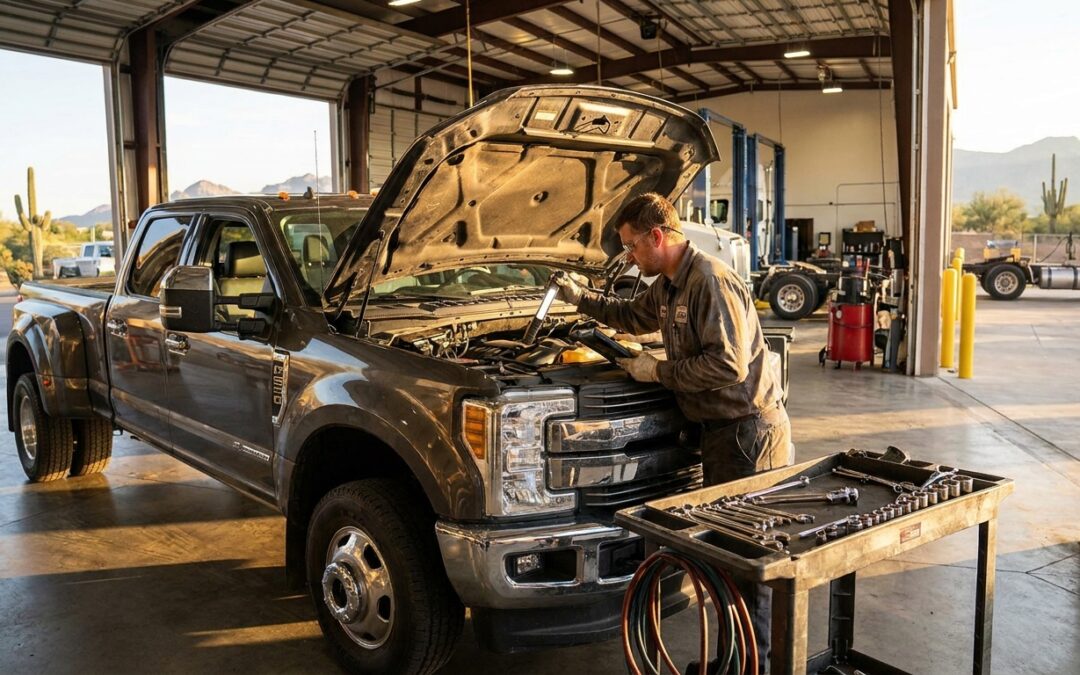
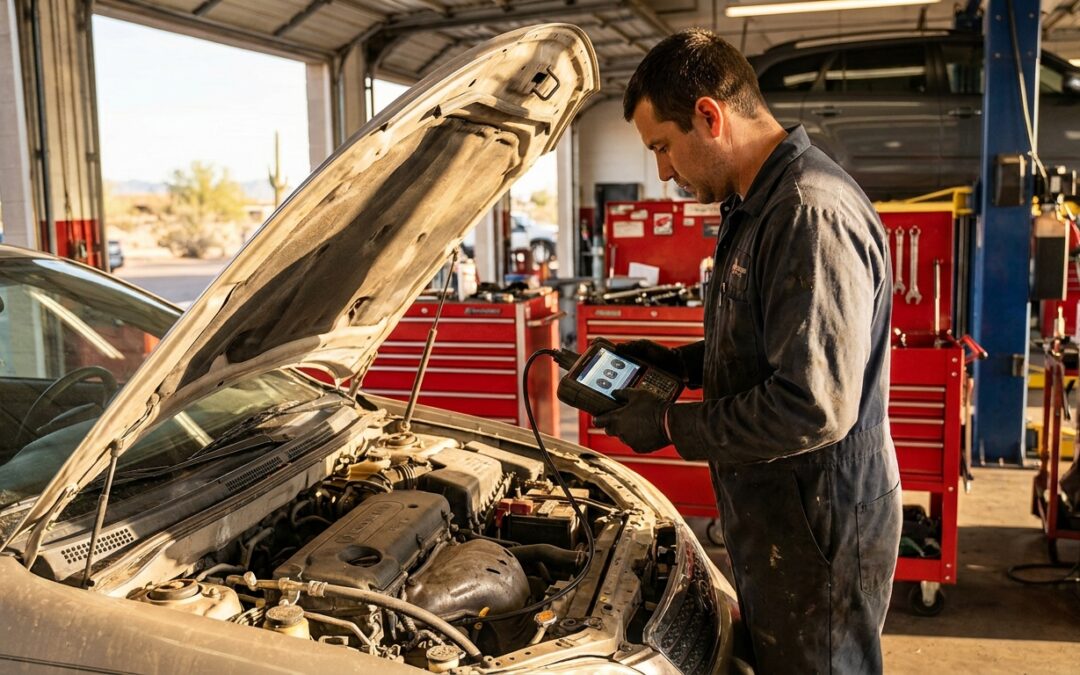
Diesel Repair Prescott AZ: 5 Warning Signs (Don’t Wait) 2026

Diesel Repair Prescott AZ: 5 Warning Signs (Don’t Wait) 2026

HomeBlog › Diesel Repair Prescott AZ

Diesel Repair Prescott AZ: 5 Warning Signs You Shouldn’t Ignore (2026)

By Network Automotive Service CenterPrescott, AZUpdated August 2026

Hard start on a cold high-country morning, black smoke on the grades, or a check engine light that won’t clear? Here’s the honest, mechanic-written guide to diesel repair Prescott AZ truck owners actually search for — real warning signs, real 2026 costs, and what to do right now.

You’re climbing out of the Prescott Valley on Highway 69 with a trailer behind you when it starts — a rough idle, a puff of black smoke under load, or a dash light that wasn’t there yesterday. Or maybe it’s 34°F at 6 a.m. and your truck cranks and cranks before it finally catches. If you’re searching “diesel repair Prescott AZ” right now because something feels off, this guide is for you.

At Network Automotive Service Center, we’ve been repairing diesel trucks for East Valley and high-country drivers since 1995 — Power Stroke, Cummins, and Duramax alike. Prescott-area customers bring us everything from daily-driver work trucks to rigs that haul horse trailers up Iron Springs Road every week, and diesel systems in this part of Arizona take a different kind of beating than they do down in the valley. This article walks through exactly what causes the most common diesel problems at elevation, what diesel repair Prescott AZ actually costs in 2026, how to tell a routine service from a genuine emergency, and what our technicians do when your truck is on the lift.

5,400
feet of elevation in Prescott means colder mornings, thinner air, and more sustained load on turbos, glow plugs, and fuel systems than the same truck sees running flat pavement in Phoenix or Mesa.

What’s Happening to Your Diesel

Modern diesel engines are built to handle heavy loads and long hauls better than almost any gas engine on the road — but they’re also more sensitive to a handful of specific stressors, and Prescott’s driving environment hits several of them at once. Cold mornings make glow plugs and fuel systems work harder just to get the engine started. Long climbs on grades like Highway 69, Iron Springs Road, and the run up toward Yarnell push turbochargers, EGR systems, and diesel particulate filters (DPF) into sustained high-load conditions that flat-valley commuting rarely produces. And a lot of Prescott-area diesels are working trucks — hauling trailers, hay, or construction gear — which multiplies fuel system and injector wear compared to a truck that only ever drives empty.

None of that means your truck is falling apart. It means diesel repair Prescott AZ follows a different maintenance curve than it does for the same truck in a flatland climate, and catching the early warning signs saves real money later.

The 5 Warning Signs You Shouldn’t Ignore

  • Hard or extended cranking on cold mornings: Usually points to weak glow plugs, a failing glow plug relay, or fuel starting to thicken in cold temperatures.
  • Black or gray smoke under acceleration: Often a sign of a dirty EGR valve, a failing turbo, or injectors delivering too much fuel for the air available.
  • Loss of power on grades: A truck that used to pull Highway 69 fine and now bogs on the same climb is telling you something — commonly a clogged fuel filter, boost leak, or failing turbo.
  • Check engine or “wrench” light with rough idle: Diesel-specific codes for EGR, DPF, injector balance, or DEF systems need a real diagnostic, not a guess.
  • Fuel smell or visible leak near the tank or filter housing: Diesel fuel system leaks can worsen quickly and are a fire and drivability risk — don’t wait on this one.

Prescott drivers, remember: if you regularly haul trailers up Iron Springs Road or run the Highway 69 grade daily, get your fuel filters and glow plugs checked on a tighter interval than the factory schedule assumes. Sustained climbs and cold starts age diesel components faster than mileage alone suggests.

Diesel Diagnostic Scan

We’ll pull your codes, check glow plug and fuel system performance, and give you a straight answer — no pressure, no upsell.

Book My Diagnostic →

Common Causes & How Diesel Systems Work

A diesel engine doesn’t use spark plugs to ignite fuel — it relies on high compression to heat the air enough that injected fuel ignites on its own. That makes diesel engines more durable under load, but it also means fuel quality, injector precision, and air delivery (turbo boost, EGR, DPF) all have to work together perfectly. When one part of that system drifts out of spec, the others compensate until they can’t anymore — which is why diesel problems often show up gradually as reduced power or rough idle before they show up as a full breakdown.

System What It Does Common Prescott-Area Failure
Glow Plugs Preheat cylinders for cold starts Slow starts on sub-40°F mornings; failed relay
Fuel Filter / Water Separator Removes water and debris from diesel fuel Clogging from condensation during cold nights
Turbocharger Forces extra air into cylinders for power Boost leaks and bearing wear from sustained grade climbs
EGR / DPF Recirculates exhaust, traps soot for emissions Clogging from short trips and low-load city driving
Fuel Injectors Deliver precise, high-pressure fuel spray Wear from fuel quality and high mileage towing

The most common mistake we see is a driver — or a shop — treating a symptom instead of the system. Clearing a DPF code without finding out why the filter clogged just means it clogs again in a few thousand miles. A proper diesel repair Prescott AZ job traces the symptom back to the actual cause before any parts get replaced.

Turbochargers deserve a special mention here, because they’re one of the parts most affected by Prescott’s combination of elevation and grade. Thinner air at 5,400 feet means the turbo has to spin harder to force the same amount of air into the cylinders that it would at sea level, and a long, sustained climb like the run up Highway 69 keeps that turbo working at high boost for minutes at a time instead of the short bursts a flat-city commute produces. Over years of towing and climbing, that adds up to more wear on turbo bearings and boost hoses than the same truck would see running errands in Phoenix. It’s not a defect — it’s just the environment the truck operates in, and it’s exactly why we check boost pressure and hose condition on every diesel repair Prescott AZ diagnostic, even when the customer’s complaint is something else entirely. For more on how modern diesel emissions and turbo technology works, the Diesel Technology Forum publishes plain-language explainers worth a read.

Our Diesel Repair Process

Here’s exactly what happens when you bring your diesel in for service at Network Automotive. No smoke, no mirrors — just the real workflow, whether you’re here for a routine fuel filter swap or a full diesel repair Prescott AZ diagnostic after a loss of power.

  1. Intake & history. We ask what you’re noticing, when it started, and how the truck is used — towing, commuting, or both.
  2. Full diagnostic scan. We pull manufacturer-specific codes, freeze-frame data, and live sensor readings, not just a generic parts-store scan.
  3. Visual & physical inspection. Glow plugs, fuel filter, boost lines, and injector connectors get a hands-on check, not just a computer read.
  4. Road test (when needed). Grade and load-related complaints often only show up under real driving conditions, so we test accordingly.
  5. Written estimate. You get a clear, itemized quote before any work begins — no surprise charges at pickup.
  6. Repair. Certified technicians perform the work using quality parts matched to your specific engine — Power Stroke, Cummins, or Duramax.
  7. Post-repair verification. We re-scan and, when relevant, road test again to confirm the original symptom is actually resolved.
  8. Walkthrough. We explain what we found and what we did in plain language, plus what to watch for going forward.

What Does Diesel Repair Cost in Prescott, AZ?

Diesel repair costs vary more than gas engine repair because parts and labor differ significantly between Power Stroke, Cummins, and Duramax platforms, and because diesel components are simply built heavier and priced higher. Here’s a realistic 2026 range for the repairs we see most often in the Prescott area:

  • Full diagnostic scan: $150 to $280, quoted up front and often credited toward the repair.
  • Fuel filter / water separator service: $120 to $220.
  • Glow plug set replacement: $350 to $650 depending on engine platform and access.
  • EGR or DPF cleaning service: $450 to $1,200 depending on severity and whether a filter replacement is needed.
  • Fuel injector replacement (single): $600 to $1,400 depending on platform.
  • Fuel injector set replacement: $1,800 to $4,500 depending on platform and labor access.
  • Turbocharger replacement: $1,800 to $3,500 installed.
  • DEF system repair: $250 to $900 depending on the failed component.

Every quote for diesel repair Prescott AZ customers receive from us is written before any work starts. If we find something unexpected once the truck is on the lift, we call before proceeding — never after. Most diagnostic and single-component repairs are same-day; larger jobs like injector sets or turbo replacement typically take one to two days depending on parts availability.

A lot of Prescott customers ask whether it’s cheaper to wait until a small issue becomes a bigger one. It almost never is. A fuel filter that’s starting to restrict flow costs a couple hundred dollars to replace on its own schedule; the same clogged filter left alone can starve an injector of clean fuel and turn a $180 part into a $1,500 repair. That’s the pattern behind most of the expensive diesel repair Prescott AZ jobs we see — a cheap early fix that got put off until it wasn’t cheap anymore.

Diesel Diagnostic Scan

Don’t guess at what’s wrong. We’ll scan your codes and walk you through exactly what we find.

Book My Diagnostic →

When Is It Urgent? Safety Warnings for Prescott Drivers

Not every diesel symptom needs an emergency same-day appointment — but some absolutely do, especially when you’re regularly running mountain grades or towing.

  • Loss of power mid-climb: A truck that suddenly can’t hold speed on a grade with a trailer attached is a safety issue, not just an inconvenience.
  • Heavy black or blue smoke: Blue smoke especially can indicate oil being burned alongside fuel — get it checked before a short trip turns into a tow.
  • Fuel smell in the cabin or near the tank: Stop driving and have it inspected. Diesel leaks near hot exhaust components are a fire risk.
  • Overheating on a climb: Diesel engines under heavy load generate significant heat — if your temp gauge climbs on a grade, pull over and let it cool before continuing.
Arizona-Specific Warning: Prescott’s winter mornings regularly drop into the 20s and 30s, and standard diesel fuel can begin to thicken (gel) in sustained cold, especially at elevation. A truck that struggles to start on a cold morning shouldn’t be repeatedly cranked — that strains the starter and battery. If cold starts have gotten noticeably harder this season, get the fuel system and glow plugs checked before the next cold snap.

What to Do Right Now

  1. Note exactly what you’re seeing. Smoke color, when it happens (cold start vs. under load vs. idle), and any dash lights.
  2. Check the obvious first. Fuel level, oil level, and whether the DEF tank is full if your truck uses one.
  3. Don’t keep cranking a truck that won’t start. Repeated cranking on a cold morning can drain the battery and strain the starter unnecessarily.
  4. Call ahead. Describe the symptom to us at (480) 444-0242 so we can plan the right diagnostic before you arrive.
  5. Get a written diagnostic, not a guess. A proper scan and inspection beats swapping parts based on a hunch.
  6. Ask for the estimate in writing before any repair work begins.

Why Prescott Drivers Choose Network Automotive

We know you have options for diesel repair Prescott AZ drivers can choose from, including dealerships and specialty diesel shops. Here’s what consistently brings Prescott-area drivers to Network Automotive:

  • Family-owned since 1995. Same trucks, same families, same mechanics across the East Valley and high-country Prescott region for three decades.
  • Certified technicians experienced across Power Stroke, Cummins, and Duramax platforms.
  • Written estimates before work begins — no surprise charges at pickup.
  • 24-month / 24,000-mile nationwide warranty on parts and labor.
  • Straight answers, not upsells. If your truck doesn’t need the repair, we’ll tell you.

Learn more about our full lineup of auto repair services, get to know the shop on our about page, or check current service coupons before you book.

Prescott & Surrounding Service Area

Network Automotive serves customers throughout the greater Prescott region and surrounding communities for diesel repair and every other service we offer. If you’re driving in from any of these areas, we can help:

  • Prescott — Including downtown, Prescott Lakes, Hassayampa Village, and Forest Trails
  • Prescott Valley — Including Glassford Hill, Viewpoint, and Long Valley areas
  • Dewey-Humboldt — And surrounding rural properties
  • Chino Valley — North of Prescott along Highway 89
  • Wickenburg — Via Highway 93 for drivers in the far western service area

Not sure if we cover your area for diesel repair Prescott AZ service? Call (480) 444-0242 and we’ll tell you straight. We also serve customers in our primary East Valley locations including Mesa, Gilbert, Apache Junction, and Queen Creek — the same team handling diesel repair Prescott AZ trucks handles every one of those service areas too.

Prescott Diesel Repair FAQ

How much does diesel repair cost in Prescott, AZ?

Diesel repair Prescott AZ pricing depends heavily on what’s wrong and which platform you drive. A diagnostic scan runs $150–$280, routine services like a fuel filter change run $120–$220, and larger repairs like injector sets or turbo replacement can run $1,800–$4,500. Every quote for diesel repair Prescott AZ customers receive is written before work starts, so there are no surprises at pickup. Call (480) 444-0242 for an estimate on your specific truck.

Why is my diesel truck hard to start on cold Prescott mornings?

Cold weather makes it harder for glow plugs to sufficiently preheat the cylinders, and diesel fuel can begin to thicken in sustained cold, especially at Prescott’s elevation. Weak glow plugs, a failing relay, or a fuel filter starting to clog with cold-weather condensation are the most common culprits. Repeated cranking without success can also drain your battery and strain the starter, so don’t keep trying — get it looked at.

Do you work on Ford Power Stroke, Ram Cummins, and Chevy Duramax trucks?

Yes. Our technicians work on all three major diesel platforms, from routine maintenance to injector, turbo, and EGR/DPF repair. Let us know your engine when you call so we can have the right parts and tools ready.

What does black or gray smoke from my diesel exhaust mean?

Black or gray smoke under acceleration usually points to a dirty EGR valve, a failing turbo, or injectors delivering too much fuel relative to available air. It’s worth a diagnostic scan rather than guessing, since several different systems can cause the same visible symptom.

Is it safe to keep driving with a DPF or EGR warning light on?

Short-term, usually yes if the truck is otherwise running normally — but don’t delay more than a few days. Continuing to drive with a clogged DPF can lead to reduced power, higher fuel consumption, and eventually a forced regeneration cycle or a more expensive repair. If you also notice a loss of power, treat it as more urgent.

Does towing in Prescott’s mountains wear out a diesel engine faster?

Sustained climbs with a loaded trailer put more heat and load stress on the turbo, EGR system, and transmission than flat-road towing does. It doesn’t mean towing is bad for your truck — diesels are built for exactly this — but it does mean fuel filters, glow plugs, and fluid services benefit from a tighter inspection interval than the factory schedule assumes for flatland driving.

How often should I change my diesel fuel filter?

Most manufacturers recommend every 10,000–15,000 miles, but Prescott-area trucks that tow regularly or see a lot of cold-weather condensation often benefit from checking sooner. A clogged fuel filter is one of the most common causes of power loss on grades.

Do you warranty diesel repair work?

Yes. Network Automotive backs every repair with a 24-month / 24,000-mile nationwide warranty on parts and labor. If our diagnosis leads to a repair and the issue comes back inside that window, we fix it — at any participating shop across the country.

Don’t Wait on a Diesel Warning Sign

Family-owned in the East Valley since 1995, certified diesel technicians, and a 24-month / 24,000-mile nationwide warranty. Bring us your Power Stroke, Cummins, or Duramax — we’ll give you a straight answer.

Don’t Ignore a Check Engine Light Diagnostic Mesa AZ (2026)

Don’t Ignore a Check Engine Light Diagnostic Mesa AZ (2026)

HomeBlog › Check Engine Light Diagnostic Mesa AZ

Check Engine Light DiagnosticMesa AZ: What That Light Is Really Telling You

By Network Automotive Service CenterMesa, AZUpdated August 2026

That amber icon just lit up on Power Road or the US-60 — here’s the honest, mechanic-written guide to check engine light diagnostic Mesa AZ drivers actually need: what it means, what it costs, when it’s urgent, and why the free scan at the parts store usually isn’t the full answer.

You’re merging onto the US-60 near Dobson Road, or maybe you just pulled out of a parking lot on Southern Avenue, when that little amber engine icon flickers on and stays lit. If you’re already typing “check engine light diagnostic Mesa AZ” into your phone at the next red light, you’re not alone — it’s one of the most common searches we see from East Valley drivers, and for good reason. The light doesn’t tell you what’s wrong. It just tells you the computer noticed something.

At Network Automotive, we diagnose check engine lights for Mesa drivers on everything from daily-driver Civics to diesel trucks hauling trailers out past Red Mountain. This guide walks through what the light actually means, the real causes we see most often in Mesa, what a proper diagnostic costs here, and how to tell an “I’ll get to it this week” code apart from a “pull over now” emergency.

85%
of the check engine lights we diagnose in Mesa trace back to one of just six root causes. The trouble code alone rarely tells you which one — that’s what a real diagnostic is for.

What a Check Engine Light Actually Means

The check engine light — officially the Malfunction Indicator Lamp — is part of your vehicle’s OBD-II system, a federally required onboard computer network that’s monitored every car and light truck sold in the U.S. since 1996. Dozens of sensors track your engine, transmission, fuel system, and emissions equipment in real time. When a reading falls outside the range the manufacturer programmed in, the computer logs a Diagnostic Trouble Code and turns on the light.

Here’s the part most drivers get wrong: the code doesn’t name the broken part, it names the symptom the computer saw. A code like P0420 means “catalyst system efficiency below threshold” — but that single code can be triggered by a failing catalytic converter, a lazy oxygen sensor, an exhaust leak, a string of small misfires, or even the wrong oil viscosity. A check engine light diagnostic Mesa AZ visit is the process of narrowing six possible causes down to the one that’s actually happening in your car.

Solid Light vs. Flashing Light: Know the Difference

  • Solid amber light: Something needs attention, but the car is usually safe to drive to a shop. Think loose gas cap, an aging oxygen sensor, or a small evap leak.
  • Flashing light: This is an emergency. A flashing check engine light almost always means an active misfire that’s dumping unburned fuel into the exhaust. Keep driving and you can cook a $600–$2,400 catalytic converter in a matter of minutes. Pull over, shut the engine off, and call us at (480) 444-0242.
  • Red warning light or a “stop engine” message: Shut the vehicle down immediately — this usually points to oil pressure, coolant temperature, or another critical system, not the emissions-related codes a check engine light typically covers.
Mesa asphalt regularly tops 140°F on a summer afternoon, and under-hood temperatures climb right along with it. An engine that’s already throwing a code is already under more stress here than the same code would cause in a milder climate — which is exactly why we tell Mesa drivers not to wait out the hottest months before getting a light checked.

Check Engine Light Diagnostic

We’ll pull your codes and freeze-frame data at no charge, so you leave knowing what’s actually happening under the hood — no pressure, no upsell.

Book My Diagnostic →

Common Causes & What They Cost to Fix

A code reader at the parts store pulls a generic OBD-II code and stops there. It won’t catch manufacturer-specific codes, it won’t show live sensor data while the engine is running, and it can’t test a suspect component with a multimeter or smoke machine the way a full check engine light diagnostic Mesa AZ appointment does. That gap is exactly where drivers end up buying a $300 part that turns out not to be the problem. Here’s how the causes we actually diagnose most often break down:

Cause How Common Typical Cost Safe to Drive?
Loose or worn gas cap Very common $0–$35 Yes
Oxygen (O2) sensor Very common $180–$420 Usually
Evap system leak Common $150–$600 Yes
Mass airflow (MAF) sensor Common $220–$480 Usually
Spark plugs / ignition coils (misfire) Common $180–$900 Only if not flashing
Catalytic converter Moderate $600–$2,400+ Short trips only
EGR valve / EGR system Moderate $300–$1,200 Usually
Thermostat / coolant sensor Moderate $220–$520 Watch temp gauge

Those numbers are ranges, not quotes — the exact figure depends on your vehicle’s year, make, and model, plus whatever the diagnostic actually finds. The part that matters most isn’t the price of any single component; it’s correctly identifying which one of these is causing your specific light before you pay for a repair.

You can rule out one common cause yourself before you ever book an appointment: pull off your gas cap, wipe the threads, and click it until it ratchets three times. A loose cap trips an evap code, and it can take 50–100 miles of driving for the light to clear on its own once it’s fixed.

Our Process

Here’s exactly what happens when you bring a vehicle to Network Automotive for a check engine light diagnostic Mesa AZ appointment — no guesswork, no skipped steps.

  1. Customer interview. When did it start, is it solid or flashing, any smells or loss of power? What you’ve already noticed narrows the search before we touch the car.
  2. Full code scan, every module. We pull generic and manufacturer-specific codes from the engine, transmission, and related control modules, not just the ones a basic reader can see.
  3. Freeze-frame review. We read the snapshot of engine conditions captured the moment the code set, plus any pending codes the light hasn’t fully committed to yet.
  4. Live data analysis. With the engine running, we watch fuel trims, oxygen sensor activity, airflow readings, and misfire counters in real time — this is where dealership-grade scan tools earn their keep over a basic code reader.
  5. Component testing. We don’t swap parts on a hunch. A suspect sensor gets tested with a multimeter; a suspect coil gets swap-tested to see if the misfire follows it.
  6. Written diagnostic report. You get a plain-language explanation of what’s actually wrong and an itemized estimate before anything is repaired.
  7. Repair, on your approval. Nothing happens until you say go. Want to think it over? Take the report home.
  8. Verification drive. After the repair, we clear the codes and road-test until the readiness monitors reset, confirming the fix actually held.
30+
Years serving the East Valley. Network Automotive has been family-owned and ASE-certified since 1995 — Mesa, Gilbert, Apache Junction, Queen Creek, and Prescott, same mechanics, same standards.

Cost & Time

Straight numbers for what a check engine light diagnostic Mesa AZ visit actually costs at Network Automotive:

  • Basic code scan: free — we’ll pull your codes and freeze-frame data
  • Full diagnostic (live data + component testing): typically $89–$150, often credited toward the repair if you approve it with us
  • Advanced diagnostic (intermittent faults, multi-system, diesel, European): $150–$280, always quoted before we start
  • Simple issues (gas cap, single O2 sensor, one-cylinder misfire) are usually diagnosed same-day, often in 60–90 minutes
  • Intermittent problems that only show up on hot days or after 20+ miles sometimes need a repeat drive cycle

Compare that to the cost of guessing: a misdiagnosed sensor swap that turns out to be a bad catalytic converter is money you don’t get back. A real check engine light diagnostic Mesa AZ appointment pays for itself the first time it keeps you from buying a part you didn’t need.

Stop Guessing. Start Driving Again.

Bring us your check engine light, get a real answer in writing, and decide from there — no pressure either way.

Schedule My Diagnostic →

When Is It Urgent?

Most check engine lights can wait a few days for an appointment. A few signs mean you should stop driving and call now.

  • The light is flashing, not solid
  • Burning or rotten-egg smell from under the vehicle
  • Noticeable shaking, hesitation, or loss of power at idle or under acceleration
  • Temperature gauge climbing or an oil-pressure warning alongside the check engine light
  • Rough idle that wasn’t there yesterday
  • Registration renewal coming up and the light is on
Arizona emissions note: Mesa sits in Maricopa County, and Maricopa County requires emissions testing for most vehicles. A car will automatically fail that test with an active check engine light — and simply clearing the code beforehand usually isn’t enough, because the readiness monitors also have to finish resetting. If your registration is due soon, get the light diagnosed with time to spare rather than clearing it right before the test.

What to Do Right Now

  1. Don’t panic — most check engine lights are not catastrophic.
  2. Check whether the gas cap is loose; tighten it until it clicks three times.
  3. Notice whether the light is solid or flashing. Flashing means stop.
  4. Pay attention to any shaking, smell, or loss of power, and note when it happens.
  5. Watch the temperature gauge and oil-pressure light for anything abnormal.
  6. Call (480) 444-0242 for a diagnostic, or book online before the symptom gets worse.

Why Choose Network Automotive

Mesa drivers have plenty of shops to choose from. Here’s why customers keep coming back to Network Automotive for check engine light diagnostic Mesa AZ appointments instead of guessing at the parts store.

  • Written diagnostic report and estimate before any repair starts
  • 24-month / 24,000-mile nationwide warranty on parts and labor
  • ASE-certified technicians using dealership-grade scan tools, not a $15 Bluetooth dongle
  • Family-owned in the East Valley since 1995
  • Honest guidance on what’s actually urgent versus what can wait
  • See our full diagnostic and repair services, learn more about our shop, or check current service coupons before you book

Our goal on every check engine light diagnostic Mesa AZ visit is the same: close the gap between “I don’t know what this light means” and “here’s exactly what’s wrong and what it costs to fix,” as fast as an honest diagnostic allows.

A Quick Word on Diesel Check Engine Lights

If you’re driving a Power Stroke, Cummins, or Duramax around Mesa, your check engine light is playing a different game than a gas engine’s. Diesel warning lights often trace back to:

  • DPF (diesel particulate filter) regeneration issues — especially common on trucks that only see short city commutes and never complete a full regen cycle
  • EGR valve failures — accelerated by Mesa’s heat and dust
  • DEF system faults that can eventually push a truck into limp mode
  • Injector balance codes from fuel quality or wear over high mileage
  • Turbo actuator faults after sustained high-heat towing

A generic gas-engine approach to a diesel code often misses the real cause, since the code names look similar but the systems and fixes behind them are not. Our diesel technicians run the manufacturer-specific scan tools these trucks actually need, rather than treating a diesel check engine light diagnostic Mesa AZ appointment the same as a gas-engine one.

Service Area

We handle check engine light diagnostic Mesa AZ appointments throughout the city and the surrounding East Valley, including:

  • Mesa — East Mesa, Red Mountain, Las Sendas, Dobson Ranch, the Fiesta District, and downtown
  • Gilbert — Agritopia, Morrison Ranch, Power Ranch
  • Apache Junction — Superstition, Gold Canyon
  • Queen Creek — San Tan Heights, Ironwood Crossing
  • Prescott and Prescott Valley

Not sure whether your address falls inside our service area? Call us — we also see plenty of drivers coming from Tempe and Chandler who prefer an honest, independent shop over a dealership quote for a check engine light diagnostic Mesa AZ appointment.

Mesa Check Engine Light FAQ

How much does a check engine light diagnostic cost in Mesa, AZ?

A basic code scan at Network Automotive carries a diagnostic fee, quoted upfront. A full diagnostic with live data and component testing typically runs $89–$150, and that fee is usually credited toward the repair if you approve it with us. Advanced multi-system or intermittent diagnostics run $150–$280 and are always quoted in writing before we start.

Is it safe to drive with the check engine light on?

If the light is solid and the car is driving normally with no unusual smells or power loss, it’s usually safe to drive to a shop within a few days. If the light is flashing, stop driving immediately — that almost always means an active misfire that can destroy a catalytic converter within minutes, especially in Mesa summer heat.

Why did the parts store scanner say one thing and the shop found another?

Parts-store scanners pull generic codes only and don’t show live sensor data or manufacturer-specific codes. A real check engine light diagnostic Mesa AZ appointment adds freeze-frame analysis, live data while the engine runs, and hands-on component testing — the generic code is a clue, not a full diagnosis.

Can a loose gas cap really trigger the check engine light?

Yes, it’s one of the most common causes we see. Your evap system pressurizes to check for leaks, and a loose or worn cap fails that test. Tighten it until it clicks three times and drive 50–100 miles; if the light stays on after that, come in for a diagnostic.

Will my car fail Arizona emissions with the check engine light on?

Yes. Maricopa County automatically fails any vehicle with an active check engine light, and simply clearing the code right before testing usually isn’t enough because the readiness monitors also need to finish resetting. We diagnose and prep vehicles specifically with AZ emissions testing in mind.

How long does a check engine light diagnostic take?

Most Mesa diagnostics are done same-day. Straightforward issues like a gas cap, single sensor, or one-cylinder misfire are typically diagnosed in 60–90 minutes. Intermittent problems that only show up on hot days or after a longer drive sometimes need a repeat drive cycle, and we’ll tell you up front which category yours falls into.

Can I just clear the code myself and keep driving?

You can, but it’s usually a mistake. The underlying problem is still there and will typically come back within a few drive cycles, and clearing the code also erases the freeze-frame data that would have made diagnosis faster and cheaper the next time.

Do you warranty your diagnostic work?

Yes. Every repair at Network Automotive is backed by a 24-month / 24,000-mile nationwide warranty on parts and labor. If a repair we performed is related to the original issue and it comes back inside that window, we make it right.

Let’s Get That Light Figured Out

Family-owned in the East Valley since 1995, ASE-certified technicians, dealership-grade scan tools, and a 24-month / 24,000-mile nationwide warranty. Bring us your check engine light and we’ll tell you exactly what it means.

Don’t Overpay for Brake Repair Mesa AZ (2026 Prices)

Don’t Overpay for Brake Repair Mesa AZ (2026 Prices)

HomeBlog › Brake Repair Mesa AZ

Brake Repair Mesa AZ: What It Actually Costs in 2026

By Network Automotive Service CenterMesa, AZUpdated July 2026

Grinding pads, a soft pedal, or a dash light won’t fix themselves. Here’s what brake repair in Mesa AZ really costs, how long it takes, and how to tell if you can wait.

That grinding sound when you hit the brakes at a red light on Gilbert Road isn’t going to fix itself. If you’re searching for brake repair Mesa AZ, you’re probably already feeling it: a soft pedal, a squeal that’s gotten worse every week, or a dashboard warning light that won’t turn off. Arizona’s heat and stop-and-go traffic are hard on brake components, and putting off a repair here can turn a simple pad replacement into a much bigger rotor-and-caliper job in a matter of months.

This guide covers what actually causes brake wear and failure in Mesa, what real brake repair Mesa AZ pricing looks like in 2026, how to tell if your brakes are safe to drive on today, and what our shop does at every step of the process. No guessing, no upsell pressure — just what you need to know before you book.

We wrote this because too many Mesa drivers end up overpaying for brake work simply because they didn’t know what a fair price looks like, or they waited too long and turned a $200 pad job into a $600 rotor-and-caliper repair. Whether you’re hearing a faint squeal on your morning commute down Country Club Drive or you’ve already got a dashboard warning light staring back at you, the goal here is the same: give you enough real information to make a confident decision before you spend a dollar.

25-65K
Miles is the typical lifespan of a set of brake pads — but Arizona’s heat and heavy stop-and-go traffic on roads like Main Street and the US-60 corridor often cut that range in half.

What Brake Wear Actually Looks Like in Mesa

A car’s brake system relies on a handful of parts working together: pads that clamp down on rotors, calipers that apply that clamping pressure, and fluid that transfers the force from your foot on the pedal to the wheels. Every one of those parts wears out on a schedule, and every one of them wears out faster in Mesa than it would somewhere with a mild climate and light traffic.

Pavement in Mesa regularly hits well over 140°F in the summer, and brake components run even hotter than the road surface every time you use them. That heat breaks down brake fluid faster, dries out rubber seals in the calipers sooner, and accelerates pad wear on top of the wear you’d expect from normal stop-and-go driving on Country Club Drive, Baseline Road, or the Superstition Freeway. Add in the grit and dust that’s common in the Valley, and it’s no surprise that Mesa drivers often need brake service well before the mileage number on the box would suggest.

The most common signs we see at the shop: squealing or squeaking that gets louder over a few weeks, a grinding metal-on-metal sound, a brake pedal that feels softer or sinks lower than it used to, the car pulling to one side under braking, or a vibration that shows up specifically when you brake at highway speed. Any one of those is worth having looked at before it turns into a bigger repair.

It also helps to understand what “brake repair” actually covers, because the term gets used loosely. A true brake repair can mean anything from a simple pad swap to a full rebuild involving rotors, calipers, brake lines, and fluid. Vehicles that tow, carry heavy loads, or spend a lot of time in stop-and-go traffic on Southern Avenue or the US-60 tend to need the more involved version sooner than a car that mostly sees light neighborhood driving. That’s part of why a fair quote for brake repair Mesa AZ depends on an actual inspection rather than a flat rate over the phone — two cars with the same symptom can need very different levels of work.

Brake fluid is the part of the system most drivers forget about entirely. It’s hygroscopic, meaning it absorbs moisture from the air over time, and that moisture lowers the fluid’s boiling point. Combine that with how hot brake components already run in Arizona traffic, and fluid that’s overdue for a flush can leave you with a spongier pedal and reduced stopping power right when you need it most, even if the pads and rotors themselves still have some life left.

Free Brake Inspection

Not sure if it’s pads, rotors, or something else? We’ll check pad thickness, rotor condition, and fluid at no charge before you approve any work.

Book My Free Inspection

Common Causes & How Brake Systems Work

Most brake repairs trace back to one of a small number of root causes. Here’s how the symptoms you’re noticing usually map to what’s actually wrong under the wheel:

Symptom Likely Cause Typical Fix
Squealing or squeaking Worn pad wear indicator contacting the rotor Pad replacement
Grinding, metal-on-metal Pads worn past the friction material, backing plate on rotor Pads + rotor resurface or replacement
Soft or spongy pedal Air in the brake lines or a fluid leak Bleed brake lines / repair leak
Car pulls to one side Stuck or seized caliper, uneven pad wear Caliper service or replacement
Vibration when braking Warped or unevenly worn rotors Rotor resurfacing or replacement
Brake warning light on Low fluid level or worn pad sensor Diagnostic, then fluid top-off or pad service

A brake job usually isn’t just “new pads.” Rotors wear alongside pads and often need resurfacing or replacement to keep the new pads seating correctly, and fluid that’s more than two years old can hide moisture that lowers your brakes’ boiling point — a real concern with how hot brake components run in Arizona traffic.

It’s worth noting that not every noise coming from your wheel area is a brake problem. Worn suspension components, a loose heat shield, or even a rock caught in the wheel well can mimic brake noise. Part of a proper inspection before any brake repair Mesa AZ shop quotes you a price is ruling those other causes out first, so you’re not paying to replace parts that were never the problem in the first place.

Pro tip: If your car pulls to one side only when you brake and drives straight otherwise, start with the calipers and pads before assuming it’s an alignment issue. A caliper that isn’t releasing fully will drag one wheel and pull the car toward that side under braking.

Our Brake Repair Process

A lot of Mesa drivers have been burned before by a shop that quotes one price and then tacks on “surprise” charges once the car is already on the lift. That’s not how we handle brake repair Mesa AZ customers. Every step below happens in order, and you see the number before we touch a single part.

Here’s exactly what happens when you bring a car in for brake repair at our Mesa shop:

  1. Free visual inspection of pad thickness, rotor condition, caliper operation, and fluid level/condition
  2. Road test to confirm and reproduce the symptom you described when you called
  3. Pad and rotor measurements checked against manufacturer spec, not just a visual guess
  4. Written estimate before any work begins — you approve the price before we touch anything
  5. Pad replacement, rotor resurfacing or replacement, and caliper service as needed
  6. Brake fluid flush if the fluid is contaminated or overdue for a change
  7. Reassembly torqued to manufacturer spec, followed by a test drive to confirm the fix
  8. Final safety check before the car goes back to you

None of these steps get skipped, even on a job that sounds simple over the phone. A quick pad-only estimate can turn into a pad-and-rotor job once we actually measure the rotor thickness, and we’d rather tell you that up front than have you find out the hard way a few months later.

Cost & Time

Brake repair pricing depends on how far the wear has gone and whether rotors and calipers need attention along with the pads. Here’s a realistic 2026 range for brake repair Mesa AZ:

  • Pads only, one axle: $150-$300
  • Pads + rotors, one axle: $300-$500
  • Full brake service, all four wheels (pads, rotors, fluid flush): $500-$650
  • Caliper replacement: add roughly $150-$300 per caliper
  • Typical turnaround: same day, usually 1-3 hours once parts are on hand

The exact number depends on your vehicle’s make and model and how much of the system needs work, which is why we always give you a written estimate after the inspection rather than a number over the phone.

A few things move the price up or down. Larger trucks and SUVs generally use bigger, more expensive rotors and pads than a compact sedan. Vehicles with rear disc brakes cost more to service on all four corners than one with rear drums. And whether you choose OEM parts or a quality aftermarket brand can shift the total by $50-$150. None of that changes the process — you’ll always see the breakdown in writing before you approve the work, so there’s no guessing about what you’re paying for.

If you’re comparing quotes, ask what’s actually included. A “brake special” advertised at a rock-bottom price sometimes covers pads only, with rotors, fluid, and labor beyond a basic swap billed separately once the car is already apart. A real brake repair Mesa AZ estimate should spell out parts and labor for exactly what your vehicle needs, not a generic teaser price.

Get A Real Quote Today

Tell us what you’re hearing or feeling and we’ll get you a same-day appointment for an honest, written brake estimate.

Get My Quote

When Is It Urgent? Safety First

Some brake symptoms can wait a few days for an appointment. Others mean you shouldn’t be driving the car until it’s looked at. Watch for:

  • Grinding, metal-on-metal sound when braking
  • Brake pedal sinking toward the floor or feeling spongy
  • Car pulling hard to one side under braking
  • A burning smell after normal driving
  • ABS or brake warning light staying on continuously
  • Vibration through the pedal or steering wheel that worsens at highway speed
Arizona heat makes brake fade worse. Summer pavement in Mesa can exceed 140°F, and braking generates heat on top of that. Worn pads and low fluid reduce your brakes’ margin for handling that heat, which is part of why a marginal brake problem in June is more dangerous here than the same problem would be in a cooler climate. If you’re seeing any of the red flags above, don’t wait for a scheduled tune-up.

Brake fade happens when repeated hard braking, or braking on a system that’s already compromised, generates more heat than the pads and rotors can dissipate. As the components overheat, friction drops and the pedal can start to feel firm but ineffective, or in worse cases, sink further with each application. It’s more likely to show up on long downhill stretches, in stop-and-go freeway traffic during a Phoenix-area heat wave, or in any vehicle that’s towing. Healthy, properly serviced brakes handle Arizona’s heat fine. Worn ones lose their margin for error fast. The National Highway Traffic Safety Administration publishes general seasonal vehicle safety guidance worth reviewing alongside your brake service.

What To Do Right Now

If you’ve read this far because something feels off with your brakes, here’s the short version of what to do next before you search for brake repair Mesa AZ options and start calling around.

  1. Stop driving on the car if you’re hearing metal-on-metal grinding
  2. Note when the symptom started and what makes it worse (stopping hard, highway speed, first thing in the morning)
  3. Check your brake fluid reservoir level if you’re comfortable popping the hood
  4. Call or book online for a same-day inspection
  5. Get the written estimate before you approve any repair
  6. Ask about a fluid flush if it’s been more than two years since your last one

Why Choose Network Automotive

There’s no shortage of shops offering brake repair Mesa AZ drivers can choose from, and it’s not always obvious how to tell them apart from a website alone. Here’s what actually matters once your car is on the lift: whether the estimate you’re given up front is the number you actually pay, whether the person doing the inspection is measuring against real spec instead of eyeballing it, and whether the shop stands behind the work after you drive away.

  • Written estimate before any brake work starts, every time
  • Pad and rotor measurements checked against manufacturer spec, not guesswork
  • Same-day service on most brake jobs
  • Full range of auto repair services under one roof if the inspection turns up something else
  • Local Mesa shop — read more about our team
  • Current service coupons available for brake and maintenance work

Service Area

We handle brake repair Mesa AZ drivers throughout the city and the surrounding East Valley rely on, from the older neighborhoods near Downtown Mesa to the newer developments out toward Eastmark. If you commute along Superstition Springs, work near the Fiesta District, or live out toward Red Mountain, we’re a reasonable drive from most of the city:

  • Downtown Mesa
  • Dobson Ranch
  • Red Mountain
  • Superstition Springs
  • Val Vista
  • Fiesta District
  • Eastmark
  • Las Sendas

Mesa Brake Repair FAQ

How much does brake repair cost in Mesa AZ?

Brake repair Mesa AZ pricing typically runs $150-$300 for pads on one axle, $300-$500 if rotors need attention too, and $500-$650 for a full four-wheel service with a fluid flush. Caliper replacement adds roughly $150-$300 per caliper. We give you a written estimate after a free inspection, so you know the exact number before agreeing to any work.

Is it cheaper to replace brake pads myself?

DIY pad replacement can save on labor if you already own the tools and know how to properly bed in new pads, but it skips the rotor measurement, caliper inspection, and fluid check that catch bigger problems early. For most drivers, a professional brake repair Mesa AZ inspection costs little more than pads alone and avoids comebacks from a job done without the right torque specs or hardware.

How do I know if I need new brake pads or a bigger repair?

Squealing usually means the pad wear indicator is contacting the rotor, which points to pads alone. Grinding, pulling to one side, or a soft pedal usually means rotors, calipers, or the fluid need attention too. A visual inspection with pad and rotor measurements tells you for certain rather than guessing from the sound alone.

Can I keep driving with grinding brakes?

We don’t recommend it. Metal-on-metal grinding means the pad’s friction material is gone, and continuing to drive on it usually damages the rotor, turning a pad replacement into a more expensive pad-and-rotor job. It also means significantly reduced stopping power, which is a real safety risk.

How long does a brake job take?

Most brake repairs are same-day, typically 1-3 hours once we have the parts on hand for your vehicle. A full four-wheel service with a fluid flush can run toward the longer end of that range.

Do you offer same-day brake repair in Mesa?

Yes, most brake jobs are completed the same day you bring the car in, assuming parts are in stock for your make and model. Call ahead or book online and we’ll confirm parts availability before your appointment.

How often should brake fluid be flushed?

Most manufacturers recommend a brake fluid flush every two years, and Arizona’s heat can shorten that interval since heat accelerates moisture absorption into the fluid. Contaminated fluid lowers the boiling point of your brakes, which matters most exactly when you need stopping power the most.

What’s the difference between resurfacing and replacing rotors?

Resurfacing shaves a thin layer off a rotor’s braking surface to correct minor warping or uneven wear, and it’s only possible if the rotor is still thick enough to meet the manufacturer’s minimum spec. If a rotor is too thin, cracked, or badly warped, replacement is the safer option.

Does Network Automotive warranty brake work?

Yes. Brake repairs are backed by our standard parts and labor warranty. Ask your service advisor for the specific terms that apply to the parts used on your vehicle.

Get Your Brakes Checked Today

A free inspection tells you exactly what’s going on and what brake repair Mesa AZ actually costs for your vehicle, before you spend a dollar. Most Mesa brake repairs are done the same day.

Don’t Overpay for Brake Repair Prescott AZ (2026 Prices)

Don’t Overpay for Brake Repair Prescott AZ (2026 Prices)

HomeBlog › Brake Repair Prescott AZ

Brake Repair Prescott AZ: What It Actually Costs in 2026

By Network Automotive Service CenterPrescott, AZUpdated July 2026

Squeaking, grinding, or a soft pedal on Prescott’s mountain grades? Here’s the honest, mechanic-written guide to brake repair Prescott AZ drivers actually search for — real prices, warning signs, and what to do right now.

You’re dropping down Senator Highway or coming off the switchbacks on Iron Springs Road when you hear it — a squeal, a grind, or a pedal that sinks a little farther than it used to. At 5,400 feet, Prescott’s mountain terrain puts more demand on a braking system in one commute than a flat valley drive puts on in a week. If you’re searching “brake repair Prescott AZ” right now because something doesn’t feel right, this guide is for you.

At Network Automotive Service Center, we’ve been repairing brakes for East Valley and high-country drivers since 1995. Prescott-area customers make the drive to us because they want a straight answer, not an upsell — and because mountain grades wear brakes differently than flat pavement does. This article walks through exactly what causes brake wear and failure, what a proper brake repair Prescott AZ job costs in 2026, how to tell a routine pad job from a genuine emergency, and what our certified technicians actually do when your vehicle is on the lift.

3x
Faster brake wear is common on descents like Senator Highway and Iron Springs Road compared to flat-valley driving — sustained downhill braking generates far more heat and friction-pad wear per mile than city stop-and-go.

What’s Happening to Your Brakes

Every time you press the pedal, brake pads clamp against a spinning rotor and convert your vehicle’s momentum into heat through friction. That’s simple physics — but it means brake pads are a wear item by design, not a defect when they wear down. The question is never “will they wear out,” it’s “how fast, and what does that mean for your specific vehicle.”

In Prescott’s driving environment, three factors accelerate that wear beyond what a typical valley commute produces. First, elevation and grade: long descents on roads like Highway 89, Senator Highway, and the Thumb Butte Road switchbacks force sustained braking rather than the intermittent stop-and-go of city driving, which builds heat far faster than pads and rotors are designed to dissipate on a flat road. Second, temperature swings: Prescott sees genuine winter cold that valley shops rarely deal with, and the freeze-thaw cycle causes rust to form on rotor surfaces overnight, which shows up as morning squeal and, over time, uneven rotor wear. Third, towing and hauling: a lot of Prescott-area vehicles pull trailers, haul firewood, or carry gear up forest roads, and added weight dramatically increases brake workload on every stop.

None of that means your brakes are failing prematurely — it means brake repair Prescott AZ follows a different wear curve than it does in Phoenix or Mesa, and your inspection schedule should account for that.

Squeaking vs. Grinding: There’s a Real Difference

  • Occasional morning squeal: Usually just overnight rust flash on the rotor from Prescott’s cooler nights. It typically burns off within the first few stops of the day.
  • Constant, high-pitched squeal: That’s the wear indicator — a small metal tab built into the pad that’s designed to make noise once the friction material is nearly gone. Schedule service soon; don’t ignore it.
  • Grinding or a metal-on-metal sound: This is an emergency. The pad is completely worn through and the backing plate is now cutting into the rotor. Every mile makes the repair more expensive. Call us at (480) 444-0242 before you drive further than necessary.

Prescott drivers, remember: if you regularly descend grades like Senator Highway or haul a trailer up Iron Springs Road, get your brakes inspected more often than the standard interval. Sustained mountain braking ages pads faster than the mileage on your odometer suggests.

Free Brake Inspection

We’ll check pad thickness, rotor condition, fluid quality, and caliper function at no charge. You’ll leave knowing exactly where you stand — no pressure, no upsell.

Book My Free Inspection →

Common Causes of Brake Problems & How the System Works

A modern disc brake system has four main wear points: pads, rotors, calipers, and fluid. Understanding each helps you have a more informed conversation when a technician explains what your vehicle needs.

  • Worn friction pads. The single most common reason for a brake repair. Pads are engineered to wear down gradually and are replaced on a schedule — the question is always how many miles are left, not whether they’ll eventually need replacement.
  • Warped or scored rotors. Heat cycling from mountain descents, combined with rust pitting from winter moisture, can warp a rotor enough to cause a pulsing brake pedal or steering wheel shake under braking.
  • Sticking calipers. A caliper that doesn’t release fully drags the pad against the rotor constantly, causing uneven wear, a burning smell, and reduced fuel economy. This is one of the most commonly missed causes of one-sided brake wear.
  • Contaminated or old brake fluid. Brake fluid absorbs moisture over time. Moisture-laden fluid boils at a lower temperature, which is exactly the scenario you don’t want during a long downhill stretch — this is called brake fade, and it’s dangerous.
  • Worn ABS wheel-speed sensors. These don’t cause the wear itself, but a failing sensor can trigger dashboard warnings and disable traction control at the worst possible time on a wet mountain road.

A thorough brake repair Prescott AZ job addresses the actual cause, not just the symptom. Replacing pads on a vehicle with a sticking caliper, for example, just means you’ll be back in six months with the same complaint.

Symptom Likely Cause Urgency
Occasional morning squeal Overnight rust flash Low — monitor
Constant high-pitched squeal Wear indicator tab Moderate — schedule soon
Grinding sound Pad fully worn through High — stop driving
Pulsing pedal or wheel shake Warped/scored rotor Moderate — schedule soon
Pulling to one side Sticking caliper Moderate — schedule soon
Soft or spongy pedal Air or moisture in fluid High — inspect promptly
Burning smell after descent Overheated pads/dragging caliper High — stop and let cool

How Network Automotive Handles Brake Repair

Here’s exactly what happens when you bring your vehicle in for brake repair Prescott AZ service. No smoke, no mirrors — just the real workflow.

  1. Customer interview. We ask when the noise or feel started, whether it happens on every stop or only certain conditions, and whether you’ve been towing, hauling, or driving mountain grades recently.
  2. Free visual inspection. We pull each wheel and measure remaining pad thickness, check rotor surface condition and thickness, and inspect caliper slide pins for binding or corrosion.
  3. Fluid check. We test brake fluid moisture content with a refractometer — not a guess. Fluid over 3% moisture is due for a flush regardless of pad condition.
  4. Rotor measurement. Every rotor gets measured against manufacturer minimum thickness specs. Most modern rotors are too thin by the time pads are due to safely resurface, so we measure rather than assume.
  5. Written estimate. You get a plain-English breakdown of exactly what needs attention, what can wait, and the parts-and-labor cost in writing before anything is touched.
  6. Repair approval — your call. Nothing happens until you authorize it. Want a second opinion? Take the estimate home. Ready now? We can usually start the same day.
  7. Torque-to-spec installation. Every caliper bolt and wheel lug is torqued to manufacturer spec with a calibrated wrench — not an impact gun guess.
  8. Bed-in and road test. New pads need a proper bed-in cycle to seat correctly against the rotor. We road-test every brake repair before handing back the keys.
30+
Years serving the region. Network Automotive has been family-owned and ASE-certified since 1995. Prescott, Mesa, Gilbert, Apache Junction, Queen Creek — same trucks, same families, same mechanics, for three decades.

What Does Brake Repair Cost in Prescott, AZ?

Straight numbers, because you deserve them. These are the real ranges we quote — not teaser pricing that balloons once you’re in the chair:

  • Front pads + rotors, most passenger cars: $295 to $475 out the door, including labor and a road test.
  • Rear pads + rotors, most passenger cars: $265 to $445 out the door.
  • Half-ton trucks & large SUVs (F-150, Silverado, Tahoe, and similar): $425 to $650 per axle.
  • 3/4 and 1-ton diesels (Cummins, Power Stroke, Duramax): $575 to $950 per axle depending on OE-spec or severe-duty pad choice.
  • Brake fluid flush (recommended every 30–40k miles given Prescott’s temperature swings): $125 to $165.
  • Caliper replacement (single): $265 to $475 including labor and system bleed.
  • ABS wheel-speed sensor replacement (single): $195 to $325 with scan-tool clearing and verification.

Every quote for brake repair Prescott AZ customers receive from us is written before any work starts. If we find something unexpected once the wheel is off, we call before proceeding — never after.

How long does brake repair take?

A single-axle pad-and-rotor job typically takes 90 minutes to two hours. Both axles together runs about three hours. Drop your vehicle off before 10 AM and most brake repairs are finished the same day, including a full road test to confirm the pedal feels correct and there’s no residual noise.

Stop Guessing. Get a Real Number.

Bring us your squeak, grind, or soft pedal and we’ll give you an honest, written estimate — free inspection, no obligation. Same-day service available most weeks.

Schedule My Brake Inspection →

When Is It Urgent? Safety Warnings for Prescott Drivers

Not every brake symptom needs an emergency same-day appointment — but some absolutely do, especially on Prescott’s mountain grades where stopping distance matters more than on flat valley roads.

  • Grinding, metal-on-metal sound: The pad is gone and the rotor is being damaged with every stop. Stop unnecessary driving immediately.
  • Soft, spongy, or sinking pedal: This can mean air or moisture in the brake lines, or a failing master cylinder. Stopping distance is compromised right now, not eventually.
  • Vehicle pulling hard to one side under braking: Often a sticking caliper or uneven pad wear, which becomes dangerous during a sudden stop or on a wet road.
  • Brake warning light illuminated: This can indicate low fluid, a hydraulic fault, or a worn-pad sensor. Never ignore it — the NHTSA recommends immediate inspection, especially before a mountain descent.
  • Burning smell after a long downhill stretch: A sign of brake fade — the pads and fluid have overheated. Pull over, let the vehicle cool, and do not continue the descent until inspected.
  • Any brake symptom combined with ABS or stability control warnings: These systems depend on properly functioning brake components to keep the vehicle controllable in an emergency stop.
Arizona-Specific Warning: Monsoon season brings sudden downpours to Prescott’s mountain roads, and wet pavement combined with worn brakes is a dangerous combination on grades like Senator Highway and Highway 89. If your vehicle is showing any of the symptoms above and monsoon season is approaching, don’t wait for the first storm to find out how your brakes perform wet.

What to Do Right Now

If you’re reading this because something feels or sounds off, here’s a practical sequence to follow before you book anything:

  1. Listen for the specific sound. Squeal only when braking, constant squeal, or grinding? Each points to a different cause and a different urgency level.
  2. Check pedal feel. Does the pedal feel firm, or does it sink lower than usual before engaging? A changing pedal feel is one of the most reliable early warning signs.
  3. Note any pulling or vibration. Does the vehicle pull to one side, or does the steering wheel shake under braking? Write down when it happens — every time, only at highway speed, only when hot.
  4. Check the dash for warning lights. A brake warning light or ABS light changes the urgency of the visit and helps the technician prepare the right diagnostic tools.
  5. Call Network Automotive at (480) 444-0242. Describe what you’re hearing or feeling. We can often give you a ballpark idea over the phone and schedule a same-day inspection if it sounds urgent.
  6. Avoid unnecessary mountain descents until inspected if you’re hearing grinding or feeling a soft pedal. Stick to flatter routes and lower speeds until a technician confirms what’s going on.

Why Prescott Drivers Choose Network Automotive

We know you have options for brake repair. Here’s what consistently brings Prescott-area drivers to Network Automotive over the quick-lube chains and tire shops that treat brakes as an afterthought:

  • ASE-Certified Technicians — Brake work goes to certified specialists, not whoever happens to be free. See our full services list to see what else our techs handle.
  • Free Brake Inspection — we check pad thickness, rotor condition, and fluid quality. You leave with a written estimate, no obligation attached.
  • Transparent, Itemized Quotes — Every estimate breaks down parts and labor line by line, so you know exactly what you’re approving. Check our current coupons before you book.
  • Nationwide 24-Month / 24,000-Mile Warranty — Every brake repair is backed coast-to-coast, not just while you’re parked in our lot.
  • Torque-to-Spec, Every Time — Calibrated tools, not an impact gun guess, on every caliper bolt and lug nut.
  • Same-Day Service Available — Most single-axle brake jobs finish same day when you drop off early. Learn more about our team.
  • Honest Assessment — Not Upselling — If your rear brakes still have 40% pad life left, we tell you that instead of selling a job you don’t need yet.

Prescott & Surrounding Service Area

Network Automotive serves customers throughout the greater Prescott region and surrounding communities for brake repair and every other service we offer. If you’re driving in from any of these areas, we can help:

  • Prescott — Including downtown, Prescott Lakes, Hassayampa Village, and Forest Trails
  • Prescott Valley — Including Glassford Hill, Viewpoint, and Long Valley areas
  • Dewey-Humboldt — Including Mayer and the Agua Fria River corridor
  • Chino Valley — Including Del Rio Springs and Paulden
  • Skull Valley — Serving ranchers and rural drivers in the Kirkland corridor
  • Congress & Yarnell — Serving drivers coming off Highway 89
  • Cordes Lakes & Black Canyon City — Interstate 17 corridor customers
  • Wickenburg — Via Highway 93 for drivers in the far western service area

Not sure if we cover your area? Call (480) 444-0242 and we’ll tell you straight. We also serve customers in our primary East Valley locations including Mesa, Gilbert, Apache Junction, and Queen Creek.

Prescott Brake Repair FAQ

How much does brake repair cost in Prescott, AZ?

Most passenger cars run $295 to $475 per axle for pads and rotors. SUVs and half-ton trucks land $425 to $650 per axle. Heavy-duty diesels can reach $950 per axle. Every quote for brake repair Prescott AZ customers receive is written before work starts, so there are no surprises at pickup.

How long does a brake repair take?

A single-axle pad-and-rotor replacement typically takes 90 minutes to two hours. Both axles together runs about three hours. Drop off before 10 AM and most brake jobs finish the same day, including a full road test to confirm everything feels correct.

Is it safe to drive with grinding brakes?

No. Grinding means the friction pad is completely worn through and metal is now scoring the rotor surface. Every additional mile makes the damage worse and increases the eventual repair cost. Stop unnecessary driving and call for a same-day appointment or a tow.

Do I need new rotors every time I replace brake pads?

Not always, but often. Modern rotors are frequently too thin by the time pads wear out to safely resurface, so we measure every rotor against the manufacturer’s minimum spec rather than assuming. If a rotor still has adequate thickness and a smooth surface, we reuse it and you save on the repair.

Why do my brakes squeak only in the morning?

Morning squeal in Prescott is usually rust flash that forms on the rotor surface overnight, especially during cooler months. It typically burns off within the first few stops of the day. If the squeal continues all day, that’s more likely the wear indicator telling you the pads need replacement soon.

Does mountain driving wear out brakes faster?

Yes. Sustained downhill braking on grades like Senator Highway or Iron Springs Road generates significantly more heat and pad wear per mile than flat-valley stop-and-go driving. If you regularly descend mountain grades or tow a trailer, plan on inspecting your brakes more often than the standard interval.

Does Network Automotive service vehicles in Prescott?

Yes. We serve customers throughout the greater Prescott region, including Prescott Valley, Dewey-Humboldt, Chino Valley, and surrounding areas. Many Prescott-area drivers make the trip to our East Valley locations for transparent pricing, free brake inspections, and same-day availability. Call (480) 444-0242 to confirm and schedule an appointment that works with your drive.

Do you offer a warranty on brake repairs?

Yes. Every brake repair at Network Automotive is backed by a nationwide 24-month / 24,000-mile parts-and-labor warranty, valid coast-to-coast — not just while your vehicle is parked in our lot.

Don’t Wait for Grinding to Get Worse

Squeaking, soft pedal, or pulling to one side — get an honest, free brake inspection before a small fix turns into a big one. Network Automotive offers same-day brake repair for most Prescott-area vehicles.

Network Automotive Service Center
Privacy Overview

This website uses cookies so that we can provide you with the best user experience possible. Cookie information is stored in your browser and performs functions such as recognising you when you return to our website and helping our team to understand which sections of the website you find most interesting and useful.