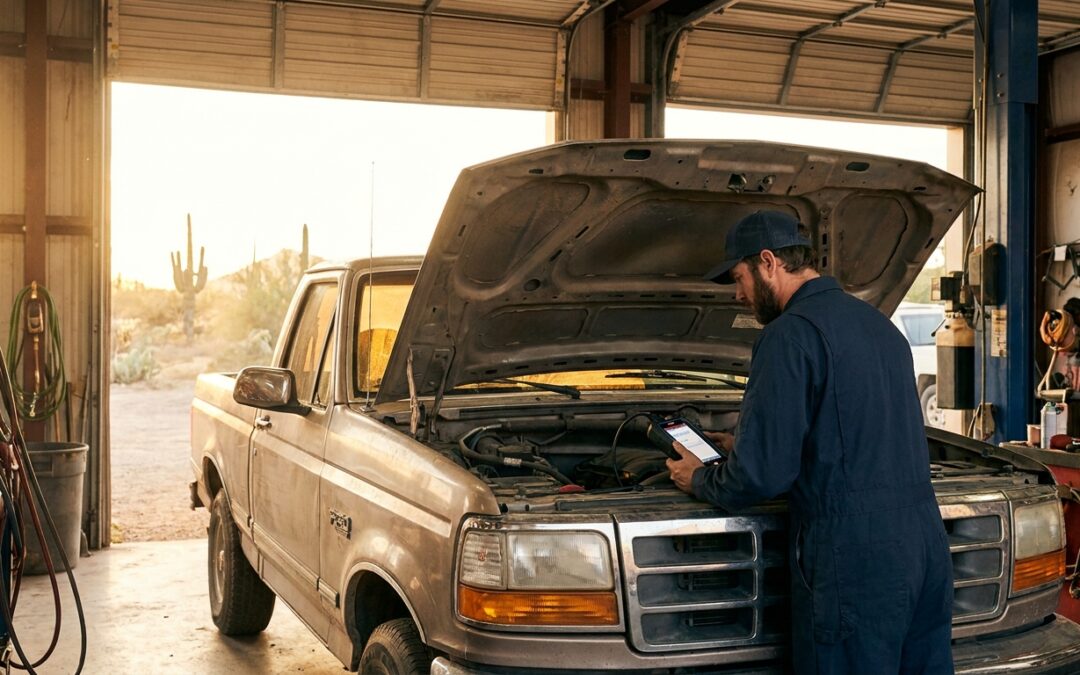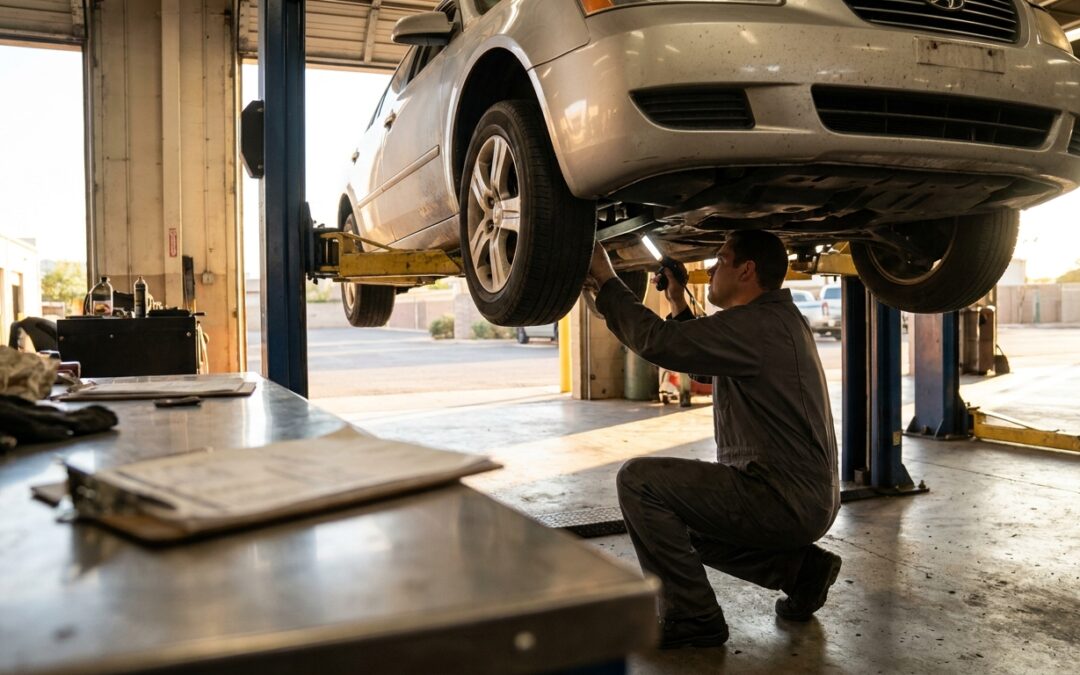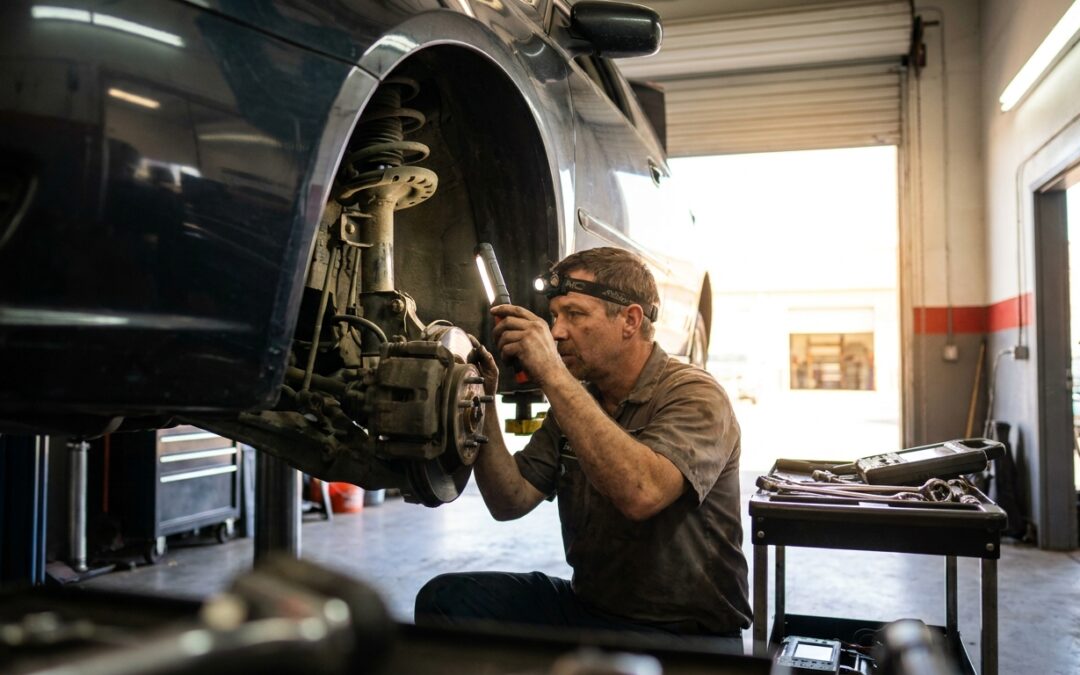
Shocks and Struts Replacement Apache Junction AZ Now? (2026)

Shocks and Struts Replacement Apache Junction AZ Now? (2026)

HomeBlog › Shocks and Struts Replacement Apache Junction AZ

Shocks and Struts Replacement Apache Junction AZ: 5 Warning Signs You Can’t Ignore

By Network Automotive Service CenterApache Junction, AZUpdated August 2026

Bouncy ride, nose-diving brakes, uneven tire wear? Here’s the honest, mechanic-written guide to shocks and struts replacement Apache Junction AZ drivers actually need: the warning signs, what it costs, and why waiting almost always costs more.

You feel it before you can explain it. The truck dips hard when you brake at the Idaho Road light, or every seam on the US-60 near Ironwood sends a jolt straight through the seat. If you’ve been searching “shocks and struts replacement Apache Junction AZ” after a rough drive home from Gold Canyon or Superstition, this guide is for you.

At Network Automotive Service Center, we’ve been keeping East Valley vehicles planted and predictable since 1995. Apache Junction’s mix of washboard dirt roads, sun-baked pavement, and long highway hauls out toward Superstition Mountain wears out suspension components faster than almost anywhere else in the Valley. This article walks through exactly what shocks and struts do, the warning signs that mean it’s time for shocks and struts replacement Apache Junction AZ drivers can trust, what it costs, and how to tell the difference between “schedule it this month” and “don’t drive on this.”

50K
miles is the typical lifespan of a shock or strut before ride quality and handling start to noticeably degrade. In Apache Junction’s heat and rough roads, many vehicles show real symptoms well before that number.

What Shocks and Struts Replacement Apache Junction AZ Actually Involves

Shocks and struts are the parts of your suspension that control how your wheels react to bumps, dips, and hard braking. A shock absorbs and dampens motion after the spring compresses. A strut does the same job but also serves as a structural part of the suspension, supporting the vehicle’s weight and holding the wheel alignment in place. Most modern cars and crossovers use struts up front and either struts or shocks in the rear; trucks and older SUVs more often run shocks at all four corners.

Here’s the part most drivers don’t realize: shocks and struts don’t fail all at once. They degrade slowly, a little more give each month, until one day the ride feels “off” and you can’t quite say why. By the time you notice bouncing, nose-diving, or a rougher ride, the internal valving has usually already lost a meaningful chunk of its damping ability. That’s why shocks and struts replacement Apache Junction AZ shops recommend isn’t just about comfort. Worn shocks and struts measurably increase stopping distance and reduce tire contact with the road, especially during hard braking or emergency swerves.

Struts vs. Shocks: Quick Comparison

Feature Shocks Struts
Structural role Dampening only Dampening + structural support
Common location Rear axle, trucks/SUVs Front axle, most cars/crossovers
Alignment impact when replaced Rarely needed Almost always needed
Typical AZ lifespan 45,000–65,000 mi 45,000–65,000 mi

Apache Junction drivers, remember: summer pavement temps can exceed 150°F. Heat accelerates the breakdown of the rubber bushings and seals inside shocks and struts, which is why Apache Junction vehicles often need replacement sooner than the same model driven in a milder climate.

Free Suspension Inspection

We’ll put your vehicle on the lift, bounce-test every corner, and check for leaking, worn, or damaged shocks and struts at no charge. No pressure, no upsell, just an honest answer.

Book My Free Inspection →

5 Warning Signs You Need Shocks and Struts Replacement Apache Junction AZ

After inspecting thousands of East Valley suspensions, here are the signs that mean it’s time to stop putting it off:

  • Excessive bouncing. Push down hard on a corner of the car and let go. If it bounces more than once or twice before settling, the shock or strut has lost its damping ability.
  • Nose-diving or squatting. The front end dips hard under braking, or the rear squats hard on acceleration. Healthy suspension keeps the body level.
  • Uneven or cupped tire wear. Worn struts let the tire bounce instead of staying flat on the road, wearing scalloped “cupped” patches into the tread.
  • Clunking or knocking over bumps. Often a worn strut mount or a fully blown shock letting metal parts contact each other.
  • Visible fluid leaking from the shock or strut body. Hydraulic fluid seeping down the shaft means the seal has failed and the part is no longer damping properly.

If you’re noticing two or more of these, it’s worth scheduling shocks and struts replacement Apache Junction AZ technicians can actually verify with a proper inspection rather than guessing from the driver’s seat.

Why This Is a Safety Issue, Not Just a Comfort Issue

It’s easy to think of worn shocks and struts as a comfort problem: a stiffer ride, a few more rattles, nothing urgent. The reality is that shocks and struts do most of their real work keeping your tires in contact with the road during braking, cornering, and evasive maneuvers, which is exactly when you need traction the most.

It’s a well-documented fact in the auto industry that worn shocks and struts can meaningfully lengthen stopping distance from highway speed compared to new components. On the wide, high-speed stretches around Apache Junction, that difference can be measured in car lengths, not inches. Worn suspension also makes a vehicle more prone to swaying or bottoming out during a sudden lane change, which matters if you’re sharing the road with trailers, ATVs, or side-by-sides heading out to Superstition on a weekend.

This is why we treat shocks and struts replacement Apache Junction AZ drivers schedule with us as a safety inspection first and a comfort upgrade second. If a bounce test or lift inspection turns up a failed shock or strut, we’ll tell you plainly whether it’s a “get it done this month” repair or a “don’t wait” one.

What Causes Shocks and Struts to Wear Out Faster in Apache Junction

Shocks and struts are wear items on every vehicle, but a handful of local factors push Apache Junction vehicles toward replacement sooner than the same model driven somewhere with milder weather and smoother pavement.

  • Extended heat exposure. Pavement temperatures well above 130°F for months at a time dry out and crack the rubber bushings and seals inside shocks and struts, letting hydraulic fluid escape faster.
  • Washboard and dirt roads. Frequent trips out toward Superstition, Gold Canyon, or unpaved side streets subject the suspension to constant small impacts that add up faster than smooth city driving.
  • Towing and hauling. Trailers, side-by-sides, and work loads add sustained weight that struts and shocks weren’t designed to carry indefinitely, especially on trucks already logging highway miles.
  • Lifted trucks and aftermarket suspension. Lift kits change the geometry and leverage on shocks, which can shorten their service life if not matched correctly to the vehicle.
  • High mileage without inspection. Because shocks and struts degrade gradually instead of failing suddenly, many drivers simply never get them checked until the ride quality has noticeably declined.

None of this means your vehicle is doing anything wrong. It just means shocks and struts replacement Apache Junction AZ vehicles need tends to come up on a shorter mileage interval than the owner’s manual might suggest, which is exactly why we build a suspension check into every multi-point inspection.

Our Shocks and Struts Replacement Apache Junction AZ Process

Here’s exactly what happens when you bring your vehicle in for shocks and struts replacement Apache Junction AZ residents have trusted us with for years. No smoke, no mirrors, just the real workflow.

  1. Test drive and customer interview. We ask when the symptoms started, what they feel like, and over what kind of roads. Half the diagnosis is what you’ve already noticed.
  2. Lift inspection, all four corners. We visually check every shock and strut for leaking fluid, physical damage, worn mounts, and torn boots.
  3. Bounce test. We compress and release each corner to measure how quickly it settles, a direct read on remaining damping ability.
  4. Mount, bushing, and linkage check. Worn strut mounts or sway bar links can mimic bad shocks. We test them separately so you’re not paying for parts you don’t need.
  5. Written estimate. You get a plain-English explanation of what’s worn, why, and the exact parts and labor cost in writing before we touch anything.
  6. Replacement, in pairs. We always replace shocks or struts as a pair (left and right on the same axle) so your vehicle handles evenly, even if only one side shows visible failure.
  7. Alignment check. Front strut replacement changes ride height and geometry slightly, so we check (and correct, if needed) your alignment before you leave.
  8. Road test. We verify the ride feels tight, level, and quiet over the same bumps and corners you first complained about.
30+
Years serving the East Valley. Network Automotive has been family-owned and ASE-certified since 1995. Apache Junction, Mesa, Gilbert, Queen Creek, Prescott, same trucks, same families, same mechanics, for three decades.

What Does Shocks and Struts Replacement Cost in Apache Junction?

Straight numbers, because you deserve them:

  • Free suspension inspection: at Network Automotive, we’ll bounce-test and visually inspect your shocks and struts at no charge.
  • Rear shocks (pair): typically $220–$450 installed, depending on make and model.
  • Front struts (pair, with mounts): typically $450–$900 installed, since front strut replacement usually includes new mounts and an alignment check.
  • Full four-corner replacement: typically $700–$1,400 depending on vehicle and parts quality.

Those are ranges, not quotes. Your exact cost for shocks and struts replacement Apache Junction AZ depends on year, make, model, and whether mounts, bushings, or an alignment are also needed. We always quote the full job in writing before we start.

How long does it take?

Most shocks and struts replacement Apache Junction AZ appointments are finished the same day. A rear shock pair typically takes 60–90 minutes. Front struts with an alignment check usually take 2–3 hours. We’ll give you a realistic pickup time before you drop the keys.

Stop Bouncing. Start Driving Level.

Bring us your Apache Junction vehicle, get a free inspection, and a fair written quote for shocks and struts replacement, no pressure either way.

Schedule My Inspection →

Is It Safe to Keep Driving on Worn Shocks and Struts?

The honest answer: it depends on how worn they are. Here’s the rule of thumb we give every Apache Junction customer:

  • Mild bounce, no leaking, tires wearing evenly: OK to drive a few weeks, but schedule an inspection soon.
  • Visible fluid leaking, or noticeable nose-dive under braking: schedule shocks and struts replacement Apache Junction AZ service within the week. Stopping distance is already affected.
  • Clunking, knocking, or a wheel that feels loose over bumps: stop hard driving and get it inspected immediately. A failed mount or linkage can affect steering control.
  • Any suspension part visibly broken or hanging: do not drive. Call for a tow.

A note on Arizona heat and dirt roads: Apache Junction’s washboard roads out toward Superstition and the extended summer heat both accelerate wear on rubber bushings, mounts, and seals. A shock or strut that would last 65,000 miles in a mild climate can show real symptoms 15,000 to 20,000 miles sooner out here. Don’t assume your suspension is fine just because your last vehicle lasted longer.

What to Do Right Now

  1. Do the bounce test. Push down hard on each corner and let go. More than one or two bounces means it’s time to get checked.
  2. Look underneath for leaking fluid. A wet, oily shock or strut body is a clear sign of a failed seal.
  3. Check your tires. Cupped or scalloped wear patterns point to worn struts, not just an alignment issue.
  4. Notice how the vehicle brakes and corners. Excessive nose-dive or body roll is a suspension symptom, not just “an old car feel.”
  5. Call Network Automotive. (480) 444-0242, we’ll tell you over the phone what to expect. Free advice, no appointment needed to ask.

Why Apache Junction Drivers Trust Network Automotive

There are plenty of shops between Idaho Road and Ironwood. Here’s what’s different about ours: we’ve spent thirty years watching how Apache Junction’s roads and climate actually wear out a vehicle, not just reading a service manual written for a different state. That experience shapes every shocks and struts replacement Apache Junction AZ customers get from us, from the parts we recommend to the mileage intervals we flag during a routine inspection.

  • Family-owned since 1995. Three decades, five-plus locations across Mesa, Gilbert, Apache Junction, Queen Creek, and Prescott.
  • ASE-certified technicians who bounce-test and inspect every corner, not just the side you complained about.
  • Pairs, not singles. We replace shocks and struts as a matched pair so your vehicle handles evenly on both sides.
  • 24-month / 24,000-mile nationwide warranty on parts and labor, not just 12 months.
  • Written estimates before we start. Zero phone-tag surprises, zero “while we were in there” add-ons without your approval.
  • Alignment checked, not assumed. Front strut jobs include a ride-height and alignment check so your new parts wear evenly.

Read more about our shop and philosophy on the About Network Automotive page, see the full service menu, or browse current Apache Junction service coupons.

Proudly Serving Apache Junction and the Greater East Valley

Network Automotive Service Center is the trusted choice for shocks and struts replacement Apache Junction AZ drivers rely on, and across:

  • Apache Junction, including Superstition and Gold Canyon
  • Mesa, East Mesa, Las Sendas, Red Mountain, downtown
  • Gilbert, Agritopia, Morrison Ranch, Seville, Power Ranch
  • Queen Creek, San Tan Heights, Ironwood Crossing, Harvest
  • Prescott, and Prescott Valley

Coming from Apache Junction? Most of our Apache Junction-area customers book at the shop nearest Idaho Road or make the short drive up US-60 to our East Mesa location.

Apache Junction Shocks and Struts Replacement FAQ

How much does shocks and struts replacement cost in Apache Junction AZ?

Rear shocks typically run $220–$450 installed as a pair. Front struts, which usually include new mounts and an alignment check, typically run $450–$900 installed. A full four-corner job typically runs $700–$1,400 depending on vehicle and parts. We always provide a written quote for shocks and struts replacement Apache Junction AZ vehicles need before we start any work. Call (480) 444-0242 for an estimate on your specific vehicle.

How do I know if I need shocks and struts replacement?

Watch for excessive bouncing after hitting a bump, nose-diving under braking, cupped or uneven tire wear, clunking noises over bumps, or visible fluid leaking from the shock or strut body. Two or more of these signs usually means it’s time for shocks and struts replacement Apache Junction AZ shops can confirm with a lift inspection and bounce test.

Can I replace just one shock or strut instead of a pair?

We don’t recommend it. Shocks and struts are always replaced in pairs (left and right on the same axle), because mismatched damping between the two sides makes the vehicle handle unevenly, especially during hard braking or in a sudden swerve.

Do I need an alignment after replacing my struts?

Almost always for front struts, since they hold part of the suspension geometry in place and changing them shifts ride height slightly. Rear shock replacement rarely requires an alignment. We check and correct alignment as part of every front strut job.

Why does Apache Junction wear out shocks and struts faster?

The combination of extended summer heat, washboard dirt roads near Superstition and Gold Canyon, and long highway stretches accelerates wear on the rubber bushings and seals inside shocks and struts. Vehicles here often need replacement 15,000 to 20,000 miles sooner than the same model in a milder climate.

Is it safe to keep driving with worn shocks and struts?

Mild bouncing with no leaking is usually safe for a few weeks, but don’t wait too long. Visible fluid leaking, noticeable nose-diving, or clunking noises mean stopping distance and steering control are already affected, and you should schedule shocks and struts replacement Apache Junction AZ service right away.

How long does shocks and struts replacement take?

Most appointments are finished the same day. A rear shock pair typically takes 60–90 minutes. Front struts with an alignment check usually take 2–3 hours. We’ll give you a realistic pickup time before you leave your vehicle.

Does Network Automotive warranty shocks and struts replacement?

Yes. Network Automotive backs every repair, including shocks and struts replacement, with a 24-month / 24,000-mile nationwide warranty on parts and labor.

Let’s Get You Driving Level Again

Family-owned in the East Valley since 1995, ASE-certified, and backed by a 24-month / 24,000-mile nationwide warranty. Bring us your Apache Junction vehicle for a free shocks and struts inspection, honest answers, no pressure.
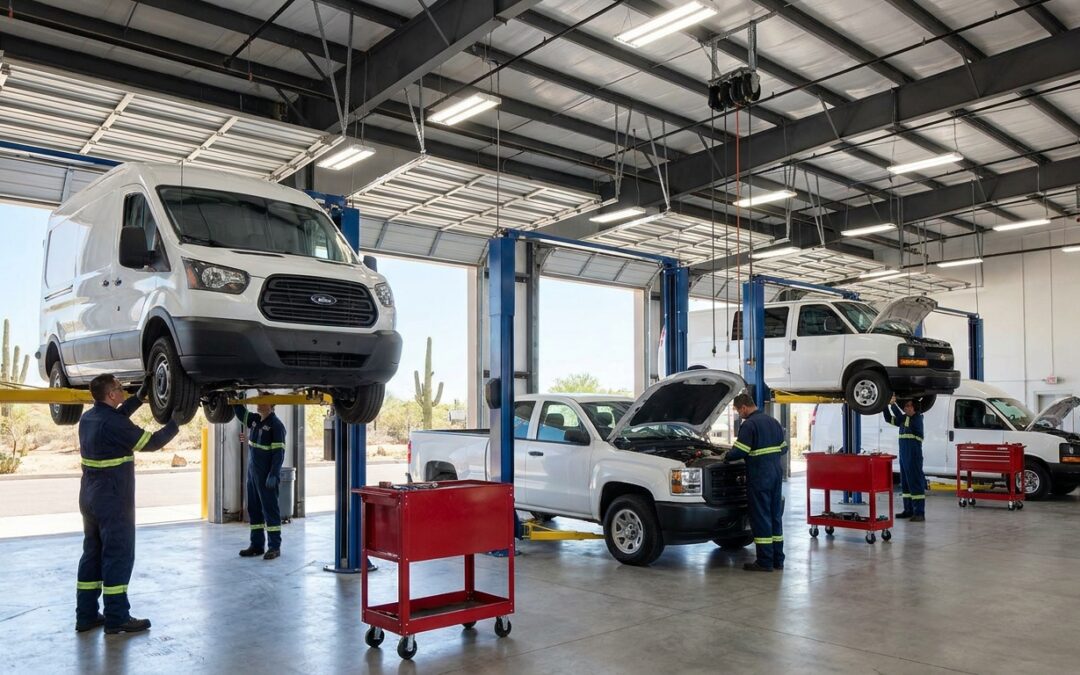
Don’t Skip Fleet Vehicle Maintenance Mesa AZ (2026 Guide)

Don’t Skip Fleet Vehicle Maintenance Mesa AZ (2026 Guide)

HomeBlog › Fleet Vehicle Maintenance Mesa AZ

Fleet Vehicle Maintenance Mesa AZ: Don’t Skip It (2026 Guide)

By Network Automotive Service CenterMesa, AZUpdated August 2026

One breakdown can cost more than a year of preventive maintenance. Here is the honest, mechanic-written guide to fleet vehicle maintenance Mesa AZ business owners actually need: what it covers, what it costs, and how to keep your vehicles on the road instead of on a tow truck.

If you run more than one work vehicle in the East Valley, you already know the math: a van sitting in a shop bay isn’t earning money, and a breakdown on the Loop 202 during a service call is worse than the repair itself. Fleet vehicle maintenance Mesa AZ businesses rely on isn’t a luxury add-on, it’s the difference between predictable costs and a truck that dies on a customer’s driveway. This guide breaks down exactly what fleet vehicle maintenance Mesa AZ operators should expect, what it costs, and how to build a program that actually keeps vehicles moving.

At Network Automotive Service Center, we’ve serviced everything from single work trucks to multi-vehicle fleets for contractors, delivery services, landscaping crews, and property managers across Mesa since 1995. This article explains what a real fleet vehicle maintenance program covers, why so many small and mid-size fleets fall behind, what it costs to do it right, and how to tell the difference between routine upkeep and a vehicle that needs attention today.

82%
of roadside breakdowns trace back to a maintenance item that was already overdue. Fleet vehicle maintenance Mesa AZ programs exist to catch those items before they turn into a tow bill and a missed job.

What Fleet Vehicle Maintenance Actually Covers

Fleet vehicle maintenance Mesa AZ is more than an oil change reminder. A real program tracks every vehicle in your business by mileage, engine hours, and calendar interval, and it schedules service before something fails instead of after. For a typical work truck, van, or light-duty fleet vehicle, that means oil and filter changes, brake inspections, tire rotation and pressure checks, battery and charging system tests, cooling system service, transmission fluid checks, belts and hoses, and a full multi-point inspection at every visit.

The goal of fleet vehicle maintenance Mesa AZ shops provide is uptime, not just repair. A single vehicle owner can afford to wait for a warning light. A fleet owner cannot, because every vehicle off the road is a crew member sitting idle or a job that has to be rescheduled. That is why fleet vehicle maintenance is built around a schedule, not a symptom.

What a multi-point inspection actually checks

Every fleet vehicle maintenance Mesa AZ visit at Network Automotive includes a full walk-around and under-vehicle inspection, not just the item you called about. That means brake pad and rotor thickness, tire tread depth and pressure across all positions including the spare, battery voltage and terminal condition, belt and hose wear, coolant level and condition, transmission and differential fluid, wiper blades, all exterior lighting, and a visual check for leaks under the vehicle. Each item gets logged, so a vehicle that passes today has a documented baseline for the next visit.

Who needs a fleet maintenance program

Any Mesa business running two or more vehicles benefits from a structured program: HVAC and plumbing contractors, electricians, landscaping and irrigation crews, delivery and courier services, property management companies, real estate teams with multiple field vehicles, and any business with a mix of trucks, vans, and SUVs covering the East Valley daily. If any of your vehicles are used for commercial hauling, it is also worth knowing the federal inspection standards outlined by the Federal Motor Carrier Safety Administration, since some fleet vehicles fall under those requirements even when the business is small.

Get a Free Fleet Maintenance Assessment

Tell us how many vehicles you run and we will build a maintenance schedule around your business, not a generic mileage chart.

Book My Fleet Assessment →

Why Mesa Fleets Fall Behind on Maintenance

Most fleet owners do not skip maintenance on purpose. It slips because the truck is always booked on a job, because one vehicle is squeaky and another isn’t, or because nobody owns the schedule. Fleet vehicle maintenance Mesa AZ businesses need has to work around real job schedules, not the other way around, which is why a program with flexible drop-off and priority turnaround matters more than a wall calendar.

Reason It Slips What Happens Next What Fleet Maintenance Fixes
Vehicle is always “on a job” Service pushed month after month Scheduled drop-off windows and loaner options
No single owner of maintenance Different vehicles on different intervals One tracked schedule per VIN
Reactive-only repairs Bigger repairs, more downtime Preventive multi-point inspections
AZ heat accelerates wear Belts, batteries, and AC fail early Heat-adjusted service intervals
No written history Warranty and resale value drop Digital service records per vehicle

Arizona heat is its own factor in fleet vehicle maintenance Mesa AZ operators cannot ignore. Asphalt temperatures well above 140°F in summer shorten the life of rubber belts, hoses, and battery terminals far faster than a mild climate would. A maintenance interval that works fine in a cooler state can leave a Mesa fleet vehicle stranded a full season early.

There is also a liability angle that gets overlooked. A vehicle with worn brakes or bald tires involved in a collision during a work errand exposes the business, not just the driver, especially if a maintenance log would have shown the problem was known and unaddressed. A documented fleet vehicle maintenance Mesa AZ program is not just about avoiding breakdowns, it is a paper trail that shows the business took reasonable care of every vehicle it puts on the road.

Our Fleet Vehicle Maintenance Process

Here is exactly what happens when a business brings its fleet to Network Automotive for fleet vehicle maintenance Mesa AZ service. No guesswork, and no surprise add-ons without your approval.

  1. Fleet intake call. We log every vehicle by year, make, model, mileage, and how it is used (short city routes, highway miles, towing, or stop-and-go service calls).
  2. Custom maintenance schedule. We build an interval per vehicle, adjusted for Arizona heat, not a generic factory chart written for a mild climate.
  3. Priority scheduling. Fleet accounts get flexible drop-off windows so a vehicle is never out of service longer than it has to be.
  4. Full multi-point inspection. Every visit includes brakes, tires, fluids, belts, hoses, battery, and charging system, not just the single item you booked for.
  5. Written report per vehicle. You get a plain-English breakdown of what was done, what is coming due, and what needs attention now, with parts and labor quoted in writing.
  6. Digital service history. Every vehicle in your fleet gets a running record, which protects resale value and keeps you audit-ready for insurance or DOT purposes.
  7. Same-day turnaround when possible. Routine fleet vehicle maintenance Mesa AZ service is typically completed same-day so vehicles get back on the road fast.
  8. Fleet account support. One point of contact, consolidated invoicing, and a shop that knows your vehicles instead of starting over every visit.
30+
Years serving the East Valley. Network Automotive has been family-owned and ASE-certified since 1995, servicing everyday drivers and local business fleets across Mesa, Gilbert, Apache Junction, Queen Creek, and Prescott.

What Does Fleet Vehicle Maintenance Cost in Mesa?

Straight numbers, because fleet budgets need them:

  • Routine service visit (oil, filter, multi-point inspection): typically $70–$140 per vehicle, depending on engine type and vehicle class.
  • Brake service across a fleet: usually $180–$450 per axle, quoted up-front before any work starts.
  • Fleet account discounts are available once you commit two or more vehicles to a scheduled program, lowering the per-visit cost compared to one-off walk-in service.
  • Downtime cost is the number most fleet owners underestimate: a single crew truck sitting idle for two days can cost more in lost billable hours than an entire year of fleet vehicle maintenance Mesa AZ service.

Compare that to the cost of a breakdown: a tow, a rental replacement vehicle, and a missed appointment window almost always cost more than the preventive visit that would have caught the problem. A structured fleet vehicle maintenance program is one of the few line items that pays for itself.

Budgeting tip: most fleet owners find it easier to set a flat monthly maintenance budget per vehicle rather than reacting to invoices as they come in. Ask your shop for a rough annual estimate per vehicle class so you can build it into overhead instead of treating every repair as a surprise expense.

How long does service take?

Most routine fleet vehicle maintenance Mesa AZ visits are completed same-day, often within a couple of hours per vehicle for standard service. Larger jobs, like brake replacement across multiple vehicles or a full fleet inspection sweep, are scheduled in batches so you never lose more than one or two vehicles from the road at a time.

Stop Reacting. Start Scheduling.

Set up a fleet vehicle maintenance Mesa AZ program built around your job schedule, not a generic mileage sticker. One call gets every vehicle you run on a real plan.

Set Up My Fleet Program →

When Fleet Vehicle Maintenance Becomes Urgent

Preventive service catches most problems early, but some signs mean a vehicle needs attention today, not at the next scheduled visit:

  • Warning light on any fleet vehicle: get it scanned the same day, especially before a highway job or a long service route.
  • Grinding or squealing brakes: stop scheduling that vehicle for jobs until it is inspected.
  • Overheating or coolant smell: pull the vehicle from service immediately. Arizona heat turns a minor cooling issue into a stranded truck fast.
  • Battery slow to start: replace before it fails on a job site, not after a crew is stuck waiting for a jump.
  • Uneven tire wear or low tread: a blowout on the 202 or US-60 is a liability risk, not just a repair bill.

A note on Arizona heat: summer asphalt temperatures in Mesa routinely exceed 140°F. Belts, hoses, batteries, and AC systems all fail faster under that stress than published maintenance intervals assume. A fleet vehicle maintenance Mesa AZ program that does not adjust for heat is working off the wrong numbers.

What To Do Right Now

  1. List every vehicle you run, with current mileage and last known service date for each one.
  2. Flag anything overdue. Oil, brakes, tires, and battery are the four items that most often slip on a busy fleet.
  3. Note any warning lights or noises your drivers have mentioned but never got around to reporting.
  4. Call Network Automotive. (480) 444-0242 to set up a fleet vehicle maintenance Mesa AZ schedule for every vehicle at once, instead of chasing each one individually.
  5. Set a recurring inspection cadence so the next overdue vehicle gets caught before it becomes a breakdown call.

Why Mesa Fleets Choose Network Automotive

There are plenty of shops in the East Valley. Here is what is different about fleet vehicle maintenance Mesa AZ businesses get from Network Automotive:

  • Family-owned since 1995. Three decades, five-plus locations across Mesa, Gilbert, Apache Junction, Queen Creek, and Prescott, so your fleet is covered no matter where a job takes it.
  • ASE-certified technicians handling every vehicle in your fleet, from daily-driver sedans to diesel work trucks.
  • Written estimates before we start, per vehicle, so there is never a surprise line item on a fleet invoice.
  • 24-month / 24,000-mile nationwide warranty on parts and labor across every vehicle we service.
  • Flexible fleet scheduling, including priority drop-off windows so vehicles spend less time in the bay and more time on the job.
  • Digital service history for every vehicle in your fleet, useful for resale, insurance, and internal recordkeeping.

Read more about our shop and philosophy on the About Network Automotive page, see the full service menu, or browse current Mesa service coupons.

Setting up your fleet account

Getting started takes one phone call. We log every vehicle in your fleet, note anything already overdue, and put together a maintenance calendar for the whole group instead of scheduling each vehicle one at a time as problems come up. From there, you get a reminder before each vehicle is due, not after it breaks down. Most fleet owners tell us the biggest change is not the repairs themselves, it is no longer having to remember which truck is due for what.

Fleet Vehicle Maintenance Service Area

Network Automotive Service Center provides fleet vehicle maintenance Mesa AZ businesses depend on, along with coverage across:

  • Mesa – East Mesa, Las Sendas, Red Mountain, downtown Mesa, and the Falcon Field business corridor
  • Gilbert – Agritopia, Morrison Ranch, Seville, and the Power Ranch area
  • Apache Junction – Superstition and Gold Canyon
  • Queen Creek – Cortina, San Tan Heights, and the Ironwood Crossing area
  • Prescott – Prescott Valley and surrounding areas

Running vehicles out of an East Mesa or Falcon Field business address? Most of our fleet accounts book service through the East Mesa location, minutes from the Loop 202.

Mesa Fleet Vehicle Maintenance FAQ

How much does fleet vehicle maintenance cost in Mesa?

A routine service visit typically runs $70 to $140 per vehicle, and brake service usually falls between $180 and $450 per axle, always quoted in writing before work starts. Fleet accounts with two or more vehicles on a scheduled program often qualify for lower per-visit pricing than one-off walk-in service. Call (480) 444-0242 for a quote across your specific vehicles.

How many vehicles do I need before a fleet program makes sense?

Two or more work vehicles is usually the tipping point. Once you are juggling service dates for more than one truck or van, a single tracked schedule saves more time than it costs, and it stops the common problem of one vehicle quietly falling months behind the others.

Does Arizona heat really affect fleet vehicle maintenance intervals?

Yes. Summer asphalt temperatures in Mesa routinely exceed 140°F, which shortens the life of belts, hoses, batteries, and AC components well below the intervals published for milder climates. A fleet vehicle maintenance Mesa AZ program should be adjusted for heat, not built off a generic factory chart.

Can you work around our job schedule instead of ours around yours?

Yes, that is the point of a fleet program. We build service windows around when a vehicle is actually available, offer flexible drop-off, and batch larger jobs like fleet-wide brake service so you never lose more than one or two vehicles from the road at once.

What is included in a fleet vehicle maintenance visit?

Every visit includes a full multi-point inspection covering brakes, tires, fluids, belts, hoses, battery, and charging system, in addition to whatever service you booked for. You get a written, plain-English report on what was done and what is coming due next.

Do you keep service records for each vehicle in our fleet?

Yes. Every vehicle gets a digital service history, which helps protect resale value, keeps you organized for insurance purposes, and makes it easy to see which vehicle is due for service without checking a spreadsheet.

Do you service diesel trucks as part of a fleet program?

Yes. Our technicians service gas and diesel vehicles, including Power Stroke, Cummins, and Duramax trucks, alongside daily-driver cars and vans, so a mixed fleet can be maintained through one shop instead of several.

How fast can you turn a fleet vehicle around?

Most routine fleet vehicle maintenance Mesa AZ visits are completed same-day, often within a couple of hours per vehicle. Larger jobs are scheduled in batches so the rest of your fleet keeps running while one vehicle is in the bay.

Keep Your Fleet On the Road

Family-owned in the East Valley since 1995, ASE-certified, and backed by a 24-month / 24,000-mile nationwide warranty. Set up fleet vehicle maintenance Mesa AZ businesses can count on, and stop losing job time to preventable breakdowns.

Car AC Blowing Hot Air Gilbert AZ? Don’t Ignore This (2026)

Car AC Blowing Hot Air Gilbert AZ? Don’t Ignore This (2026)

HomeBlog › Car AC Blowing Hot Air Gilbert AZ

Car AC Blowing Hot Air Gilbert AZ: Here’s Why (And How to Fix It)

By Network Automotive Service CenterGilbert, AZUpdated August 2026

Searching “car AC blowing hot air Gilbert AZ”? You’re not alone – and it isn’t a “wait it out” problem. Here’s the honest, mechanic-written guide to why it happens, what it costs to fix, and how fast we can get cold air back before the next 110° afternoon.

You crank the dial to max cold, point every vent at your face, and… nothing but warm air rolls out. In Gilbert, where the asphalt hits 140°F in July and your dashboard can top 190°F, car AC blowing hot air Gilbert AZ isn’t an inconvenience – it’s a real safety issue for kids, pets, and anyone with a medical condition. If you’ve been searching “car AC blowing hot air Gilbert AZ” while sweating through a red light on Val Vista, this guide is for you.

At Network Automotive Service Center, we’ve diagnosed thousands of Gilbert-area AC systems since 1995. Every single summer, the same story: a compressor that worked fine in April suddenly quits in June, or a system that was “kind of cool” in May goes fully warm by the Fourth of July. This article on car AC blowing hot air Gilbert AZ walks through exactly why your AC blows hot air, what a real diagnostic finds, what it costs to fix in Gilbert today, and how to tell a $120 fix from a $1,800 one before you commit to either.

72%
of car AC blowing hot air Gilbert AZ complaints we see trace back to a refrigerant leak or a failed AC compressor clutch – not a blown fuse or bad thermostat. A proper diagnostic finds the actual leak point instead of just topping off refrigerant and hoping.

Why Car AC Blowing Hot Air Gilbert AZ Happens

Your car’s AC is a sealed, pressurized refrigerant loop. Cold air only happens when refrigerant compresses, cools, and expands correctly through four main components: the compressor, condenser, expansion valve (or orifice tube), and evaporator. If any one of those fails, or if the system loses refrigerant through even a pinhole leak, the whole loop stops removing heat and you get warm or room-temperature air instead of cold.

Most Gilbert drivers notice the problem gradually: air that used to be ice-cold turns lukewarm over a few weeks, then goes fully warm almost overnight once refrigerant drops below the level needed to engage the compressor clutch. Others notice it instantly – the compressor clutch simply stops engaging (you can often hear the clunk when it kicks on, and notice when it doesn’t) and the air blows warm the moment you turn the AC on.

Arizona heat makes this worse than almost anywhere else in the country. Rubber O-rings and hoses that might last 10 years in a mild climate degrade in 5–7 years here, and a system already running at the edge of its capacity in 115° ambient heat has zero margin for a partial refrigerant loss. That’s why Gilbert AC failures cluster hard in May through August – the system was already borderline, and the heat pushed it over.

AC Diagnostic Check

We’ll check your system pressures, look for the leak, and tell you exactly what’s wrong before you pay for anything. No pressure, no upsell.

Book My AC Check →

Car AC Blowing Hot Air Gilbert AZ: Common Causes and Costs

After diagnosing thousands of Gilbert and East Valley vehicles, here’s our real-world breakdown of what car AC blowing hot air Gilbert AZ usually turns out to be:

Cause How Common Typical Repair Cost (Gilbert) Drive-Safe?
Refrigerant leak (hose, O-ring, condenser) Very common $150–$650 Yes
AC compressor clutch failure Very common $450–$1,100 Yes
Full compressor failure Common $800–$1,800 Yes, but no cold air
Condenser damage (road debris, corrosion) Common $350–$900 Yes
Bad AC relay or fuse Common $25–$120 Yes
Cabin air filter fully clogged Common $25–$60 Yes
Expansion valve / orifice tube clogged Moderate $220–$550 Yes
Blend door actuator (stuck on “hot”) Moderate $260–$620 Yes
Electrical / low-pressure switch fault Less common $150–$400 Yes

Those are ranges, not quotes – your exact cost depends on year, make, model, and what the diagnostic finds. The biggest mistake we see is drivers paying for a refrigerant “recharge” at a quick-lube shop that doesn’t find or fix the leak, so the AC blows cold for two weeks and goes warm again right on schedule.

Why a Simple Recharge Usually Doesn’t Fix It

An AC system is sealed. If it’s low on refrigerant, that refrigerant went somewhere, and it didn’t evaporate on its own. Adding more refrigerant without finding the leak is like refilling a leaking tire without patching it. It buys you a few weeks, sometimes less in Gilbert’s heat, and then you’re back to warm air and out another $100–$150 for the recharge that didn’t solve anything.

Does the Type of Refrigerant Matter?

Most vehicles on the road in Gilbert today use one of two refrigerants: R134a (standard on nearly everything built before roughly 2021) or R1234yf (the newer, more environmentally friendly refrigerant phased in on most late-model vehicles). They aren’t interchangeable, and the two systems use different fittings specifically to prevent someone from cross-charging a car with the wrong gas.

The practical difference for Gilbert drivers is cost. R1234yf currently runs several times more expensive per pound than R134a, so a leak repair and recharge on a newer vehicle can land toward the higher end of our cost ranges even when the actual labor is identical to an older R134a job. If you’re not sure which one your vehicle uses, it’s printed on a sticker under the hood, and we’ll confirm it as the first step of any diagnostic so there are no surprises on the estimate.

Signs the Compressor Itself Is Failing

Not every warm-air complaint is a leak. A handful of signs point specifically at the compressor rather than the refrigerant charge:

  • Loud clicking or grinding when the AC is switched on, especially if it changes with engine RPM.
  • The compressor clutch won’t engage at all, even with a full refrigerant charge confirmed by gauge readings.
  • Visible oily residue around the compressor shaft seal, which usually means the seal itself has failed and is leaking both refrigerant and oil.
  • AC belt squeal that’s louder or different than a normal accessory belt squeak, which can mean the compressor is seizing internally.

Catching a failing compressor early, before it seizes completely, can be the difference between a clutch-only repair and a full compressor replacement that also requires flushing the entire system of contaminated refrigerant and oil.

How We Diagnose Car AC Blowing Hot Air Gilbert AZ

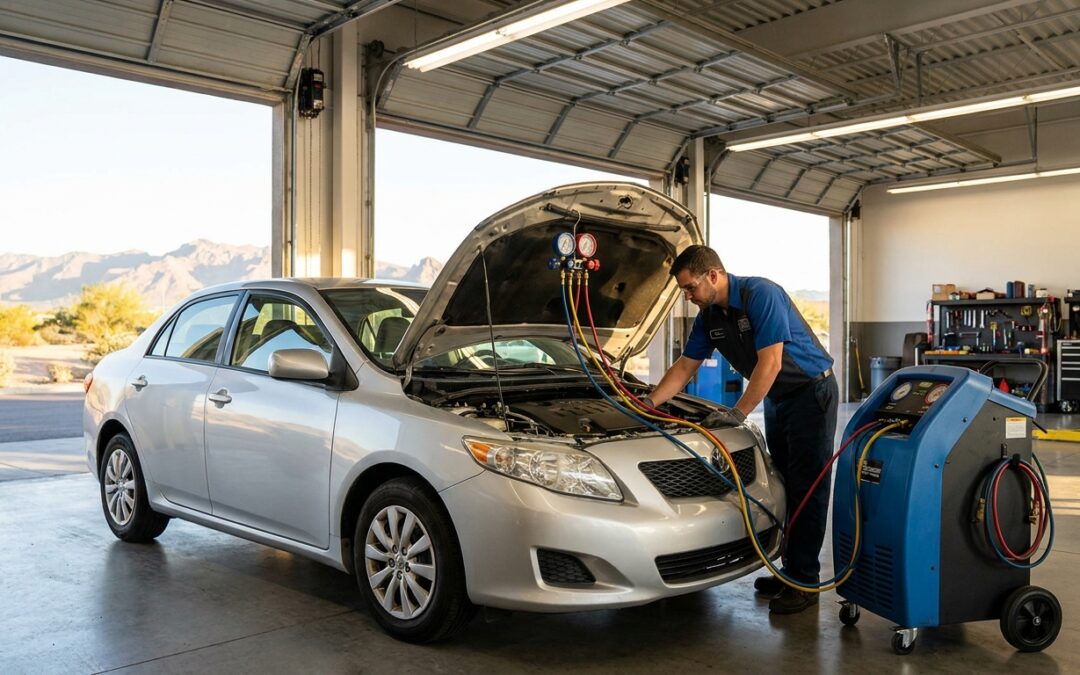
Here’s exactly what happens when you bring your car, truck, or SUV to our Gilbert-area shop for a car AC blowing hot air Gilbert AZ diagnostic. No guesswork, just the real process:

  1. Customer interview. When did it start? Gradual or sudden? Any hissing, grinding, or burning smell? Has the AC ever been serviced before? Half the diagnosis is what you’ve already noticed.
  2. Visual and manual inspection. We check the compressor belt, fuses, relays, and cabin air filter first – the cheapest fixes get ruled out before anything else.
  3. System pressure test. We connect gauges to the high and low sides of the system and read actual pressures against factory spec. This tells us instantly whether the system is low on refrigerant, overcharged, or blocked.
  4. UV dye and electronic leak detection. If refrigerant is low, we add UV-reactive dye and use an electronic sniffer to trace the exact leak point – a hose fitting, the condenser, the compressor shaft seal, or an evaporator inside the dash.
  5. Compressor clutch and electrical testing. We verify the compressor clutch engages properly, test the low-pressure cutoff switch, and check the AC relay and fuse circuit with a multimeter.
  6. Blend door and vent testing. If pressures and refrigerant are fine, we test the blend door actuator to rule out a mechanical issue mixing in hot air from the heater core.
  7. Written diagnostic report. You get a plain-English explanation of what’s wrong, why, and what it costs to fix – parts and labor quoted in writing before we touch anything.
  8. Repair, recharge, and verification. Once you approve, we repair the actual fault, evacuate and recharge the system to factory spec, and verify vent temperature before you leave. We want to see the number, not just feel “cold enough.”
30+
Years serving the East Valley. Network Automotive has been family-owned and ASE-certified since 1995. Gilbert, Mesa, Apache Junction, Queen Creek, Prescott – same trucks, same families, same mechanics, for three decades.

Car AC Blowing Hot Air Gilbert AZ: What It Costs to Fix

Straight numbers on car AC blowing hot air Gilbert AZ repairs, because you deserve them:

  • AC system diagnostic: typically $89–$150, usually credited toward the repair if you approve the work with us.
  • Refrigerant leak repair + recharge: most common fix, generally $150–$650 depending on where the leak is and how much labor it takes to reach it.
  • Compressor clutch or full compressor replacement: the bigger-ticket repair, typically $450–$1,800 depending on whether the whole compressor needs to come out.
  • Simple fixes (fuse, relay, cabin filter): often under $120 and done same day.

Compare that to the cost of repeatedly “topping off” refrigerant without a real diagnosis: three $130 recharges over a summer is $390 spent and the AC is still blowing hot air by August. A proper diagnostic that finds the actual leak pays for itself the first time it stops you from throwing money at the wrong fix.

How long does it take?

Most Gilbert AC diagnostics and simple repairs (fuse, relay, filter, minor leak) are done same day, often in 60–120 minutes. A full compressor replacement or a hard-to-reach leak (behind the dash, at the evaporator) can take a half day to a full day depending on parts availability. We’ll tell you up front which category yours falls into before you commit.

Stop Sweating It Out

Bring us your car AC, get a real diagnosis, pay a fair price – or get a second opinion and walk away. Either way, you’ll know exactly what’s wrong before we touch anything.

Schedule My AC Diagnostic →

Is Car AC Blowing Hot Air Gilbert AZ an Emergency?

Car AC blowing hot air Gilbert AZ isn’t a mechanical emergency the way a flashing check engine light or a grinding brake is – your car will still drive fine. But in Gilbert’s summer heat, it becomes a real safety and health issue faster than most people expect:

  • Never leave kids or pets in a car with no working AC, even for a few minutes. Interior temperatures can climb 20°F in 10 minutes and cause heatstroke fast.
  • Burning or electrical smell along with hot air: stop and have it checked immediately – this can indicate a compressor seizing or an electrical fault, not just refrigerant loss.
  • Loud grinding or squealing from the compressor area: the compressor clutch or bearing may be failing. Continuing to run it can destroy the compressor and send metal debris through the whole AC system.
  • Anyone with a heart condition, pregnancy, or medical sensitivity to heat should treat a warm-air AC as a priority repair, not a “get to it eventually” item, during Gilbert’s May–September stretch.

A note on Arizona summer driving: a vehicle with no working AC in Gilbert traffic isn’t just uncomfortable, it’s a driver-fatigue and dehydration risk on longer drives. If your AC has gone from cool to warm, treat it as a same-week fix, not a someday fix, from June through September.

Car AC Blowing Hot Air Gilbert AZ: What to Do Right Now

  1. Don’t keep cycling the AC on and off repeatedly. If the compressor clutch is failing, repeated cycling can accelerate the damage.
  2. Listen for the compressor engaging. A clunk or shift in engine sound when you hit the AC button means the clutch is at least trying to engage. Silence usually means an electrical or clutch problem.
  3. Check for a burning or electrical smell. If you notice one, turn the AC off and get it checked before driving further.
  4. Check your cabin air filter if you haven’t replaced it in over a year – a fully clogged filter can mimic AC failure by cutting off airflow entirely.
  5. Note when it started and whether it was gradual or sudden. This detail alone often narrows down the cause before we even connect gauges.
  6. Call Network Automotive. (480) 444-0242 – we’ll tell you over the phone what it’s likely to be and how soon to bring it in. Free advice, no appointment needed to ask.

Why Gilbert Drivers Trust Network Automotive

There are plenty of auto shops around Val Vista and the Power Ranch area. Here’s what’s different about ours:

  • Family-owned since 1995. Three decades, five-plus locations across Gilbert, Mesa, Apache Junction, Queen Creek, and Prescott. Same family, same values.
  • ASE-certified technicians who diagnose the actual leak or failure point instead of guessing with a recharge.
  • UV dye and electronic leak-detection equipment that finds the real problem the first time, not the third.
  • 24-month / 24,000-mile nationwide warranty on parts and labor, not just 12 months.
  • Written estimates before we start. No phone-tag surprises, no “while we were in there” add-ons without your approval.
  • Free loaner options for longer repairs. You don’t need to miss work.
  • Real reviews. Thousands of five-star Google and Yelp reviews across our AZ locations – we’d rather earn them than buy them.

Read more about our shop and philosophy on the About Network Automotive page, see the full service menu, or browse current Gilbert service coupons.

Car AC Blowing Hot Air Gilbert AZ: Service Area

Network Automotive Service Center is the trusted choice for car AC blowing hot air Gilbert AZ repairs, and across the greater East Valley:

  • Gilbert – including Agritopia, Morrison Ranch, Seville, Power Ranch, Val Vista Lakes, and the Heritage District
  • Mesa – East Mesa, Las Sendas, Red Mountain, downtown
  • Apache Junction – Superstition, Gold Canyon
  • Queen Creek – Cortina, San Tan Heights, Ironwood Crossing
  • Prescott – Prescott Valley and surrounding

Coming from Gilbert? Most of our Gilbert-area customers book at the Gilbert-area location or our East Mesa shop just minutes up the 202.

Gilbert Car AC Blowing Hot Air FAQ

Why is car AC blowing hot air Gilbert AZ so common?

The most common causes are a refrigerant leak (usually gradual, occasionally sudden if a hose or fitting fails) or a compressor clutch that stops engaging. Arizona heat accelerates both because O-rings and hoses wear out faster, and a marginal system has no cushion once summer temperatures hit. A pressure test tells us which one it is in about 20 minutes.

How much does it cost to fix car AC blowing hot air Gilbert AZ?

A diagnostic runs $89–$150, usually credited toward the repair. A refrigerant leak repair with recharge typically runs $150–$650. A compressor clutch or full compressor replacement runs $450–$1,800 depending on the vehicle. Call (480) 444-0242 for an estimate specific to your car.

Can I just add refrigerant myself to fix it?

You can, but it rarely fixes the actual problem. If the system is low, refrigerant escaped through a leak somewhere, and adding more without finding that leak just delays the warm air by a few weeks. It also risks overcharging the system if you don’t know how much to add, which can damage the compressor.

Is it safe to drive with no working AC in Gilbert summer heat?

Mechanically, yes, your car will drive fine. But it becomes a real comfort and safety issue fast in 110°+ heat, especially for kids, pets, or anyone with a heat sensitivity. We’d treat it as a same-week fix rather than something to put off through summer.

Why does my AC blow cold sometimes and hot other times?

Intermittent cooling often points to a compressor clutch that’s starting to fail, a low-pressure switch cycling on and off, or a refrigerant level right at the edge of what’s needed to engage the compressor. It’s worth diagnosing before it goes to fully warm, since the fix is often cheaper at this stage.

Could it just be my cabin air filter?

Sometimes. A fully clogged cabin air filter can choke off airflow enough that it feels like the AC isn’t working, even though the refrigerant system is fine. It’s one of the first things we check because it’s a $25–$60 fix if that turns out to be it.

How long does an AC diagnostic take at Network Automotive?

Most Gilbert AC diagnostics are same-day, typically 60–90 minutes for the pressure test and leak detection. If UV dye is added to trace a slow leak, we may ask you to drive it a few days and bring it back for a follow-up check under UV light.

Do you warranty AC repair work?

Yes. Network Automotive backs every repair with a 24-month / 24,000-mile nationwide warranty on parts and labor. If the same issue comes back inside that window, we fix it at any participating shop across the country.

Car AC Blowing Hot Air Gilbert AZ? Let’s Fix It

Family-owned in the East Valley since 1995, ASE-certified, and backed by a 24-month / 24,000-mile nationwide warranty. Bring us your car AC blowing hot air Gilbert AZ problem and we’ll find the actual cause, not just recharge and hope.

Check Engine Light Diagnostic Apache Junction AZ: What That Dash Light Really Means

Check Engine Light Diagnostic Apache Junction AZ: What That Dash Light Really Means

HomeBlog › Check Engine Light Diagnostic Apache Junction AZ

Check Engine Light Diagnostic Apache Junction AZ: What That Dash Light Really Means

By Network Automotive Service CenterApache Junction, AZUpdated August 2026

Your dashboard just lit up out past the Superstitions — now what? Here’s the honest, mechanic-written guide to check engine light diagnostics in Apache Junction: what it actually means, what it costs, when it’s urgent, and why a free scanner reading at the parts store usually isn’t a real diagnosis.

You’re heading down US-60 past Gold Canyon, or backing the trailer out of the driveway near Idaho Road, and that little amber engine icon flickers on. Your stomach drops. Is it safe to keep driving? Is this a $40 sensor or a $4,000 engine job? If you’ve been searching “check engine light diagnostic Apache Junction AZ” from the side of the road, this guide is for you.

At Network Automotive Service Center, we’ve been diagnosing check engine lights for East Valley drivers since 1995. Our Apache Junction-area customers drive everything from daily-driver sedans to diesel trucks hauling OHV trailers up the Apache Trail, and we see the same warning light on every one of them — sometimes for five completely different reasons. This article explains exactly what that light means, how a proper diagnostic works, what it costs in Apache Junction today, and how to tell the difference between an “I’ll schedule it next week” code and a “pull over now” emergency.

87%
of check engine lights we diagnose in Apache Junction come back with a code that also needs a second test to find the real cause. A code reader is only step one — not the diagnosis.

What a Check Engine Light Actually Is

The check engine light (officially: Malfunction Indicator Lamp, or MIL) is part of your vehicle’s OBD-II system — a federally mandated on-board diagnostics network that’s been in every car sold in the U.S. since 1996. Dozens of sensors monitor your engine, transmission, fuel system, and emissions equipment in real time. When a reading falls outside of the factory-programmed range, the computer stores a Diagnostic Trouble Code (DTC) and turns on the light.

Here’s the part most people get wrong: the light itself doesn’t tell you what’s broken. It just tells you the computer saw something it didn’t like. The DTC gives a clue — for example, P0420 means “catalyst system efficiency below threshold, bank 1” — but that code can be triggered by a failing catalytic converter, a bad upstream oxygen sensor, an exhaust leak, misfires, or even contaminated oil. The code is a symptom. A real check engine light diagnostic is the detective work that finds the actual cause.

Solid vs. Flashing: There’s a Huge Difference

  • Solid amber light: Something needs attention soon, but you can usually drive safely to the shop. Think: oxygen sensor, evap leak, loose gas cap.
  • Flashing light: This is an emergency. Flashing almost always means an active engine misfire dumping raw fuel into your exhaust. Keep driving and you can destroy a $2,500 catalytic converter in under 10 minutes. Pull over, shut it off, call us at (480) 444-0242.
  • Red light (older vehicles) or “STOP ENGINE” message: Immediate shutdown required — usually oil pressure, coolant temp, or a critical sensor.

Apache Junction drivers, remember: summer pavement temps out past Ironwood Drive can top 130°F, and a lot of local trucks are towing trailers up into the Superstitions. An engine that’s already showing a code is already stressed — add heat and a load, and a $200 repair can turn into a $3,000 one fast.

Check Engine Light Diagnostic

We’ll pull your codes, freeze-frame data, and live sensor readings. You’ll leave knowing what’s happening under your hood — no pressure, no upsell.

Book My Diagnostic →

Why the “Free Scan” at the Parts Store Isn’t a Real Diagnostic

We hear it every week: “I went to O’Reilly and they said it’s a P0171 — just need a new O2 sensor, right?” Maybe. More often, no. Here’s why the parts-store scan is a starting point, not an answer:

  • Generic codes only. Parts-store scanners pull generic OBD-II codes but miss manufacturer-specific codes (the ones that start with P1, B, C, U). A Ford or Ram often has a dozen extra codes the cheap tool never sees.
  • No live data. A proper Apache Junction check engine light diagnostic watches sensor values in real time while the engine runs — fuel trims, O2 response, MAF grams-per-second, misfire counters. A code alone can’t show you that.
  • No freeze-frame analysis. The computer snapshots exactly what was happening when the code set — RPM, coolant temp, throttle position. That snapshot is often what tells us whether the problem is a sensor or the thing the sensor was measuring.
  • No bi-directional testing. We can command your fuel pump, EGR valve, cooling fans, or solenoids on and off through the scan tool to isolate which component is actually failing.
  • No guarantee. If the parts-store “diagnosis” is wrong, you just bought a part you don’t need. We’ve seen customers spend $400 on sensors for a cracked vacuum hose.

A real check engine light diagnostic at an Apache Junction shop like Network Automotive isn’t just “plugging in a scanner.” It’s a technician with 15+ years of experience reading live data, testing actual components with a multimeter or oscilloscope, and verifying the fix before you pay. That’s why we stand behind every diagnosis with a nationwide 24-month / 24,000-mile warranty.

The 10 Most Common Check Engine Light Causes We See in Apache Junction

After diagnosing thousands of East Valley vehicles — including a lot of dusty gravel-road commuters and trailer-towing trucks — here’s our real-world breakdown of what the light most often turns out to be:

Cause How Common Typical Repair Cost (Apache Junction) Drive-Safe?
Loose or bad gas cap Very common $0–$35 Yes
Oxygen (O2) sensor Very common $180–$420 Usually
Evap system leak Common $150–$600 Yes
Mass airflow (MAF) sensor — dust-fouled Common here $220–$480 Usually
Spark plugs / coil packs (misfire) Common $180–$900 Only if NOT flashing
Catalytic converter Moderate $600–$2,400+ Short trips only
EGR valve / EGR system Moderate (diesels high) $300–$1,200 Usually
Thermostat / coolant sensor Moderate $220–$520 Watch temp gauge
Vacuum leak (intake) Moderate $120–$600 Yes
Transmission solenoid / speed sensor Less common $300–$1,400 Depends

Those are ranges, not quotes — your exact cost depends on year, make, model, and what the diagnostic uncovers. The biggest factor isn’t the parts: it’s correctly identifying which of those items is actually causing your light. We flag dust-fouled MAF sensors more often out here than in other East Valley shops, simply because so many customers drive unpaved stretches near Iron Horse and the Superstition foothills.

How Network Automotive Diagnoses a Check Engine Light

Here’s exactly what happens when you bring your car, truck, or SUV to our Apache Junction-area shop for a check engine light diagnostic. No smoke, no mirrors — just the real workflow.

  1. Customer interview. Before we touch the car, we ask: when did it start? Does it flicker or stay on? Any unusual smells, sounds, or loss of power? Were you towing, off-roading, or driving dusty roads recently? Half the diagnosis is what you’ve already noticed.
  2. Full code scan — all modules. We pull generic and manufacturer-specific codes from every module on the vehicle: engine (PCM), transmission (TCM), body control, ABS, airbag, HVAC. Related codes in other systems often point to the real cause.
  3. Freeze-frame + history. We read the snapshot data from when the code set and check for pending codes the light hasn’t fully committed to yet.
  4. Live data analysis. Engine running, we watch fuel trims, O2 sensor activity, MAF readings, ignition timing, and misfire counters in real time. This is where a $40,000 Autel or Snap-on scanner earns its keep over a $15 Bluetooth dongle.
  5. Component testing. We don’t replace parts on a hunch. Suspected bad sensor? We test it with a multimeter. Suspected coil? We swap-test it to an adjacent cylinder and watch the misfire follow. Vacuum leak? Smoke machine.
  6. Written diagnostic report. You get a plain-English explanation of what failed, why, and what it takes to repair — with the exact parts and labor quoted in writing. No verbal surprises.
  7. Repair approval — your call. We don’t touch anything until you authorize. If you want to think about it, take the report home. If you want it fixed today, we start.
  8. Verification drive. After the repair, we clear codes and road-test until the monitors re-set. Many shops skip this. We don’t, because “it seems fixed” isn’t good enough.
30+
Years serving the East Valley. Network Automotive has been family-owned and ASE-certified since 1995. Apache Junction, Mesa, Gilbert, Queen Creek, Prescott — same trucks, same families, same mechanics, for three decades.

What Does a Check Engine Light Diagnostic Cost in Apache Junction?

Straight numbers, because you deserve them:

  • Basic code scan: Fee quoted upfront at Network Automotive — we’ll pull codes and freeze-frame data so you know where you stand.
  • Full diagnostic (live data + component testing): typically $89–$150 depending on complexity. If you approve the repair with us, this fee is usually credited toward the work.
  • Advanced diagnostic (multi-system, intermittent faults, drivability issues, European or diesel): $150–$280, quoted up-front before we start.

Compare that to the cost of guessing: a misdiagnosed O2 sensor ($400 part + labor) that turns out to be a bad catalytic converter is money you don’t get back. A real diagnostic pays for itself the first time it stops you from buying a part you didn’t need.

How long does it take?

Most Apache Junction check engine light diagnostics are done the same day. Simple issues (gas cap, O2 sensor, misfire on one cylinder) are often diagnosed in 60–90 minutes. Intermittent problems — the ones that only happen on hot days, towing uphill, or after 20 miles — sometimes require overnight monitoring or a repeat drive cycle. We’ll tell you up-front which category yours falls into.

Stop Guessing. Start Driving Again.

Bring us your check engine light, get real answers, pay a fair price — or get a second opinion and walk away. Either way, you’ll know exactly what’s going on.

Schedule My Diagnostic →

Is It Safe to Keep Driving with the Light On?

The honest answer: it depends on the light and the code. Here’s the rule of thumb we give every Apache Junction customer:

  • Solid light, car drives normally, no smell, no power loss: OK to drive a few days, but get it scanned this week. Emissions codes that linger can cause other problems over time.
  • Solid light + drivability issue (shaking, hesitation, loss of power, rough idle): stop driving hard and schedule an appointment immediately. You’re risking bigger damage, especially towing.
  • Flashing light: stop driving. Period. Pull over, shut it off, call us or a tow. A flashing CEL in 115°F desert heat can cook a catalytic converter in minutes.
  • Light + temperature or oil-pressure warning: emergency. Engine damage can happen in seconds. Shut off and call.

A note on Arizona emissions: Pinal and Maricopa County require emissions testing for many vehicles. A vehicle will automatically fail emissions with a check engine light on — or with the code cleared but the monitors not fully re-set. If your registration is due soon, don’t just clear the code before testing. We specifically prepare vehicles for AZ emissions and verify readiness monitors before you drive to the test station.

What to Do the Moment Your Check Engine Light Comes On

  1. Don’t panic. 80% of the time it’s not catastrophic.
  2. Check the gas cap first. Seriously. Take it off, clean the threads, click it three times until it ratchets. A loose cap triggers an evap code and the light can take 50–100 miles to clear on its own.
  3. Notice: is it flashing or solid? Flashing = stop.
  4. Feel the car. Any shaking, hesitation, misfire, weird smell (sweet = coolant, rotten egg = catalytic converter, gas = fuel leak)?
  5. Check the temperature gauge and oil-pressure light. If either is abnormal, pull over.
  6. Call Network Automotive. (480) 444-0242 — we’ll tell you over the phone if it’s safe to drive in. Free advice, no appointment needed to ask.

Why Apache Junction Drivers Trust Network Automotive

There are plenty of auto shops between Idaho Road and Ironwood. Here’s what’s different about ours:

  • Family-owned since 1995. Three decades, five+ locations across Mesa, Gilbert, Apache Junction, Queen Creek, and Prescott. Same family, same values.
  • ASE-certified master technicians. Our diagnosticians hold the highest industry certifications — not oil-change-and-hope mechanics.
  • Factory-level scan tools. We invest in the same diagnostic equipment the dealership uses: Autel MaxiSYS, Snap-on Zeus, plus OEM-specific tools for Ford, GM, Ram, Toyota, Honda, and European makes.
  • 24-month / 24,000-mile nationwide warranty on parts and labor — not just 12 months.
  • Written estimates before we start. Zero phone-tag surprises, zero “while we were in there” add-ons without your approval.
  • Free loaner options for longer repairs. You don’t need to miss work.
  • Real reviews. Thousands of five-star Google and Yelp reviews across our AZ locations — we’d rather earn them than buy them.

Read more about our shop and philosophy on the About Network Automotive page, see the full service menu, or browse current Apache Junction service coupons.

A Quick Word on Diesel Check Engine Lights

If you’re driving a Power Stroke, Cummins, or Duramax around Apache Junction — especially one pulling a horse trailer or OHV rig up toward the Superstitions — your check engine light plays a different game. Diesel CELs often involve:

  • DPF (diesel particulate filter) regeneration issues — especially on short in-town commutes that never let the truck complete a regen
  • EGR valve failures — extremely common in AZ heat and dust
  • DEF system faults that can throw your truck into “limp mode” and eventually refuse to start
  • Injector balance codes — cheap diesel can shorten injector life
  • Turbo actuator faults from sustained high-heat towing up grades

Network Automotive has dedicated diesel technicians and the specific scan tools to diagnose these systems properly. Don’t let a generic shop treat a diesel CEL like a gas-engine CEL — the codes look similar and the fixes are not.

Proudly Serving Apache Junction and the Greater East Valley

Network Automotive Service Center is the trusted choice for check engine light diagnostics across:

  • Apache Junction — including Gold Canyon, Superstition Mountain, Idaho Road, and the Apache Trail corridor
  • Mesa — East Mesa, Las Sendas, Red Mountain, downtown
  • Gilbert — Agritopia, Morrison Ranch, Seville, and the Power Ranch area
  • Queen Creek — Cortina, Pecan Lake, Ironwood Crossing, San Tan Heights
  • Prescott — Prescott Valley and surrounding

Coming from Apache Junction? Most of our Apache Junction-area customers book at our East Mesa shop just minutes down US-60, or call ahead and we’ll help you find the closest location.

Apache Junction Check Engine Light FAQ

How much does a check engine light diagnostic cost in Apache Junction?

At Network Automotive, a basic code scan carries a diagnostic fee. A full diagnostic — with live-data analysis and component testing — typically runs $89–$150, and that fee is usually credited back if you approve the repair with us. Advanced multi-system or intermittent diagnostics can run $150–$280 and are always quoted up-front in writing. Call (480) 444-0242 for an estimate on your specific vehicle.

Is it safe to drive my car with the check engine light on?

If the light is solid amber and the car is driving and sounding normally, you can usually drive to a shop without immediate damage — but don’t delay more than a few days. If the light is flashing, stop driving immediately. A flashing CEL almost always means an active misfire, which can destroy your catalytic converter within minutes, especially towing in Arizona summer heat.

Why did the parts store say one thing and my mechanic said another?

A parts-store scanner pulls generic codes only. A proper Apache Junction check engine light diagnostic includes manufacturer-specific codes, freeze-frame data, live sensor monitoring, and hands-on component testing. The parts-store code is a clue, not a diagnosis. That’s why customers often end up buying sensors they didn’t need — the cheap scan pointed at a symptom, not the cause.

Can a loose gas cap really cause the check engine light?

Absolutely — it’s one of the most common causes. Your evap (evaporative emissions) system pressurizes to test for leaks, and a loose or cracked cap fails the test. Tighten the cap until it clicks three times and drive 50–100 miles. If the light stays on, come see us for a diagnostic.

How long will a check engine light diagnostic take?

Most Apache Junction diagnostics are same-day. Straightforward issues are typically diagnosed in 60–90 minutes. Intermittent problems — ones that happen only on hot days, towing uphill, or after warm-up — sometimes need an extended drive cycle or overnight monitoring. We’ll give you a realistic timeline up-front.

Will my car fail Arizona emissions with the check engine light on?

Yes. Pinal and Maricopa County will automatically fail any vehicle that has an active check engine light or that has readiness monitors that haven’t fully reset. Just clearing the code before testing usually isn’t enough — the monitors need to re-run. We prep vehicles specifically for AZ emissions testing.

Can I just clear the code myself and drive?

You can, but it’s almost always a mistake. The underlying problem is still there, it’ll come back (often within a few drive cycles), and in the meantime you’ve erased the freeze-frame data that could have made diagnosis faster and cheaper. It’s like silencing a fire alarm without checking for smoke.

Do you warranty your diagnostic work?

Yes. Network Automotive backs every repair with a 24-month / 24,000-mile nationwide warranty on parts and labor. If our diagnosis leads to a repair and the issue comes back inside that window, we fix it — at any participating shop across the country.

Let’s Get That Light Off

Family-owned in the East Valley since 1995, ASE-certified, dealership-grade diagnostic equipment, and a 24-month / 24,000-mile nationwide warranty. Bring us your check engine light — we’ll figure it out together.

Don’t Skip Pre-Purchase Car Inspection Queen Creek AZ (2026)

Don’t Skip Pre-Purchase Car Inspection Queen Creek AZ (2026)

HomeBlog › Pre-Purchase Car Inspection Queen Creek AZ

Pre-Purchase Car Inspection Queen Creek AZ: What We Check Before You Buy

By Network Automotive Service CenterQueen Creek, AZUpdated August 2026

Before you hand over a check for a used car, a pre-purchase car inspection Queen Creek AZ buyers trust can tell you exactly what you’re really getting — and what it’s going to cost you later.

You found the car. The listing photos look clean, the seller sounds honest on the phone, and the price feels fair for Queen Creek’s market. Before you hand over any money, a pre-purchase car inspection Queen Creek AZ buyers request is the one step that separates a good decision from an expensive mistake. It’s a bumper-to-bumper, lift-and-scanner check of the actual vehicle in front of you, not the vehicle history report or the seller’s word. In our bays we see it constantly: a car that looked flawless in the driveway turns out to have a slipping transmission, a cracked exhaust manifold, or accident damage that was never disclosed. A pre-purchase car inspection Queen Creek AZ shoppers get before signing catches all of that while you still have the leverage to walk away or renegotiate.

Most private sellers and even some dealers aren’t lying to you outright — they often genuinely don’t know everything wrong with a car they’ve owned for years or just took in on trade. That’s exactly why a pre-purchase car inspection Queen Creek AZ mechanics perform is so valuable: it’s an independent, third-party set of eyes with no stake in whether the sale happens. We’re not trying to sell you the car, so we have zero incentive to downplay a problem, and we have every incentive to find one if it’s there. In the Arizona desert, where heat quietly wrecks rubber, plastic, and cooling systems years before a car “looks” old, that independent check matters even more than it would in a milder climate.

1 in 5
Close to 1 in 5 used vehicles on the road has an open safety recall that was never completed, according to industry recall-tracking estimates — a detail a casual test drive will never reveal, but a proper pre-purchase car inspection Queen Creek AZ buyers order will.

What a Pre-Purchase Inspection Actually Covers

A real pre-purchase car inspection Queen Creek AZ shops perform is not the same as a test drive around the block or a quick look under the hood in the seller’s driveway. It’s the car up on a lift, a scan tool plugged into the OBD-II port, and a technician who has no financial interest in whether you buy the car checking every system that’s expensive to fix and easy to hide: engine, transmission, brakes, suspension, frame, electrical, and air conditioning. We’re looking for both mechanical problems and signs of prior accident damage — mismatched panel gaps, overspray on trim or door jambs, or a frame rail that doesn’t measure symmetrically are all things a private buyer standing in a driveway will almost never catch.

The point of a pre-purchase car inspection Queen Creek AZ drivers schedule isn’t to talk you out of buying a used car. It’s to make sure you’re buying the car you think you’re buying, at a price that reflects its actual condition, with no six-figure surprise waiting three months down the road. Sometimes the inspection comes back clean and you drive away confident. Sometimes it surfaces a $150 belt that needs replacing, which is a fine reason to still buy the car, just with a small negotiated discount. And sometimes it surfaces a $4,000 transmission problem the seller either didn’t know about or didn’t mention, which is exactly the kind of thing you want to know about before you own it instead of after.

Arizona’s climate adds its own wrinkle to this. A car that spent its life outside in Queen Creek’s summer heat ages differently than the same model in a cooler state. Dashboard plastics crack and fade, rubber hoses and belts dry out and become brittle years earlier, and AC systems work harder and fail more often. A pre-purchase car inspection Queen Creek AZ buyers get through us specifically checks for these heat-related wear patterns, because a seller who’s owned the car locally the whole time may not even realize how much the desert has already worn down components that would still look fine in a cooler climate.

Free Pre-Purchase Inspection Quote

Found a used car in Queen Creek you’re serious about? Tell us the make and model and we’ll get you booked before the seller finds another buyer.

Book My Inspection

What We Check & Why It Matters

Every pre-purchase car inspection Queen Creek AZ we perform follows the same structured checklist, so you get a consistent, thorough answer regardless of the make, model, or how the car looks from the curb. Here’s how the major systems break down:

System What We Check Why It Matters
Engine Compression, fluid condition, leaks, belts, hoses, timing components Catches expensive failures before they happen on your commute
Transmission Fluid condition, shift quality on a road test, slipping or hesitation A transmission rebuild can cost more than several months of payments
Brakes & Suspension Pad/rotor life, fluid condition, worn bushings, shocks, struts Directly affects how safely the car stops and handles
Frame & Body Panel gaps, paint overspray, frame rail measurements Reveals prior accident damage a seller may not disclose
Electrical & Battery Battery health, alternator output, warning lights, OBD-II scan Flags stored fault codes hidden by a cleared check-engine light
AC & Cooling Compressor function, refrigerant charge, radiator, hoses An Arizona car without working AC is close to undrivable in summer

A pre-purchase car inspection Queen Creek AZ buyers rely on always includes a full OBD-II diagnostic scan, not just a visual check. Sellers sometimes clear a check-engine light before listing the car, which turns the dashboard warning off but doesn’t fix whatever triggered it. Our scan tool reads stored and pending trouble codes that a cleared light won’t show, so we catch a problem the seller may have hidden, intentionally or not. We also road test every vehicle ourselves, because some of the most telling issues, a transmission that hesitates before catching a gear, a subtle pull under braking, only show up once the car is actually moving.

We pay close attention to frame and body evidence of prior collision repair, since accident history isn’t always reported to vehicle history services, especially after a cash repair that never went through insurance. Panel gaps that are uneven from one side of the car to the other, paint that doesn’t quite match under good light, or fresh undercoating in only one area are all signs worth flagging before you buy, even if the seller insists the car has a clean history.

Tires and brakes get their own close look too, because they’re the two components most likely to need near-term money regardless of what else is going on with the car. We measure tread depth at multiple points on every tire, since uneven wear across the tread often points to an alignment or suspension issue that a private seller may not have mentioned, and check tread depth from corner to corner to flag a car that’s about to need a full set. On brakes, we don’t just glance at the pads through the wheel spokes; we check rotor thickness and condition, brake fluid color and moisture content, and how the pedal feels under real braking during the road test. A car that “stops fine” in the driveway can still have brake fluid that’s overdue for a flush, which is cheap now and expensive to ignore.

Before you even call us: ask the seller for the VIN and run it through a free recall lookup at NHTSA.gov. It won’t replace a hands-on pre-purchase car inspection Queen Creek AZ mechanics perform, but it takes two minutes and tells you if there’s an open safety recall the seller may not know about.

Our Process

We built our pre-purchase car inspection Queen Creek AZ process to be thorough without dragging out your negotiating window. Here’s exactly what happens when you book:

  1. Schedule fast. We understand you’re often on a clock with a seller — most inspections are booked same-day or next-day.
  2. Full lift inspection. The car goes up so we can check the undercarriage, frame, suspension, and exhaust from underneath.
  3. OBD-II diagnostic scan. We pull every stored and pending trouble code, including ones a cleared check-engine light won’t show.
  4. Fluid & component check. Engine oil, transmission fluid, coolant, brake fluid, belts, and hoses are all inspected and rated.
  5. Body & frame review. We look for panel gap inconsistencies, paint mismatches, and frame measurements out of spec.
  6. AC & electrical test. Battery health, alternator output, and full AC performance are checked, critical for an Arizona summer.
  7. Road test. A technician drives the car to confirm shift quality, braking, steering, and any noise or vibration.
  8. Written report, same day. You get a plain-language report ranking every finding by urgency, so you can negotiate or walk away with real information.

Cost & Time

A pre-purchase car inspection Queen Creek AZ costs a small fraction of what a single hidden repair can run you, and it’s one of the best-value services we offer for exactly that reason. Most inspections are completed same-day, usually within an hour or two once the car is on the lift, so you’re not left waiting days while a motivated seller moves on to another buyer. We give you a straightforward, written report with every finding ranked by urgency, not a confusing list of every minor imperfection meant to pad an invoice.

What the inspection itself costs is a fixed, upfront number we quote you before you book, so there’s no surprise bill after the fact regardless of what we find on the car. What that inspection can save you is the real story: a $4,000 transmission problem caught before you buy is a car you either walk away from or negotiate down by exactly that much. A cracked exhaust manifold or a compressor on its last leg is the same story on a smaller scale. Either way, you walk into the sale with facts instead of a gut feeling.

  • Most pre-purchase car inspection Queen Creek AZ appointments completed same-day, typically 1–2 hours on the lift
  • Fixed, upfront inspection price quoted before you book — no surprise add-ons
  • Written report same day, ranked by urgency so you know what actually matters
  • Full OBD-II scan included, not billed as a separate diagnostic charge
  • We’ll talk you through the findings by phone the same day if you’re deciding fast

Don’t Buy Blind

Get a real, hands-on pre-purchase car inspection Queen Creek AZ buyers trust before you sign anything. We’ll tell you exactly what you’re getting.

Schedule My Inspection

When Is It Urgent?

Timing matters with a pre-purchase car inspection Queen Creek AZ buyers request, because a motivated seller won’t always wait around. If you’re seriously considering a specific used car, especially one priced to move fast, treat the inspection as the very next step, not something to schedule “sometime this week.” A few situations should push you to book immediately rather than waiting:

  • The seller is pressuring you to decide or pay before an inspection can happen
  • The car has no maintenance records or the seller is vague about service history
  • You notice mismatched paint, uneven panel gaps, or a musty smell suggesting flood damage
  • The check-engine light is off but the car hesitates, shudders, or smells odd on a test drive
  • The AC blows warm or weak, which is a major red flag on any car bought for Arizona summers
  • The asking price seems noticeably below similar listings in the East Valley
Arizona heat warning: A used car that’s spent years parked outside in Queen Creek’s summer heat can have dried-out belts, cracked hoses, and a stressed AC compressor that look completely fine at a glance but fail within the first few months of ownership. A pre-purchase car inspection Queen Creek AZ shops perform specifically checks for this heat-accelerated wear, which a buyer from a cooler climate would have no reason to even think to look for.

What To Do Right Now

If you’re actively shopping for a used car, here’s how to use a pre-purchase car inspection Queen Creek AZ the right way, before you’re emotionally attached to a specific vehicle and tempted to skip the step entirely:

  1. Ask the seller for the VIN before you even see the car in person, and run a free recall check.
  2. Once you’ve test driven a car you’re seriously considering, call us before making an offer contingent on financing.
  3. Book the inspection as close to same-day as possible so a motivated seller doesn’t move on without you.
  4. Bring the written report into your negotiation, whether that means a lower price or walking away entirely.
  5. Never let a seller talk you out of an independent pre-purchase car inspection Queen Creek AZ — a seller who resists it is telling you something.

Why Choose Network Automotive

A pre-purchase car inspection Queen Creek AZ is only as good as the shop performing it, and we have zero financial stake in whether you buy the car. That independence is the entire point: our job is to tell you the truth about the vehicle in front of us, not to help close a sale for a seller we’ll never see again.

  • No incentive to downplay problems — we don’t sell the car, we just inspect it
  • Same-day pre-purchase car inspection Queen Creek AZ appointments in most cases
  • Written, plain-language report ranked by urgency, not a confusing checklist
  • Full OBD-II scan and road test included, not upsold as extras
  • Already own the car? We handle your full range of auto repair services after the purchase, too
  • Read more about our team and approach on our About page
  • Check current service coupons before you book

Service Area

We perform pre-purchase car inspection Queen Creek AZ appointments for buyers across the East Valley, whether you’re picking up a car from a private seller down the street or driving in from a neighboring city to close a deal. Our shop is an easy stop that won’t blow your afternoon. We serve:

  • Queen Creek & San Tan Valley
  • Mesa
  • Gilbert
  • Chandler
  • Apache Junction
  • Ellsworth Loop & Sossaman corridor
  • Rittenhouse Road & Ocotillo area

Queen Creek Pre-Purchase Car Inspection FAQ

How much does a pre-purchase car inspection Queen Creek AZ cost?

We quote a fixed, upfront price before you book, so there’s no surprise bill regardless of what we find. It’s a small fraction of what a single hidden repair, like a transmission or AC compressor, can cost you after the sale.

How long does a pre-purchase car inspection Queen Creek AZ take?

Most inspections are completed same-day, typically within one to two hours once the car is on the lift. You’ll usually have a written report back the same afternoon, which matters when a seller isn’t willing to wait long.

Can I get a pre-purchase car inspection Queen Creek AZ if I’m buying from a private seller?

Yes, and this is actually where it matters most. Private sellers rarely have a vehicle history report or dealer warranty backing the sale, so an independent inspection is often the only real check on the car’s true condition before you buy.

What if the seller won’t let me get an inspection?

That’s a red flag on its own. A seller confident in the car’s condition has no reason to block an independent pre-purchase car inspection Queen Creek AZ. If they refuse or pressure you to skip it, that’s valuable information before you ever sign anything.

Does a pre-purchase car inspection Queen Creek AZ include a test drive?

Yes. A technician road tests the vehicle as part of every inspection, because issues like transmission hesitation, brake pull, or unusual vibration often only show up once the car is actually moving.

Will the inspection catch hidden accident damage?

In most cases, yes. We check panel gaps, paint consistency, and frame measurements for signs of prior collision repair that may not show up on a vehicle history report, especially for damage that was repaired with cash and never filed through insurance.

Why does Arizona heat matter for a used car inspection?

Rubber hoses, belts, and seals dry out and crack years earlier in Arizona’s summer heat than in a milder climate, and AC systems work harder and fail more often. A pre-purchase car inspection Queen Creek AZ specifically checks for this heat-accelerated wear that a casual look wouldn’t catch.

Do you inspect all makes and models?

Yes. We perform pre-purchase car inspection Queen Creek AZ appointments on domestic and import cars, trucks, and SUVs. If you’re not sure whether we can handle a specific make or model, give us a call before you drive over.

Should I still get a pre-purchase car inspection Queen Creek AZ if the seller has a vehicle history report?

Yes. A vehicle history report only shows what’s been officially reported, and plenty of damage or mechanical issues never make it into those databases, especially cash repairs or wear-related problems that build up gradually. A hands-on pre-purchase car inspection Queen Creek AZ mechanics perform checks the actual car in front of you, not just its paperwork trail.

Don’t Sign Until You Know

A pre-purchase car inspection Queen Creek AZ buyers trust could save you thousands. Book yours before the seller finds another buyer.

Network Automotive Service Center
Privacy Overview

This website uses cookies so that we can provide you with the best user experience possible. Cookie information is stored in your browser and performs functions such as recognising you when you return to our website and helping our team to understand which sections of the website you find most interesting and useful.