Check Engine Light Diagnostic Apache Junction AZ: What That Dash Light Really Means
Check Engine Light Diagnostic Apache Junction AZ: What That Dash Light Really Means
Your dashboard just lit up out past the Superstitions — now what? Here’s the honest, mechanic-written guide to check engine light diagnostics in Apache Junction: what it actually means, what it costs, when it’s urgent, and why a free scanner reading at the parts store usually isn’t a real diagnosis.
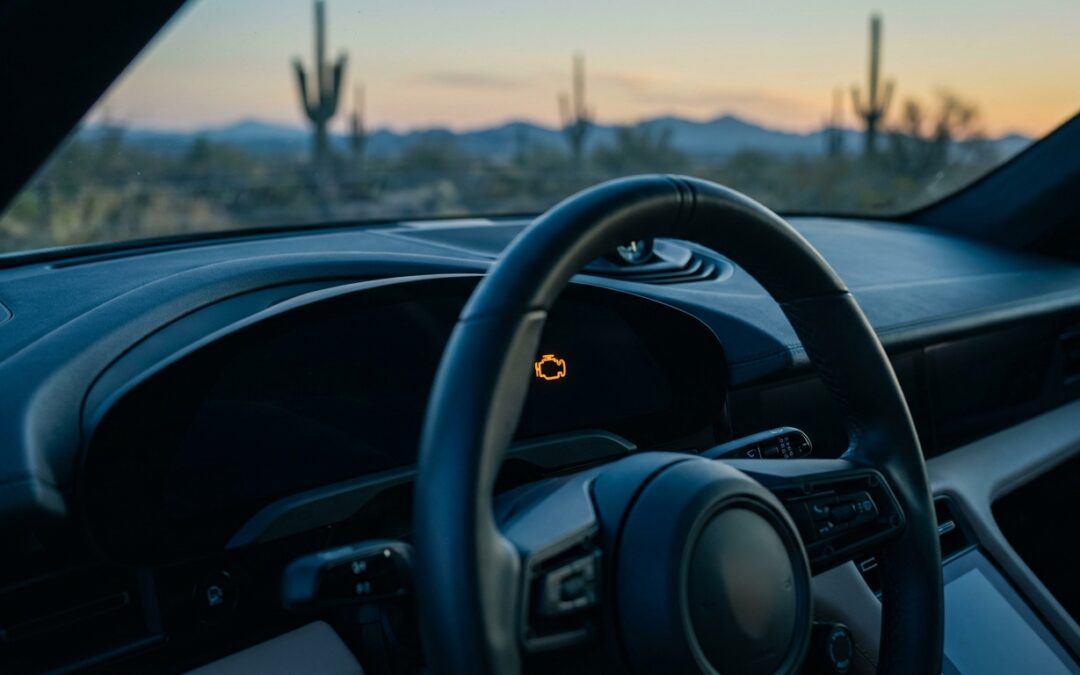
You’re heading down US-60 past Gold Canyon, or backing the trailer out of the driveway near Idaho Road, and that little amber engine icon flickers on. Your stomach drops. Is it safe to keep driving? Is this a $40 sensor or a $4,000 engine job? If you’ve been searching “check engine light diagnostic Apache Junction AZ” from the side of the road, this guide is for you.
At Network Automotive Service Center, we’ve been diagnosing check engine lights for East Valley drivers since 1995. Our Apache Junction-area customers drive everything from daily-driver sedans to diesel trucks hauling OHV trailers up the Apache Trail, and we see the same warning light on every one of them — sometimes for five completely different reasons. This article explains exactly what that light means, how a proper diagnostic works, what it costs in Apache Junction today, and how to tell the difference between an “I’ll schedule it next week” code and a “pull over now” emergency.
What a Check Engine Light Actually Is
The check engine light (officially: Malfunction Indicator Lamp, or MIL) is part of your vehicle’s OBD-II system — a federally mandated on-board diagnostics network that’s been in every car sold in the U.S. since 1996. Dozens of sensors monitor your engine, transmission, fuel system, and emissions equipment in real time. When a reading falls outside of the factory-programmed range, the computer stores a Diagnostic Trouble Code (DTC) and turns on the light.
Here’s the part most people get wrong: the light itself doesn’t tell you what’s broken. It just tells you the computer saw something it didn’t like. The DTC gives a clue — for example, P0420 means “catalyst system efficiency below threshold, bank 1” — but that code can be triggered by a failing catalytic converter, a bad upstream oxygen sensor, an exhaust leak, misfires, or even contaminated oil. The code is a symptom. A real check engine light diagnostic is the detective work that finds the actual cause.
Solid vs. Flashing: There’s a Huge Difference
- Solid amber light: Something needs attention soon, but you can usually drive safely to the shop. Think: oxygen sensor, evap leak, loose gas cap.
- Flashing light: This is an emergency. Flashing almost always means an active engine misfire dumping raw fuel into your exhaust. Keep driving and you can destroy a $2,500 catalytic converter in under 10 minutes. Pull over, shut it off, call us at (480) 444-0242.
- Red light (older vehicles) or “STOP ENGINE” message: Immediate shutdown required — usually oil pressure, coolant temp, or a critical sensor.
Apache Junction drivers, remember: summer pavement temps out past Ironwood Drive can top 130°F, and a lot of local trucks are towing trailers up into the Superstitions. An engine that’s already showing a code is already stressed — add heat and a load, and a $200 repair can turn into a $3,000 one fast.
Check Engine Light Diagnostic
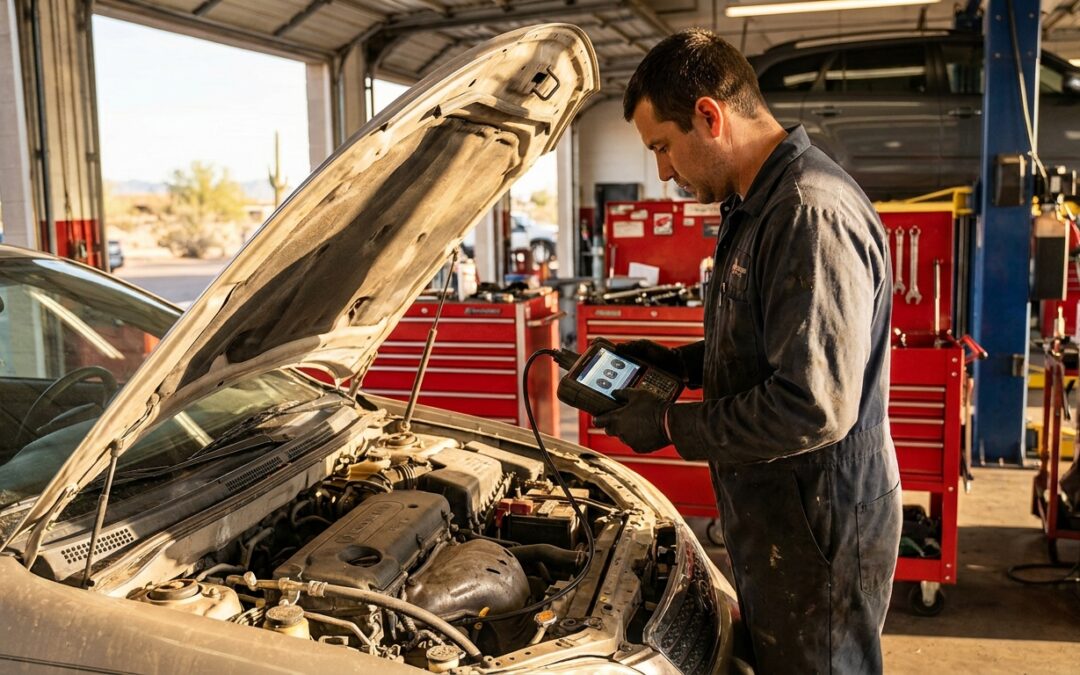
We’ll pull your codes, freeze-frame data, and live sensor readings. You’ll leave knowing what’s happening under your hood — no pressure, no upsell.
Why the “Free Scan” at the Parts Store Isn’t a Real Diagnostic
We hear it every week: “I went to O’Reilly and they said it’s a P0171 — just need a new O2 sensor, right?” Maybe. More often, no. Here’s why the parts-store scan is a starting point, not an answer:
- Generic codes only. Parts-store scanners pull generic OBD-II codes but miss manufacturer-specific codes (the ones that start with P1, B, C, U). A Ford or Ram often has a dozen extra codes the cheap tool never sees.
- No live data. A proper Apache Junction check engine light diagnostic watches sensor values in real time while the engine runs — fuel trims, O2 response, MAF grams-per-second, misfire counters. A code alone can’t show you that.
- No freeze-frame analysis. The computer snapshots exactly what was happening when the code set — RPM, coolant temp, throttle position. That snapshot is often what tells us whether the problem is a sensor or the thing the sensor was measuring.
- No bi-directional testing. We can command your fuel pump, EGR valve, cooling fans, or solenoids on and off through the scan tool to isolate which component is actually failing.
- No guarantee. If the parts-store “diagnosis” is wrong, you just bought a part you don’t need. We’ve seen customers spend $400 on sensors for a cracked vacuum hose.
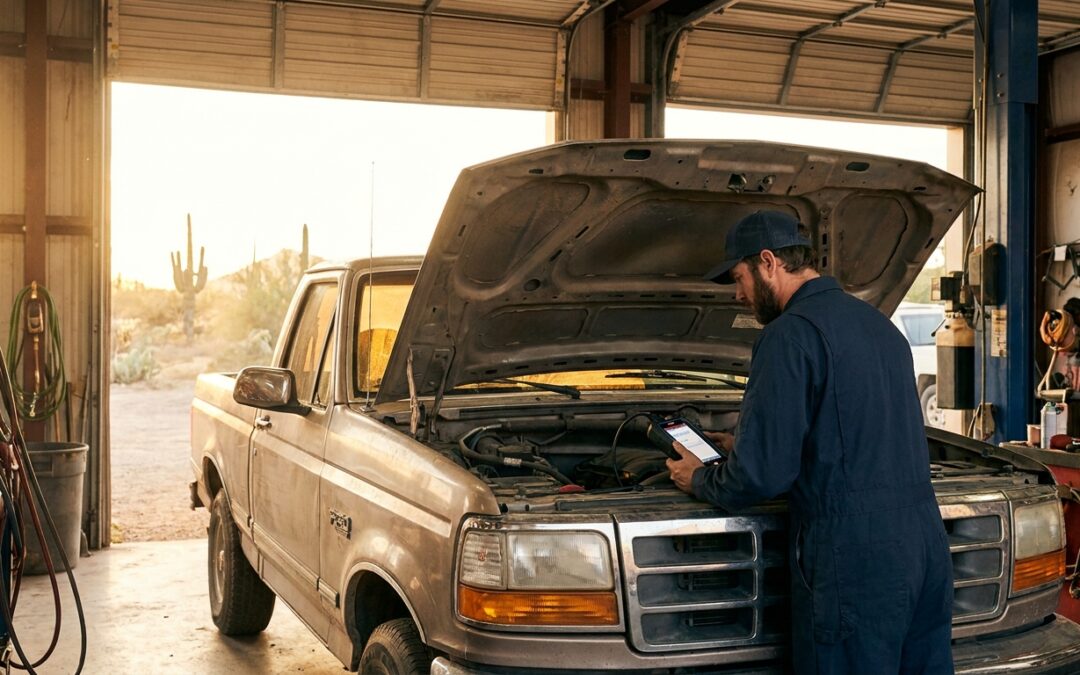
A real check engine light diagnostic at an Apache Junction shop like Network Automotive isn’t just “plugging in a scanner.” It’s a technician with 15+ years of experience reading live data, testing actual components with a multimeter or oscilloscope, and verifying the fix before you pay. That’s why we stand behind every diagnosis with a nationwide 24-month / 24,000-mile warranty.
The 10 Most Common Check Engine Light Causes We See in Apache Junction
After diagnosing thousands of East Valley vehicles — including a lot of dusty gravel-road commuters and trailer-towing trucks — here’s our real-world breakdown of what the light most often turns out to be:
| Cause | How Common | Typical Repair Cost (Apache Junction) | Drive-Safe? |
|---|---|---|---|
| Loose or bad gas cap | Very common | $0–$35 | Yes |
| Oxygen (O2) sensor | Very common | $180–$420 | Usually |
| Evap system leak | Common | $150–$600 | Yes |
| Mass airflow (MAF) sensor — dust-fouled | Common here | $220–$480 | Usually |
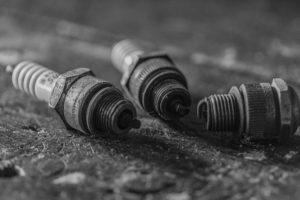
| Spark plugs / coil packs (misfire) | Common | $180–$900 | Only if NOT flashing |
| Catalytic converter | Moderate | $600–$2,400+ | Short trips only |
| EGR valve / EGR system | Moderate (diesels high) | $300–$1,200 | Usually |
| Thermostat / coolant sensor | Moderate | $220–$520 | Watch temp gauge |
| Vacuum leak (intake) | Moderate | $120–$600 | Yes |
| Transmission solenoid / speed sensor | Less common | $300–$1,400 | Depends |
Those are ranges, not quotes — your exact cost depends on year, make, model, and what the diagnostic uncovers. The biggest factor isn’t the parts: it’s correctly identifying which of those items is actually causing your light. We flag dust-fouled MAF sensors more often out here than in other East Valley shops, simply because so many customers drive unpaved stretches near Iron Horse and the Superstition foothills.
How Network Automotive Diagnoses a Check Engine Light
Here’s exactly what happens when you bring your car, truck, or SUV to our Apache Junction-area shop for a check engine light diagnostic. No smoke, no mirrors — just the real workflow.
- Customer interview. Before we touch the car, we ask: when did it start? Does it flicker or stay on? Any unusual smells, sounds, or loss of power? Were you towing, off-roading, or driving dusty roads recently? Half the diagnosis is what you’ve already noticed.
- Full code scan — all modules. We pull generic and manufacturer-specific codes from every module on the vehicle: engine (PCM), transmission (TCM), body control, ABS, airbag, HVAC. Related codes in other systems often point to the real cause.
- Freeze-frame + history. We read the snapshot data from when the code set and check for pending codes the light hasn’t fully committed to yet.
- Live data analysis. Engine running, we watch fuel trims, O2 sensor activity, MAF readings, ignition timing, and misfire counters in real time. This is where a $40,000 Autel or Snap-on scanner earns its keep over a $15 Bluetooth dongle.
- Component testing. We don’t replace parts on a hunch. Suspected bad sensor? We test it with a multimeter. Suspected coil? We swap-test it to an adjacent cylinder and watch the misfire follow. Vacuum leak? Smoke machine.
- Written diagnostic report. You get a plain-English explanation of what failed, why, and what it takes to repair — with the exact parts and labor quoted in writing. No verbal surprises.
- Repair approval — your call. We don’t touch anything until you authorize. If you want to think about it, take the report home. If you want it fixed today, we start.
- Verification drive. After the repair, we clear codes and road-test until the monitors re-set. Many shops skip this. We don’t, because “it seems fixed” isn’t good enough.
What Does a Check Engine Light Diagnostic Cost in Apache Junction?
Straight numbers, because you deserve them:
- Basic code scan: Fee quoted upfront at Network Automotive — we’ll pull codes and freeze-frame data so you know where you stand.
- Full diagnostic (live data + component testing): typically $89–$150 depending on complexity. If you approve the repair with us, this fee is usually credited toward the work.
- Advanced diagnostic (multi-system, intermittent faults, drivability issues, European or diesel): $150–$280, quoted up-front before we start.
Compare that to the cost of guessing: a misdiagnosed O2 sensor ($400 part + labor) that turns out to be a bad catalytic converter is money you don’t get back. A real diagnostic pays for itself the first time it stops you from buying a part you didn’t need.
How long does it take?
Most Apache Junction check engine light diagnostics are done the same day. Simple issues (gas cap, O2 sensor, misfire on one cylinder) are often diagnosed in 60–90 minutes. Intermittent problems — the ones that only happen on hot days, towing uphill, or after 20 miles — sometimes require overnight monitoring or a repeat drive cycle. We’ll tell you up-front which category yours falls into.
Stop Guessing. Start Driving Again.
Bring us your check engine light, get real answers, pay a fair price — or get a second opinion and walk away. Either way, you’ll know exactly what’s going on.
Is It Safe to Keep Driving with the Light On?
The honest answer: it depends on the light and the code. Here’s the rule of thumb we give every Apache Junction customer:
- Solid light, car drives normally, no smell, no power loss: OK to drive a few days, but get it scanned this week. Emissions codes that linger can cause other problems over time.
- Solid light + drivability issue (shaking, hesitation, loss of power, rough idle): stop driving hard and schedule an appointment immediately. You’re risking bigger damage, especially towing.
- Flashing light: stop driving. Period. Pull over, shut it off, call us or a tow. A flashing CEL in 115°F desert heat can cook a catalytic converter in minutes.
- Light + temperature or oil-pressure warning: emergency. Engine damage can happen in seconds. Shut off and call.
A note on Arizona emissions: Pinal and Maricopa County require emissions testing for many vehicles. A vehicle will automatically fail emissions with a check engine light on — or with the code cleared but the monitors not fully re-set. If your registration is due soon, don’t just clear the code before testing. We specifically prepare vehicles for AZ emissions and verify readiness monitors before you drive to the test station.
What to Do the Moment Your Check Engine Light Comes On
- Don’t panic. 80% of the time it’s not catastrophic.
- Check the gas cap first. Seriously. Take it off, clean the threads, click it three times until it ratchets. A loose cap triggers an evap code and the light can take 50–100 miles to clear on its own.
- Notice: is it flashing or solid? Flashing = stop.
- Feel the car. Any shaking, hesitation, misfire, weird smell (sweet = coolant, rotten egg = catalytic converter, gas = fuel leak)?
- Check the temperature gauge and oil-pressure light. If either is abnormal, pull over.
- Call Network Automotive. (480) 444-0242 — we’ll tell you over the phone if it’s safe to drive in. Free advice, no appointment needed to ask.
Why Apache Junction Drivers Trust Network Automotive
There are plenty of auto shops between Idaho Road and Ironwood. Here’s what’s different about ours:
- Family-owned since 1995. Three decades, five+ locations across Mesa, Gilbert, Apache Junction, Queen Creek, and Prescott. Same family, same values.
- ASE-certified master technicians. Our diagnosticians hold the highest industry certifications — not oil-change-and-hope mechanics.
- Factory-level scan tools. We invest in the same diagnostic equipment the dealership uses: Autel MaxiSYS, Snap-on Zeus, plus OEM-specific tools for Ford, GM, Ram, Toyota, Honda, and European makes.
- 24-month / 24,000-mile nationwide warranty on parts and labor — not just 12 months.
- Written estimates before we start. Zero phone-tag surprises, zero “while we were in there” add-ons without your approval.
- Free loaner options for longer repairs. You don’t need to miss work.
- Real reviews. Thousands of five-star Google and Yelp reviews across our AZ locations — we’d rather earn them than buy them.
Read more about our shop and philosophy on the About Network Automotive page, see the full service menu, or browse current Apache Junction service coupons.
A Quick Word on Diesel Check Engine Lights
If you’re driving a Power Stroke, Cummins, or Duramax around Apache Junction — especially one pulling a horse trailer or OHV rig up toward the Superstitions — your check engine light plays a different game. Diesel CELs often involve:
- DPF (diesel particulate filter) regeneration issues — especially on short in-town commutes that never let the truck complete a regen
- EGR valve failures — extremely common in AZ heat and dust
- DEF system faults that can throw your truck into “limp mode” and eventually refuse to start
- Injector balance codes — cheap diesel can shorten injector life
- Turbo actuator faults from sustained high-heat towing up grades
Network Automotive has dedicated diesel technicians and the specific scan tools to diagnose these systems properly. Don’t let a generic shop treat a diesel CEL like a gas-engine CEL — the codes look similar and the fixes are not.
Proudly Serving Apache Junction and the Greater East Valley
Network Automotive Service Center is the trusted choice for check engine light diagnostics across:
- Apache Junction — including Gold Canyon, Superstition Mountain, Idaho Road, and the Apache Trail corridor
- Mesa — East Mesa, Las Sendas, Red Mountain, downtown
- Gilbert — Agritopia, Morrison Ranch, Seville, and the Power Ranch area
- Queen Creek — Cortina, Pecan Lake, Ironwood Crossing, San Tan Heights
- Prescott — Prescott Valley and surrounding
Coming from Apache Junction? Most of our Apache Junction-area customers book at our East Mesa shop just minutes down US-60, or call ahead and we’ll help you find the closest location.
Apache Junction Check Engine Light FAQ
How much does a check engine light diagnostic cost in Apache Junction?
At Network Automotive, a basic code scan carries a diagnostic fee. A full diagnostic — with live-data analysis and component testing — typically runs $89–$150, and that fee is usually credited back if you approve the repair with us. Advanced multi-system or intermittent diagnostics can run $150–$280 and are always quoted up-front in writing. Call (480) 444-0242 for an estimate on your specific vehicle.
Is it safe to drive my car with the check engine light on?
If the light is solid amber and the car is driving and sounding normally, you can usually drive to a shop without immediate damage — but don’t delay more than a few days. If the light is flashing, stop driving immediately. A flashing CEL almost always means an active misfire, which can destroy your catalytic converter within minutes, especially towing in Arizona summer heat.
Why did the parts store say one thing and my mechanic said another?
A parts-store scanner pulls generic codes only. A proper Apache Junction check engine light diagnostic includes manufacturer-specific codes, freeze-frame data, live sensor monitoring, and hands-on component testing. The parts-store code is a clue, not a diagnosis. That’s why customers often end up buying sensors they didn’t need — the cheap scan pointed at a symptom, not the cause.
Can a loose gas cap really cause the check engine light?
Absolutely — it’s one of the most common causes. Your evap (evaporative emissions) system pressurizes to test for leaks, and a loose or cracked cap fails the test. Tighten the cap until it clicks three times and drive 50–100 miles. If the light stays on, come see us for a diagnostic.
How long will a check engine light diagnostic take?
Most Apache Junction diagnostics are same-day. Straightforward issues are typically diagnosed in 60–90 minutes. Intermittent problems — ones that happen only on hot days, towing uphill, or after warm-up — sometimes need an extended drive cycle or overnight monitoring. We’ll give you a realistic timeline up-front.
Will my car fail Arizona emissions with the check engine light on?
Yes. Pinal and Maricopa County will automatically fail any vehicle that has an active check engine light or that has readiness monitors that haven’t fully reset. Just clearing the code before testing usually isn’t enough — the monitors need to re-run. We prep vehicles specifically for AZ emissions testing.
Can I just clear the code myself and drive?
You can, but it’s almost always a mistake. The underlying problem is still there, it’ll come back (often within a few drive cycles), and in the meantime you’ve erased the freeze-frame data that could have made diagnosis faster and cheaper. It’s like silencing a fire alarm without checking for smoke.
Do you warranty your diagnostic work?
Yes. Network Automotive backs every repair with a 24-month / 24,000-mile nationwide warranty on parts and labor. If our diagnosis leads to a repair and the issue comes back inside that window, we fix it — at any participating shop across the country.
Let’s Get That Light Off
Family-owned in the East Valley since 1995, ASE-certified, dealership-grade diagnostic equipment, and a 24-month / 24,000-mile nationwide warranty. Bring us your check engine light — we’ll figure it out together.