Diesel Mechanic in Mesa, AZ: Power Stroke, Cummins, Duramax Done Right

Diesel Mechanic in Mesa, AZ: Power Stroke, Cummins, Duramax Done Right

HomeBlog › Diesel Mechanic Mesa AZ

Diesel Mechanic in Mesa, AZ: Power Stroke, Cummins, Duramax — Done Right, Done Local

By Network Automotive Service CenterMesa, AZUpdated May 2026

Your diesel deserves better than a generic shop guessing its way through a regen problem. Whether you’re running a 6.7 Power Stroke towing a fifth wheel, a 6.7 Cummins work truck, or a Duramax that just threw a P2002, this is the mechanic-written guide to diesel repair in Mesa — the real failures, real 2026 prices, and how to spot the shops that don’t know a DPF from a DEF tank.

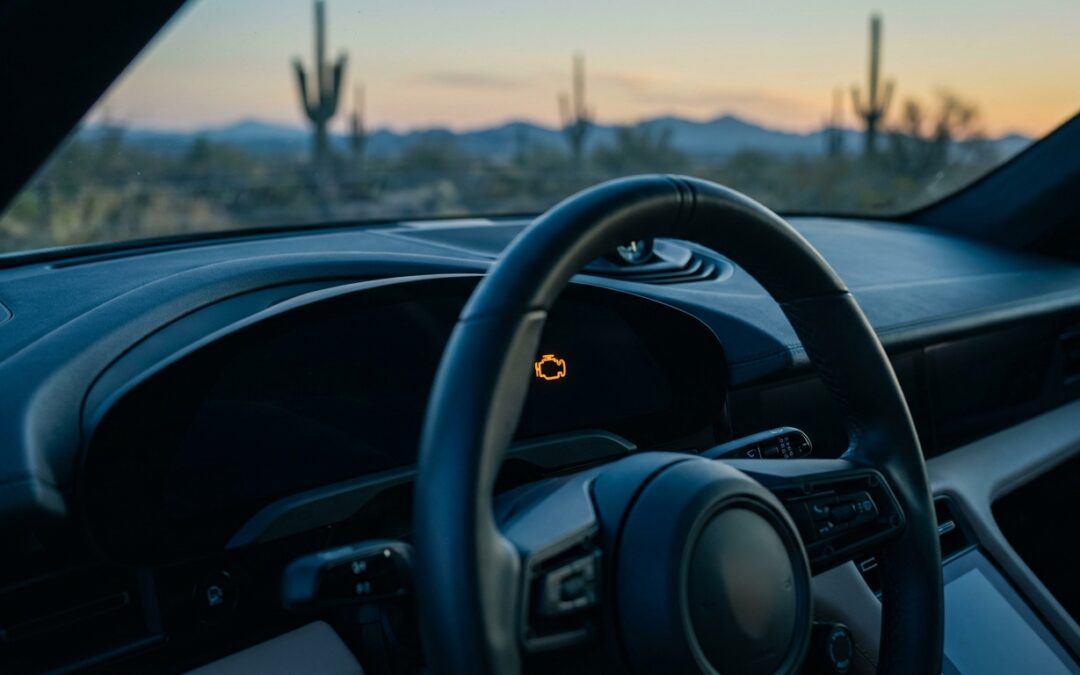
The check-engine light came on somewhere between Apache Junction and the Costco gas station on Power Road. The truck went into limp mode at the next light. You’re in line at the dealer for two weeks, $185/hr labor, and they want $4,800 to “start diagnosing.” If you’ve been Googling “diesel mechanic Mesa AZ” from the cab of a truck you can’t get above 35 mph, you’re in the right place.

At Network Automotive Service Center, we’ve been working on East Valley diesels since 1995. Mesa has more 3/4-ton and 1-ton diesel trucks per capita than almost any city in the Southwest — work trucks, RV pullers, horse trailer haulers, weekend toy haulers, side-business landscapers, contractors, off-roaders, and overlanders. We see them all. This guide walks you through what actually goes wrong on modern diesels, what real diesel repair costs in Mesa in 2026, how a real diesel shop diagnoses a problem, and how to avoid the two biggest traps: under-qualified general shops and overpriced dealerships.

$185+
per hour — what the local Ford/Ram/Chevy dealerships are charging for diesel labor in 2026. Network Automotive offers dealer-grade diesel work at honest independent-shop rates, with a 24-month / 24,000-mile nationwide warranty most dealers can’t match.

What Diesel Engines We Service in Mesa

Our techs are factory-trained and ASE-certified across the three modern American diesel platforms plus the most common heavy-duty light-truck imports:

  • Ford Power Stroke — 6.0L, 6.4L, 6.7L (all generations through 2026)
  • Ram Cummins — 5.9L 12-valve, 5.9L 24-valve, 6.7L (HO and SO), 2025+ Hercules platform
  • GM Duramax — LB7, LLY, LBZ, LMM, LML, L5P, LZ0 (all model years)
  • Sprinter / Mercedes OM642 & OM651 diesel vans
  • Volkswagen TDI and other compact diesels
  • Diesel SUVs — GMT900/T1 1500 diesels, Jeep EcoDiesel, etc.

Why Mesa Is Especially Hard on Diesel Engines

  • Heat soak. Mesa summer pulls 115°F at the asphalt. Diesel coolant, oil, and DEF all break down faster, and exhaust gas temps run hotter on hard pulls.
  • Towing. Mesa has more boats, RVs, horse trailers, and car haulers than most cities. Heavy towing in 110° heat is the worst case for any diesel.
  • Short-trip city driving. A diesel that never gets to highway speed can’t complete a DPF regen — the #1 reason we see modern diesels in limp mode.
  • Desert dust. Fine grit kills air filters, clogs intercoolers, and contaminates fuel.
  • Bad diesel fuel. Not every Mesa truck stop has consistent fuel quality. Watery or contaminated diesel destroys HPFPs and injectors.

Mesa diesel tip: If your modern diesel mostly does short trips around Mesa and never sees a sustained 65+ mph highway run, you are guaranteed to have DPF problems within 50,000 miles. A monthly 30-minute highway loop on the 202 or US-60 is the single cheapest preventive maintenance you can do.

Mesa Diesel Diagnostic

Bring us your Power Stroke, Cummins, or Duramax. We’ll pull every code (engine, trans, body, ABS), read live data, and quote your repair in writing before you authorize a dollar of work.

Book My Diesel Diagnostic →

The Most Common Diesel Failures We See in Mesa

After three decades of East Valley diesel work, here is the honest breakdown of what rolls into our shop and what each repair typically runs in 2026:

Failure Platforms Most Affected Typical Mesa Repair Cost Limp Mode?
DPF clog / regen failure All 2008+ $650–$2,400 Yes
EGR valve / EGR cooler 6.0/6.4 Powerstroke, 6.7 Cummins $900–$2,800 Sometimes
DEF system / NOx sensor failure All 2011+ $650–$2,400 Yes, after countdown
Turbo actuator / VGT 6.7 Power Stroke, 6.7 Cummins, LML/L5P $1,400–$3,800 Sometimes
HPFP (CP3/CP4) failure LBZ/LMM/LML Duramax, 6.7 Power Stroke $5,500–$12,000+ Yes, catastrophic
Injector failure (one or more) All platforms $1,200–$4,800 Often misfires
Turbo replacement All platforms with mileage $2,200–$5,500 Performance loss
Glow plug / glow plug module All platforms $280–$1,400 Hard start cold
Coolant leak / EGR cooler / oil cooler 6.0/6.4 Power Stroke especially $1,400–$3,600 Overheating
Transmission (Allison, 6R140, 68RFE/AS69RC) All platforms $3,800–$8,500 (rebuild) Yes
Fuel filter housing / WIF sensor All platforms $220–$680 Maybe
Wiring / sensor / electrical gremlins All platforms $180–$1,400 Varies

Those are real Mesa 2026 ranges. Your number depends on year, mileage, parts grade (OEM vs. quality aftermarket), and what the diagnostic uncovers. The biggest single variable on a diesel repair is whether the shop correctly identifies the actual failure on the first try — or whether they throw $3,000 in parts at it before finding the $250 sensor that started everything.

The DPF + DEF + EGR “Trifecta” That Eats Modern Diesels

If you own a 2011+ diesel and you’re going to have one big problem, it’ll almost certainly involve the emissions system. Modern diesels run three interlinked systems that can each individually take your truck off the road:

  • DPF (Diesel Particulate Filter) — traps soot, periodically “regens” (burns soot off) at highway speed. Short-trip Mesa driving = chronic incomplete regens = clogged DPF.
  • DEF (Diesel Exhaust Fluid) system — sprays urea into the exhaust to break NOx into nitrogen and water. NOx sensors, DEF heaters, and the SCR catalyst all fail in AZ heat.
  • EGR (Exhaust Gas Recirculation) — cools and recirculates exhaust gases. EGR coolers crack and dump coolant into the engine on 6.0 and 6.4 Power Strokes. EGR valves stick open or shut on every platform.

These three systems are connected by sensors and software, which means a single bad sensor anywhere in the trifecta can throw your truck into limp mode and store six codes that all look like real failures. Misdiagnosing this is how shops sell you a $3,000 DPF when the real culprit was a $180 NOx sensor.

How Network Automotive Diagnoses Diesel Problems in Mesa

Here is exactly what happens when you bring your diesel into our shop — same workflow on a 7.3 Power Stroke as on a 2025 L5P Duramax.

  1. Customer interview. When did the issue start? Loaded, empty, hot, cold, idle, highway, towing, after fuel-up? Diesel diagnostics are 50% pattern recognition.
  2. Full multi-module code scan. Engine PCM, transmission TCM, body, ABS, instrument cluster, glow plug module, DEF dosing module, and any aftermarket programmer. Diesel codes in unrelated modules often point at the actual failure.
  3. Freeze frame + pending codes. We read what the truck was doing the instant the code stored. RPM, load, temperature, regen state, DEF level — all of it.
  4. Live data analysis. Boost pressure, EGT, fuel rail pressure, injection timing, exhaust pressure, DEF dosing rates, NOx sensor outputs, regen status. This is where dealer-grade scan tools earn their cost.
  5. Bi-directional and component testing. We command the EGR valve, turbo vanes, DEF doser, transmission solenoids, glow plugs, and cooling fans individually. We test injector balance and contribution. We pressure-test boost and exhaust systems with a smoke machine.
  6. Mechanical inspection. Coolant leaks, oil leaks, fuel filter condition (looking for water, contamination, and metal), turbo shaft play, intercooler condition.
  7. Written diagnostic report. Plain-English summary of what failed, why, and what it takes to repair — with exact parts and labor quoted. No surprises.
  8. Repair approval — your call. Want a second opinion? Take the report. Want it fixed today? We start. Either way, we don’t touch the truck without your authorization.
  9. Verification + drive cycle. Diesels often need a multi-stage drive cycle to fully verify a repair (clearing monitors, completing a regen, validating DEF dosing). We do this before we hand the keys back — not after the customer drives away.
30+
years serving Mesa’s diesel community. Network Automotive has been family-owned and ASE-certified since 1995. Power Stroke, Cummins, Duramax — same techs, same shop, same ethics, for three decades.

What Does Diesel Repair Cost in Mesa in 2026?

Straight numbers, because you’ve been quoted enough $6,000 estimates already:

  • Diesel diagnostic (no repair): $150–$280, quoted up-front. Typically credited toward repair if approved.
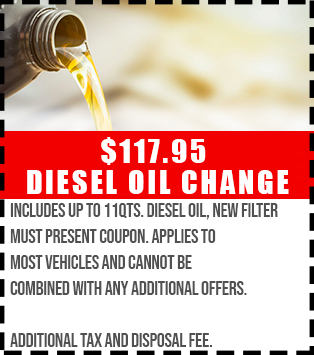
  • Diesel oil & filter service (15-quart 6.7s, 13-quart Duramax/Cummins, with OEM-spec oil): $180–$280
  • Fuel filter service (single or dual filter platforms): $140–$320
  • DPF cleaning (off-truck thermal/pneumatic clean, no removal of emissions): $650–$1,400
  • DPF replacement (OEM): $2,400–$4,800
  • EGR cooler replacement (6.0/6.4 Power Stroke, 6.7 Cummins): $1,400–$2,800
  • NOx sensor replacement (one): $320–$680
  • DEF heater / dosing module: $480–$1,400
  • Turbo actuator replacement: $1,400–$2,800
  • Turbo replacement (OEM, with install & coding): $3,200–$5,500
  • Injector replacement (one): $650–$1,200 · full set of 8: $3,800–$7,500
  • HPFP (CP3) replacement: $2,800–$4,800 · CP4 failure (full fuel system contamination): $9,500–$14,000+
  • Transmission rebuild (Allison 1000, 6R140, 68RFE, AS69RC): $4,800–$8,500
  • Programming / forced regen / module flash: $220–$520

How long does diesel repair take in Mesa?

Most diagnostics are completed in 1–2 business days — diesels are more complex than gas vehicles and often need full drive cycles to verify intermittent faults. Simple repairs (sensors, glow plugs, filters) are same-day or next-day. Major emissions work (DPF, EGR cooler, full turbo) is 2–5 business days depending on parts availability. Full engine or transmission jobs run 1–3 weeks. We offer loaner trucks on extended jobs and prioritize work trucks and commercial vehicles whenever possible.

Real Diesel Work, Honest Mesa Pricing

Skip the $185/hr dealer rate. Skip the general shop that has “done a few diesels.” Network Automotive runs dealer-grade scan tools, OEM-spec parts, and a 24-month / 24,000-mile nationwide warranty — for a fraction of the dealership ticket.

Schedule My Diesel Service →

Mesa Diesel Dealership vs. Network Automotive

Here’s the honest side-by-side most people don’t see until after they’ve been quoted at both:

Local Ford/Ram/GM Dealer Network Automotive
Labor rate $185–$240/hr $140–$165/hr
Scheduling 1–3 week wait common Usually within 48 hrs
Scan tools OEM only OEM-equivalent (Autel MaxiSYS Ultra, Snap-on Zeus, Cummins INSITE, Ford IDS)
Parts OEM only OEM or quality aftermarket — your call
Warranty 12 months / 12k miles typical 24 months / 24,000 miles nationwide
Goodwill on out-of-warranty issues Rare Common — we want repeat customers, not transactions
Owner contact Service writer Direct access to Erik, the owner — same phone, same name, every visit

When Should I Bring My Diesel In?

Diesels give you warning signs — if you know what to listen for. Get it checked when you notice:

  • Black or blue smoke under hard acceleration (overfueling, turbo, intercooler boot)
  • White smoke after warm-up (coolant entering combustion — common on 6.0 Power Stroke EGR cooler failure)
  • Hard cold-start or extended crank in cool Mesa mornings (glow plugs, fuel pressure, injector seal)
  • Active regen happening every drive instead of every 300–500 miles (DPF clog beginning)
  • DEF countdown / “XX miles to 5 mph” warning (DEF system or NOx sensor — don’t ignore)
  • Sudden loss of power / limp mode (boost leak, turbo, sensor, full emissions fault)
  • Coolant disappearing with no visible leak (oil cooler, EGR cooler, head gasket)
  • Metal in the fuel filter on a Duramax LBZ/LMM/LML (CP3 dying — act NOW)
  • Fuel in oil or oil overfull (injector leak, HPFP, DEF in fuel)
  • Vibration, slip, or harsh shift in the transmission (Allison, 6R140, 68RFE, AS69RC all have known issues)

One number you cannot ignore: if your DEF system enters the speed-limiter countdown (typically “XXX miles to 5 mph” displayed on your dash), you have a defined window to fix it before your truck physically refuses to exceed walking speed. Towing a trailer when this happens is a logistical disaster. Call (480) 444-0242 the day you see it.

Fleet, Commercial & Contractor Diesel Service

If you run service trucks, delivery vans, dump trucks, or a small construction fleet in Mesa, Network Automotive handles it. We offer:

  • Priority scheduling — fleet vehicles go to the front of the line
  • Volume pricing on oil/filter service, DEF, fuel filters, and consumables
  • Monthly invoicing on approved accounts
  • Per-vehicle service records — downloadable, sortable, ready for DOT or insurance
  • Preventive maintenance contracts tailored to your usage and mileage
  • On-site pickup & delivery for fleet accounts within East Valley

Call Erik directly at (480) 444-0242 to set up a fleet account or get a written estimate on your maintenance budget.

Why Mesa Diesel Owners Trust Network Automotive

  • Family-owned since 1995. Three decades, five East Valley locations across Mesa, Gilbert, Apache Junction, Queen Creek, and Prescott. Same family, same standards.
  • Diesel-specific ASE-certified technicians. Not gas-engine guys “who can probably figure it out.”
  • Dealer-grade scan tools across all three major platforms — including Ford IDS, GM GDS2/MDI2, Cummins INSITE, Autel MaxiSYS Ultra, and Snap-on Zeus.
  • 24-month / 24,000-mile nationwide warranty on parts and labor — significantly better than any local dealer.
  • Written estimates up-front. No phone-tag, no “while we were in there.”
  • Loaner trucks on longer repairs so your work doesn’t stop.
  • Honest fleet pricing for Mesa contractors and small businesses.
  • Thousands of five-star reviews across Google and Yelp at our AZ locations — earned, not bought.

Read more on the About Network Automotive page, see the full service menu, or browse current Mesa service coupons.

Proudly Serving Mesa and the Greater East Valley

Network Automotive Service Center is the trusted name for diesel repair across:

  • Mesa — East Mesa, West Mesa, Las Sendas, Red Mountain, Dobson Ranch, Alta Mesa, downtown corridor
  • Gilbert — Agritopia, Morrison Ranch, Seville, Power Ranch
  • Queen Creek — Cortina, Ironwood Crossing, San Tan Heights, Pecan Lake
  • Apache Junction — Superstition, Gold Canyon
  • Prescott — Prescott Valley and surrounding

Most Mesa diesel customers book at our East Mesa shop at Power Road and US-60 — the easiest in-and-out for a 1-ton truck or trailer rig.

Mesa Diesel Repair FAQ

How much does diesel repair cost in Mesa compared to the dealership?

Network Automotive typically runs $140–$165/hr in labor compared to $185–$240/hr at local Ford, Ram, and GM dealerships. On a 6-hour EGR cooler job, that’s often a $300–$500 labor savings before parts. Combined with our 24-month / 24,000-mile nationwide warranty (most dealers offer 12 months), an independent diesel shop with dealer-grade tools is usually the smarter financial choice for out-of-warranty trucks. Call (480) 444-0242 for a written quote.

Do you work on all three major diesel platforms?

Yes. Network Automotive services Ford Power Stroke (6.0, 6.4, 6.7), Ram Cummins (5.9 and 6.7 all generations), and GM Duramax (LB7 through L5P and LZ0) with dealer-grade scan tools for each platform. We also handle Mercedes/Sprinter, Volkswagen TDI, and most diesel SUVs.

My DEF system is counting down — how serious is that?

Very serious. Once a 2011+ diesel detects a DEF or NOx fault, the ECM begins a defined countdown to a speed limiter — usually ending at a 5 mph crawl. The countdown displays mileage remaining on your dash. Once it hits zero, the truck physically will not exceed walking speed. Common causes are NOx sensors, DEF heaters, contaminated DEF, or SCR catalyst failure. Bring it in immediately.

How often does my diesel need oil and filter service in Mesa?

Most modern diesels: every 7,500–10,000 miles, or 6 months, whichever comes first. Heavy towing in Arizona heat shortens that to 5,000–7,500 miles. We use OEM-spec 15W-40 or 5W-40 diesel-rated oil only — never the bargain stuff from a quick-lube chain. Fuel filters typically every 15,000–20,000 miles, sooner if you fuel at lower-quality stations.

My DPF is clogged — do I really have to replace it?

Not always. Many DPFs can be successfully off-truck cleaned (thermal + pneumatic process) for $650–$1,400 versus $2,400–$4,800 for an OEM replacement. Cleaning works on filters that have ash buildup but no thermal damage or melted substrate. We measure pressure differential and inspect the filter before recommending cleaning vs. replacement.

Can you do an EGR or DPF delete?

We cannot legally remove or modify federally-mandated emissions equipment on a road-driven vehicle. We can diagnose and properly repair emissions systems, clean DPFs, replace failed EGR coolers and valves with OEM parts, and perform forced regenerations — all of which usually solves the underlying issue most people think requires a delete.

How long does a typical diesel repair take?

Simple sensor or filter jobs are same-day. EGR cooler, NOx sensor, glow plug, and DEF heater jobs are typically 1–2 days. Major emissions work (DPF replacement, full EGR system, turbo) runs 2–5 days depending on parts. Engine and transmission jobs are 1–3 weeks. We offer loaner trucks on extended jobs so your work doesn’t stop.

Does Network Automotive warranty diesel work?

Yes. Every diesel repair is backed by our 24-month / 24,000-mile nationwide warranty on parts and labor — honored at any participating NAPA AutoCare shop across the country. That is meaningful protection on a truck that might roll into a problem 800 miles into a tow.

Mesa’s Trusted Independent Diesel Shop

Family-owned in the East Valley since 1995, ASE-certified across Power Stroke, Cummins, and Duramax, dealer-grade scan tools, and a 24-month / 24,000-mile nationwide warranty. Skip the dealership wait list and the dealership price tag.
Shocks and Struts Replacement in Prescott, AZ: Signs, Costs & Same-Day Service

Shocks and Struts Replacement in Prescott, AZ: Signs, Costs & Same-Day Service

HomeBlog › Shocks and Struts Replacement Prescott AZ

Shocks and Struts Replacement Prescott AZ

By Network Automotive Service CenterPrescott, AZUpdated April 2026

Prescott’s mountain roads and dramatic elevation changes put suspension systems under serious stress. Here’s how to know when your shocks or struts are failing — and what it costs to fix them.

Prescott, Arizona sits at 5,400 feet above sea level, surrounded by winding mountain roads, rocky terrain, and dramatic switchbacks that test your vehicle’s suspension every single day. Whether you’re navigating Thumb Butte Road, dropping down Senator Highway, or hauling gear up Iron Springs Road, your shocks and struts are working overtime compared to driving on flat valley pavement. Add in Arizona’s extreme heat (—which accelerates rubber bushing deterioration—) and it’s no surprise that shocks and struts replacement in Prescott, AZ is one of the most common repairs we handle for local drivers.

The problem is that worn suspension parts don’t always scream for attention. The ride gets gradually rougher, handling gets a little looser, and before you know it, you’re dealing with dangerous stopping distances, accelerated tire wear, and a vehicle that no longer responds predictably when you need it most. This guide will walk you through exactly what to look for, what replacement costs in 2026, and how Network Automotive’s certified technicians handle suspension work for Prescott-area drivers.

20%
Longer stopping distance is common with severely worn shocks and struts — the equivalent of an extra car length at highway speed, according to AAA research on suspension wear and brake performance.

What Are Shocks and Struts — and Why Do They Matter?

Shocks and struts are often confused or used interchangeably, but they serve slightly different roles in your vehicle’s suspension system. Understanding the difference helps you have a more informed conversation when your mechanic diagnoses a problem.

Shock absorbers (commonly just called “shocks”) are standalone hydraulic cylinders that dampen the energy transferred from road irregularities through your springs into the vehicle body. They don’t bear vehicle weight — their job is purely to control motion. Shocks are typically found on the rear axle of many trucks and SUVs, and sometimes on both front and rear of older body-on-frame vehicles.

Struts are a structural component that combines the shock absorber with a coil spring into a single assembly. Because they’re integrated into the vehicle’s steering knuckle, struts also affect wheel alignment and steering geometry. Most modern front-wheel-drive cars and many AWD vehicles use struts on the front axle. Replacing them requires more labor than shock replacement and almost always necessitates a wheel alignment afterward.

In Prescott’s driving environment, both types face accelerated wear. The elevation means colder winters with freeze-thaw road damage, while the summers are punishing on rubber seals and bushings. Off-pavement excursions to Watson Lake, the Granite Dells, or Lynx Lake put even well-maintained suspension components through the kind of punishment designed into off-road vehicles. Most manufacturers recommend inspecting shocks and struts every 50,000 miles — but for Prescott drivers, that interval often comes faster.

A quick home test: push down hard on each corner of your vehicle and release. It should bounce back once and settle. If it bounces two or more times, that corner’s shock or strut is likely worn. This “bounce test” takes 30 seconds and can tell you a lot before you ever visit a shop.

Free Suspension Inspection

Not sure if your shocks or struts need replacement? We’ll do a full suspension check at no cost — test drive, visual inspection, bounce test, and written estimate included.

Schedule My Free Inspection

Warning Signs Your Shocks or Struts Are Failing

The challenge with suspension wear is that it happens slowly over thousands of miles. Your brain adapts to the gradual change in ride quality, so you may not notice how bad things have gotten until you ride in a well-maintained vehicle and feel the difference. Here are the six clearest signals that your suspension needs attention:

Symptom What You Feel Most Likely Cause
Bouncy / Floaty Ride Vehicle keeps rocking or bouncing well after hitting a bump instead of settling quickly Worn shock absorbers — no longer damping spring oscillation
Nose-Dive When Braking Front of vehicle dips sharply forward under braking, even in routine stops Blown or weak front struts unable to resist weight transfer
Body Roll in Corners Excessive lean when turning; feels like the vehicle wants to tip outward Worn shocks and/or strut top mounts allowing too much body movement
Clunking or Knocking Metal-on-metal or hollow thud sound over speed bumps, railroad tracks, or rough pavement Worn strut mounts, end links, or jounce bumpers
Uneven Tire Wear Cupped, scalloped, or patchy tread wear pattern visible on inside or outside edges Shocks not keeping tires in consistent contact with the road surface
Oily Residue on Shock Body Dark, oily film or drip visible on the shock absorber casing Blown internal seal — hydraulic fluid leaking out, shock effectively dead

Any one of these symptoms warrants a professional inspection. Two or more is a strong indicator that replacement is overdue. Don’t wait for multiple symptoms to pile up — in Prescott’s mountain terrain, compromised suspension is a genuine safety hazard. Emergency maneuvers on steep grades, tight switchbacks, or gravel shoulders demand that your vehicle respond exactly as expected.

Our Shock & Strut Replacement Process at Network Automotive

When you bring your vehicle in for a suspension inspection at Network Automotive, here’s exactly what happens from drive-in to drive-out:

  1. Test Drive & Initial Assessment — One of our ASE-certified technicians drives your vehicle over varied surfaces to replicate the symptoms you described. We note handling characteristics, noise points, and any pulling or drift before lifting the vehicle.
  2. Full Lift Inspection — With the vehicle on the lift and wheels off, we physically inspect every suspension component: shock and strut bodies, mounting hardware, strut top plates and bearings, control arm bushings, ball joints, sway bar links, and tie rods. Nothing gets missed.
  3. Written Estimate Before We Touch Anything — We present you with a complete, itemized estimate and explain exactly what needs to be replaced and why. No surprises. You approve the work before we proceed.
  4. Component Removal & Disassembly — Worn shocks or strut assemblies are removed. On strut jobs, we use a spring compressor to safely disassemble the old unit and transfer any reusable hardware (such as spring seats and bump stops) to the new assembly.
  5. Inspect Related Components — While everything is apart, we check parts we can’t easily see during the initial inspection: CV axle boots, wheel bearing play, brake hardware condition. If something else needs attention, we let you know immediately.
  6. Install New Components to Factory Spec — We use quality replacement parts — OEM or OEM-equivalent — and torque every fastener to manufacturer specifications. Correct torque matters: under-torqued suspension hardware can work loose; over-torqued can damage threads and crush bushings.
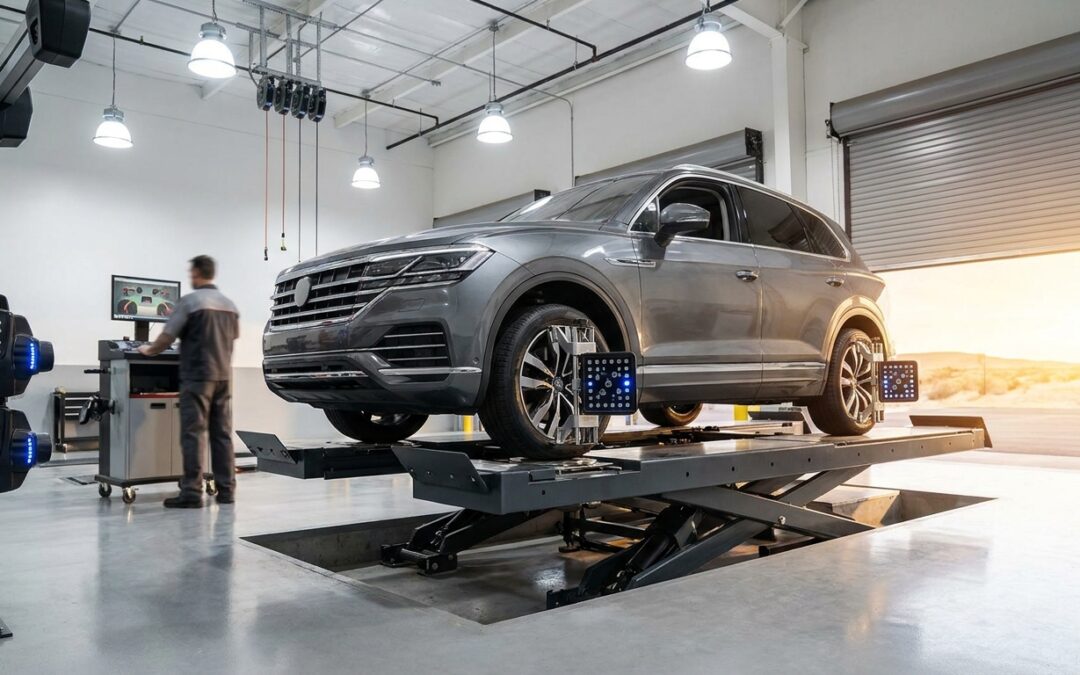
  7. Four-Wheel Alignment — Strut replacement always changes wheel alignment angles. We perform a computerized four-wheel alignment after every strut job to restore factory geometry and prevent uneven tire wear.
  8. Road Test & Confirmation — We take the vehicle through the same driving conditions as the initial test drive to confirm the repair is complete and the ride quality is back where it should be. You get a car back that handles the way it was designed to.

Cost & Turnaround Time for Prescott Drivers

Suspension repair costs vary significantly based on vehicle type, whether you need shocks or struts, and how many corners need attention. Here’s a realistic breakdown of what Prescott-area drivers typically pay in 2026:

  • Rear shock absorbers (pair): $180–$380 installed — most trucks, SUVs, and older sedans. Labor is typically 1–1.5 hours. No alignment required for rear shocks on most vehicles.
  • Front strut assembly (pair): $420–$780 installed — includes new strut cartridge, spring, mount, and bearing plate. Alignment required after; included in our quote.
  • Complete strut assembly (both axles): $700–$1,400 depending on vehicle — full four-corner replacement for high-mileage vehicles where rear struts are also worn. Most economical per-corner.
  • Quick Strut or loaded strut assemblies: $100–$200 more per axle but cut labor time and use new spring + hardware — often the better value on vehicles over 100K miles.
  • Four-wheel alignment: Included after strut replacement; $89–$129 as standalone service. Never skip this after strut work.
  • Turnaround time: Rear shocks: 1.5–2.5 hours. Front struts: 2.5–4 hours. Full suspension refresh: 4–6 hours. Same-day service is available for most jobs when you call ahead.

If your vehicle is under 80,000 miles and the original shocks or struts have never been replaced, a single-axle job is often sufficient. If you’re over 100,000 miles or started having issues at the rear after already replacing the front, it’s worth addressing all four corners — the labor savings on a complete job usually offset the additional parts cost.

Get a Same-Day Suspension Quote

Tell us your vehicle and symptoms. We’ll give you a firm price over the phone or schedule a free inspection — no obligation, no pressure.

Get My Free Quote

When Is It Urgent? AZ Safety Warnings

Not every worn shock or strut needs emergency same-day attention — but some situations do. Here are the conditions where driving on compromised suspension becomes genuinely dangerous, especially for Prescott’s mountain terrain:

  • Visible fluid leaking from the shock body — A blown seal means the shock is no longer functioning. There is no “a little bit leaking” — once the hydraulic fluid is out, the component is effectively dead.
  • Vehicle bottoming out over normal road irregularities — If you’re hitting the bump stops on regular road bumps (not off-road obstacles), the shock has lost all its damping capacity.
  • Severe nose-dive causing delayed braking response — On steep Prescott grades, front weight transfer under braking must be controlled by functioning struts. Without them, stopping distance increases unpredictably.
  • Clunking or grinding that changes with steering input — This can indicate a strut bearing plate or top mount that is cracking, which can cause sudden steering loss in extreme cases.
  • Vehicle pulling hard to one side on level road — Combined with suspension wear, this can signal a strut so badly misaligned that a blowout or loss of vehicle control is possible under sudden swerve conditions.
  • Any suspension symptom combined with ABS or stability control warnings — Your vehicle’s electronic safety systems rely on wheel speed sensors that function correctly only when tires maintain proper road contact. Worn shocks can cause enough wheel hop to confuse these systems.
Arizona-Specific Warning: Prescott’s summer heat (regularly above 90°F even at elevation) breaks down polyurethane and rubber bushings faster than temperate climates. Many Prescott drivers notice their rides getting noticeably worse in the spring after the first freezing winter — this is normal wear acceleration from the freeze-thaw cycle compounding summer heat damage. If your vehicle is 6–8 years old and hasn’t had a suspension inspection, schedule one before monsoon season. Wet mountain roads with worn suspension are a dangerous combination.

What to Do Right Now

If you’re reading this because something feels off with your vehicle’s ride, here’s a practical sequence to follow before you book anything:

  1. Do the bounce test — Push down firmly on each corner of your vehicle and let go. Count the bounces before it settles. One bounce and stop is normal. Two or more means that corner needs attention.
  2. Check for fluid on the shock body — Reach your hand behind each rear wheel and feel the shock absorber body. Any oily residue is a red flag. Do the same for the front strut towers if you can access them without the wheel being off.
  3. Inspect your tire tread pattern — Look for cupping (high-low pattern around the circumference) or uneven wear between the inner and outer edges. Either pattern can indicate suspension problems versus a simple inflation issue.
  4. Note when symptoms are worst — Over bumps? During braking? In corners? In cold weather? This information helps the technician isolate the problem faster and saves you diagnostic time.
  5. Call Network Automotive at (480) 444-0242 — Describe what you found and what you’re experiencing. We can often give you a ballpark estimate over the phone and schedule a same-day inspection if the situation is urgent.
  6. Avoid rough roads until inspected — If you’re seeing multiple warning signs, minimize off-pavement driving and avoid high-speed highway runs until a technician confirms the extent of the wear.

Why Prescott Drivers Choose Network Automotive

We know you have options when it comes to suspension repair. Here’s what consistently brings Prescott-area drivers to Network Automotive over the national chain shops and independent garages:

  • ASE-Certified Technicians — Every technician on our suspension team holds current ASE certification in suspension and steering. This isn’t a shop where your car gets handed to whoever’s available — suspension work goes to specialists.
  • Free Suspension Inspection — we put it on the lift and show you what’s worn. The visual inspection, bounce test, and test drive are included, and you’ll leave with a written estimate before any decision is required.
  • Transparent, Itemized Quotes — We don’t give you a single number and walk away. Every estimate breaks down parts, labor, and any alignment charges so you understand exactly what you’re approving. See our full services list and current coupons.
  • Quality Parts with Warranty — We use OEM and OEM-equivalent parts backed by a parts-and-labor warranty. Cheap shocks from a bargain supplier might save money on day one and cost you again in 18 months. We don’t take that shortcut.
  • Alignment Included After Strut Jobs — Some shops charge alignment as an add-on after every strut replacement. We build it into the strut quote so there are no “by the way” surprises at pickup.
  • Same-Day Service Available — Most single-axle shock and strut jobs can be completed same day when you call ahead. We’ll tell you honestly when that’s possible and when it isn’t. Learn more about our team.
  • Honest Assessment — Not Upselling — If one axle is worn and the other is fine, we tell you to replace one axle. We’re not going to recommend all four corners when only two need attention. Trust is how we build long-term relationships with Prescott-area customers.

Prescott & Surrounding Service Area

Network Automotive serves customers throughout the greater Prescott region and surrounding communities. If you’re driving in from any of these areas, we can help:

  • Prescott — Including downtown, Prescott Lakes, Hassayampa Village, and Forest Trails
  • Prescott Valley — Including Glassford Hill, Viewpoint, and Long Valley areas
  • Dewey-Humboldt — Including Mayer and the Agua Fria River corridor
  • Chino Valley — Including Del Rio Springs and Paulden
  • Skull Valley — Serving ranchers and rural drivers in the Kirkland corridor
  • Congress & Yarnell — Serving drivers coming off Highway 89
  • Cordes Lakes & Black Canyon City — Interstate 17 corridor customers
  • Wickenburg — Via Highway 93 for drivers in the far western service area

Not sure if we can help someone in your area? Call (480) 444-0242 — we’ll tell you straight. We also serve customers in our primary East Valley locations including Mesa, Gilbert, Apache Junction, and Queen Creek.

Prescott Shocks & Struts FAQ

How do I know if my shocks or struts are bad?

The most reliable home test is the bounce test: push down firmly on each corner of your vehicle and let go. If it bounces more than once before settling, that corner’s shock or strut is likely worn. Other signs include a bouncy or floaty ride, nose-diving under braking, body roll in corners, clunking over bumps, uneven tire wear, and visible oily residue on the shock body. Any of these warrant a professional inspection.

How much does shock and strut replacement cost in Prescott, AZ?

Rear shocks typically run $180–$380 installed for a pair on most trucks and SUVs. Front strut assemblies (which include the spring, mount, and bearing plate) usually cost $420–$780 per axle installed, including the required wheel alignment. Full four-corner suspension refreshes range from $700–$1,400 depending on the vehicle. Call (480) 444-0242 for a vehicle-specific quote — we can often give you a number over the phone.

Can I drive on bad shocks and struts?

You can, but it becomes increasingly risky the worse they get. Worn shocks increase stopping distance, reduce tire contact during braking and cornering, and cause handling unpredictability in emergency situations. On Prescott’s mountain grades and winding roads, these risks are amplified. If your shocks are leaking fluid, you should have the vehicle inspected before extended driving. Mild wear can typically wait a few weeks; severe wear should be addressed promptly.

How long do shocks and struts typically last?

Most manufacturers recommend inspection at 50,000 miles and replacement consideration around 75,000–100,000 miles under normal conditions. In Prescott’s environment — extreme heat damaging rubber bushings, freeze-thaw cycles, and mountain road stress — that interval often comes earlier. Trucks used for towing or off-pavement driving typically see suspension wear at 40,000–60,000 miles. Annual visual inspections are the best way to catch wear before it becomes a safety issue.

Do I need to replace shocks and struts in pairs?

Industry best practice is to replace in axle pairs (both front or both rear) even if only one side shows clear symptoms. Mismatched shock dampening — one side firm and one side soft — causes the vehicle to pull and handle unpredictably. Replacing only the worst side sets you up for the same problem in 6–18 months when the other side catches up. Replacing per axle is more cost-effective long-term and keeps your handling balanced.

Do I need an alignment after strut replacement?

Yes, always. Struts are part of the steering knuckle and directly affect camber and caster alignment angles. Removing and reinstalling a strut assembly, even with OEM parts, changes these angles. Driving on misaligned wheels after strut replacement accelerates tire wear and can cause handling pull. We include a four-wheel computerized alignment in every strut replacement quote — it’s not optional, it’s part of the job done correctly.

Does Network Automotive service vehicles in Prescott?

Yes. We serve customers throughout the greater Prescott region, including Prescott Valley, Dewey-Humboldt, Chino Valley, and surrounding areas. Many Prescott-area drivers make the trip to our East Valley locations because of our transparent pricing, free suspension inspections, and same-day availability. Call (480) 444-0242 to confirm we can help with your specific vehicle and schedule an appointment that works for the drive from your area.

How long does shock and strut replacement take?

Rear shock replacement on most trucks and SUVs takes 1.5–2.5 hours. Front strut replacement (both sides) typically takes 2.5–4 hours including the wheel alignment. A full four-corner suspension refresh runs 4–6 hours. Same-day service is available for most single-axle jobs when you call ahead and drop off before 10 AM. We’ll give you a realistic time estimate when you book so you can plan accordingly.

Ready to Fix Your Ride?

Don’t let worn shocks or struts turn Prescott’s mountain roads into a white-knuckle experience. Network Automotive’s certified technicians offer free suspension inspections and same-day service for most jobs. Get a firm quote today.

Brake Repair in Apache Junction, AZ: Pads, Rotors, Calipers and What It Honestly Costs

Brake Repair in Apache Junction, AZ: Pads, Rotors, Calipers and What It Honestly Costs

HomeBlog › Brake Repair Apache Junction AZ

Brake Repair in Apache Junction, AZ: Pads, Rotors, Calipers — And What It Honestly Costs

By Network Automotive Service CenterApache Junction, AZUpdated April 2026

Brakes don’t fix themselves. If you’re hearing a squeal coming down off the Superstitions or feeling a pulse in the pedal on US-60, this is the mechanic-written guide to brake repair in Apache Junction — what really wears out, what it actually costs in 2026, and how to spot the shops that quote $99 brakes and walk you out at $700.

You roll up to a stop sign at Apache Trail and Idaho Road and you hear it — that high-pitched squeal you’ve been ignoring for three weeks. Or maybe the steering wheel shudders when you brake hard coming down off the Superstitions. Or the pedal sinks just a little farther toward the floor than it used to. If you’ve been Googling “brake repair Apache Junction AZ” from your driveway, you’re in the right place — and you’re not procrastinating any more.

At Network Automotive Service Center, we’ve been doing brake jobs for East Valley drivers since 1995. Apache Junction has its own kind of brake wear — long downhill grades coming off the mountains, dust, heat, and a lot of trucks pulling trailers and toys out toward Tonto Basin. This guide explains exactly what wears out, what a real Apache Junction brake repair costs in 2026, the difference between a $180 pad job and a $900 brake job, and how to avoid getting upsold on parts your car doesn’t need.

5 of 10
Apache Junction brake jobs we see could have been a lot cheaper if the customer hadn’t waited until the metal-on-metal stage. Catching brake wear early is the single biggest way to save money on car repair.

How Your Brakes Actually Work (In Plain English)

Before we talk about what wears out, here’s the basic system. Most modern vehicles — cars, trucks, SUVs — use disc brakes on at least the front, with disc or drum brakes on the rear. When you push the brake pedal:

  1. Master cylinder — pedal pressure pushes brake fluid through a hydraulic line.
  2. Brake lines & hoses — carry pressurized fluid out to each wheel.
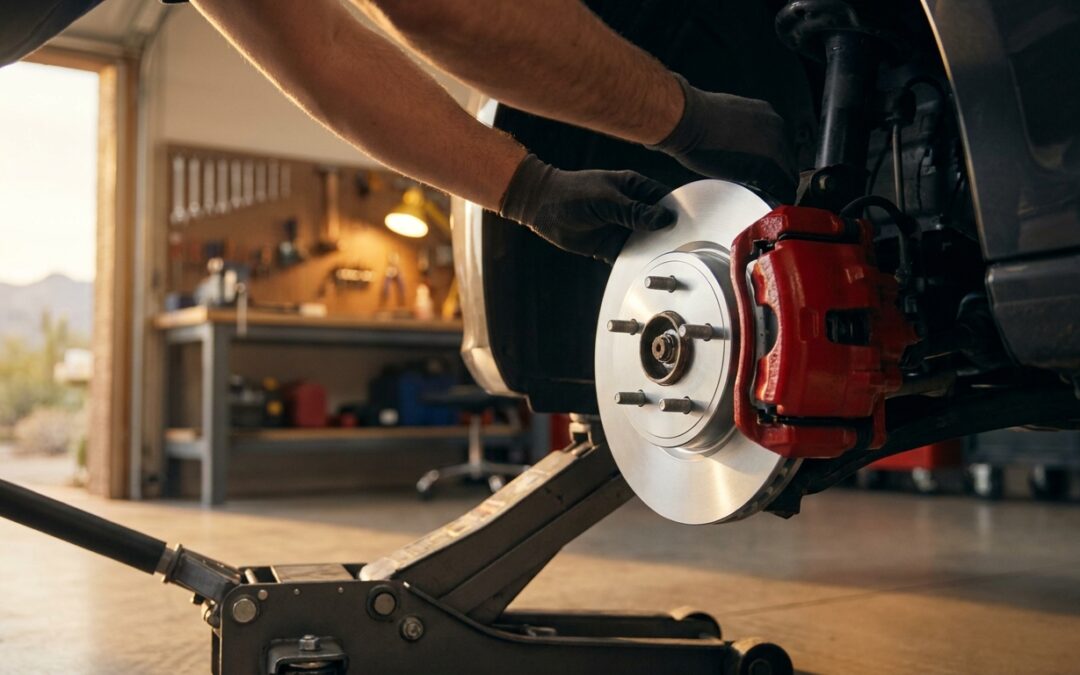
  3. Caliper — squeezes the brake pads against the spinning rotor.
  4. Brake pads — friction material that grabs the rotor and turns motion into heat.
  5. Rotor (disc) — the spinning steel disc the pad clamps onto.
  6. Drum & shoes (rear, on some vehicles) — older-style system using shoes that press outward against a drum.
  7. ABS module & sensors — the anti-lock brake system pulses pressure to prevent wheel lock-up.
  8. Parking brake — mechanical or electronic system that holds the car when parked.

Pads and rotors are wear items — they’re designed to be replaced. The rest of the system shouldn’t fail in normal use, but heat, dust, salt (yes, even some Arizona roads), and miles take their toll.

Why Apache Junction Is Hard On Brakes

  • Long downhill descents — coming down US-60 from Gold Canyon, off Peralta Road, or back from Tonto Basin builds tremendous heat in your brake system. Heat warps rotors and glazes pads.
  • Trailer towing & toy hauling — AJ has more trailers, RVs, and ATVs per capita than almost anywhere in the East Valley. Towing easily doubles brake wear.
  • Stop-and-go heat — Arizona summer turns your brakes into ovens. Brake fluid absorbs moisture and boils faster.
  • Dust & grit — fine desert dust acts like sandpaper on rotor surfaces and rear drum components.
  • Older vehicles — AJ has a higher-than-average percentage of well-loved older trucks and work vehicles. Brake hardware (clips, slides, springs) eventually corrodes and seizes.

Apache Junction-specific tip: If you tow a trailer or RV regularly, ask for premium ceramic pads and high-quality rotors, not the budget set. The upfront cost difference is $50–$100, but the rotors will last twice as long and you won’t get pedal fade on long descents like Gonzales Pass. The cheap parts are false economy if you tow.

Free Apache Junction Brake Inspection

Bring us your vehicle and we’ll measure pad thickness, rotor thickness, hardware condition, and brake fluid moisture content at no charge. You’ll get a written report — before anyone quotes a dime of repair work.

Book My Free Brake Inspection →

7 Warning Signs You Need Brake Repair Right Now

Most brake problems give you weeks of warning. Don’t ignore these:

  • High-pitched squeal when braking gently. That’s the wear indicator — a metal tab designed to scream when pads get thin. You have time, but it’s short.
  • Grinding or growling. The friction material is gone. You’re grinding metal on metal, destroying the rotor every mile you drive. This goes from a $250 pad job to a $700 pad-and-rotor job fast.
  • Pulsing or shuddering pedal under hard braking. Warped or unevenly worn rotors. Common after long downhill use without proper cooling.
  • Pulling to one side when braking. Sticking caliper, contaminated pad, or collapsed brake hose — all safety issues.
  • Soft, spongy, or sinking brake pedal. Air or moisture in the brake fluid, or a leaking line. Brake fluid is hygroscopic; in Arizona heat it should be flushed every 2–3 years.
  • Hard pedal that takes more effort. Failing brake booster or vacuum issue. Don’t drive far.
  • Brake warning light or ABS light on dash. Could be low fluid, worn pads (on some vehicles), or an ABS sensor failure. Always worth a same-day check.

Safety warning: If your pedal goes to the floor or you have to pump it to stop, do not drive the vehicle. Call (480) 444-0242 — we’ll arrange a tow if needed. A failing brake system is the single most common cause of preventable accidents in the East Valley.

What Actually Wears Out: The Apache Junction Brake Job Breakdown

Here’s the honest ranking of what we see roll into our shop, and what each typically costs in 2026:

Component How Common Typical Apache Junction Cost Drive-Safe?
Front brake pads only Very common $180–$320 Yes, briefly
Rear brake pads only Very common $180–$320 Yes, briefly
Pads + rotors (one axle) Very common $380–$700 Yes
Full 4-wheel pads + rotors Common $700–$1,250 Yes
Brake fluid flush Maintenance $120–$180 Yes
Caliper replacement (one) Moderate $280–$650 Sometimes
Brake hose / line repair Moderate $180–$520 Often NO
Brake booster replacement Less common $420–$900 Often NO
Master cylinder replacement Less common $380–$780 Often NO
ABS module / sensor Less common $220–$1,100 Yes
Drum brake rebuild (rear) Older trucks $280–$580 / axle Yes

Those are real Apache Junction ranges. Your final number depends on year/make/model, parts grade (economy vs. premium ceramic), and what the inspection finds. A 2014 Camry rear brake job is not a 2022 F-250 brake job — the parts and labor scale with the vehicle.

Cheap brakes vs. quality brakes: what’s the difference?

You’ll see ads for “$99 brake jobs” in the East Valley. Here’s what those usually leave out:

  • Pads only — rotors not replaced or resurfaced even when needed
  • Cheap economy pads — loud, dusty, fade quickly under heat, often need replacing again in 18 months
  • No new hardware — reusing rusty caliper clips and slides leads to uneven wear
  • No fluid flush — old, moisture-laden brake fluid keeps boiling on long descents
  • No road-test — many shops just hand you the keys

A real brake repair in Apache Junction includes new pads (and rotors when measured below spec), new hardware, fluid top-off or flush as needed, torque to OEM specifications, and a verified road-test. That’s the baseline at Network Automotive.

How Network Automotive Does Brake Repair in Apache Junction

Here’s exactly what happens when you bring your vehicle to our shop. No guesswork, no “leave it with us all week,” no surprise add-ons.

  1. Customer interview. When did you first notice the issue? Squeal, grind, pulse, pulling, soft pedal? Any recent towing or hard descents? Half the diagnosis is what you’ve already noticed.
  2. Free brake inspection. Wheels off, technician measures pad thickness on all four corners, rotor thickness with a micrometer, checks calipers and hardware for free movement, and tests brake fluid moisture content with a meter.
  3. Written estimate. Plain-English report — what’s within spec, what’s borderline, what needs replacement now, and what you can monitor. With exact parts and labor in writing.
  4. Parts grade conversation. Daily-driver, tow vehicle, or commuter? We recommend the right pad and rotor grade for how you actually use the vehicle — not the most expensive option by default.
  5. Repair. Pads replaced with new hardware (clips, slides, anti-rattle shims). Rotors replaced or resurfaced as needed — we don’t resurface a rotor that’s under spec just to save you $40 today and cost you $400 in six months.
  6. Caliper service. Sliders cleaned, lubricated with high-temp brake grease, dust boots inspected and replaced if torn. This is the step most cheap shops skip.
  7. Brake fluid check / flush. Topped off at minimum. Flushed if moisture content reads above 3% (common in AZ heat).
  8. Torque to spec + road-test. Lug nuts torqued to manufacturer spec with a calibrated torque wrench. Road test verifying pedal feel, no pulling, no noise, ABS function.
3 yr
24-month / 24,000-mile nationwide warranty on every Network Automotive brake repair, parts and labor. Travel out of state, brake job acts up — any participating NAPA AutoCare shop in the country honors it.

What Does Brake Repair Cost in Apache Junction in 2026?

Real numbers, no fine print:

  • Free brake inspection — pad measurement, rotor measurement, hardware check, fluid test. $0 at Network Automotive.
  • Front pads only (when rotors measure within spec): $180–$320
  • Rear pads only: $180–$320
  • Pads + rotors, one axle: $380–$700
  • 4-wheel brake job (pads + rotors all four): $700–$1,250
  • Brake fluid flush: $120–$180
  • Caliper replacement: $280–$650 per corner
  • Premium upgrade (ceramic pads + slotted/drilled rotors for tow vehicles): add $100–$250

How long does brake repair take?

Most Apache Junction brake jobs are same-day. Pads-only is 60–90 minutes. Pads + rotors on one axle is 90 minutes to 2 hours. Full 4-wheel brake job is typically 2–3 hours. Caliper replacements add 45–60 minutes per corner. Brake fluid flush adds 30–45 minutes. We’ll tell you up-front exactly which category your vehicle falls into.

Quiet, Confident Stops — Same Day

Stop driving on grinding brakes. Bring your vehicle to Network Automotive in Apache Junction for a free brake inspection, an honest quote, and a brake job backed by a 24-month / 24,000-mile nationwide warranty.

Schedule My Brake Repair →

How Long Should Brake Pads Last in Apache Junction?

The honest answer: it varies wildly. Here are realistic expectations for AJ drivers:

  • Daily commuter, mostly highway: 50,000–70,000 miles on front pads.
  • Mixed city/highway, no towing: 35,000–55,000 miles.
  • Tow vehicle / RV puller: 25,000–40,000 miles — sometimes less on heavy loads.
  • Mountain commuter (Gold Canyon, US-60 daily): 30,000–45,000 miles.
  • Stop-and-go work truck: 25,000–40,000 miles.

Rear brakes typically last 1.5–2x as long as fronts on most vehicles — but on trucks and SUVs that tow, the ratio narrows. A free brake inspection every oil change tells you exactly where you are without guessing.

Why Apache Junction Drivers Trust Network Automotive for Brake Work

Apache Junction has plenty of brake shops. Here’s what makes us different:

  • Family-owned since 1995. Three decades, five locations across Mesa, Gilbert, Apache Junction, Queen Creek, and Prescott. Same family, same values.
  • ASE-certified brake technicians. Brakes are a safety-critical system — not a job for the cheapest mechanic in the bay.
  • Quality parts — or better. We use NAPA, Wagner, Akebono, Power Stop, and OEM parts depending on vehicle and use case. No mystery brand pads.
  • 24-month / 24,000-mile nationwide warranty on parts and labor. Most chain shops give 12 months, period.
  • Free brake inspection with measurement — not a guess, not a sales pitch. Written report.
  • Written estimates up-front. No phone-tag, no “while we were in there.”
  • Towing-experienced shop. A lot of our Apache Junction customers tow. We know the difference between a daily-driver brake job and a tow-vehicle brake job.
  • Thousands of five-star reviews across Google and Yelp at our AZ locations.

Read more on the About Network Automotive page, see the full service menu, or browse Apache Junction service coupons.

What to Do The Moment You Notice a Brake Problem

  1. Don’t panic, but don’t ignore it. A squeal is a warning. A grind is a bill. A soft pedal is an emergency.
  2. Note when it happens. Cold start? Only on hard stops? Going downhill? Pulling left or right? These details cut diagnostic time.
  3. Avoid hard braking until inspection. Easier on the system and on you.
  4. Don’t pump a soft pedal and keep driving. Pull over, call us, arrange a tow if needed.
  5. Schedule a free brake inspection. Most Apache Junction brake checks at Network Automotive are completed in 30–45 minutes.
  6. Call: (480) 444-0242. We’ll get you on the schedule and tell you over the phone whether it’s safe to drive in.

Trailer, RV & Toy Hauler Brake Considerations

Apache Junction has more trailers and RVs per square mile than just about any East Valley city. If you tow regularly, your tow vehicle’s brakes are working at least 50% harder than a daily commuter’s. We recommend:

  • Premium ceramic pads rated for towing — they handle heat without fading.
  • Quality drilled or slotted rotors for better heat dissipation on long descents.
  • Annual brake fluid moisture test — tow vehicles run hotter, fluid degrades faster.
  • Brake controller inspection on trucks pulling electric-brake trailers (most travel trailers, horse trailers, car haulers).
  • Trailer brake service — we service trailer brakes too. Worn shoes, leaky wheel cylinders, frozen actuators.

Proudly Serving Apache Junction and the Greater East Valley

Network Automotive Service Center is the trusted name for brake repair across:

  • Apache Junction — including Superstition, Gold Canyon, Peralta, Roadrunner, and the Idaho Road corridor
  • Mesa — East Mesa, Las Sendas, Red Mountain, and the Power Road corridor
  • Gilbert — Agritopia, Morrison Ranch, Power Ranch
  • Queen Creek — Cortina, Ironwood Crossing, San Tan Heights
  • Prescott — Prescott Valley and surrounding

Most Apache Junction customers book at our East Mesa shop just minutes west on US-60 at Power Road. Gold Canyon and Superstition customers often prefer that location for the easy in-and-out.

Apache Junction Brake Repair FAQ

How much does brake repair cost in Apache Junction?

Front or rear pads only typically run $180–$320 at Network Automotive. Pads plus rotors on one axle is $380–$700. A full 4-wheel brake job is $700–$1,250. Brake fluid flush is $120–$180. Caliper replacement is $280–$650 per corner. Our free brake inspection tells you exactly which category your vehicle falls into before any work is authorized. Call (480) 444-0242.

How long do brake pads last on a vehicle in Apache Junction?

Highway commuters often see 50,000–70,000 miles. Mixed driving runs 35,000–55,000. Tow vehicles, RV pullers, and mountain commuters typically get 25,000–45,000 miles. Apache Junction’s long downhill grades and trailer towing put more heat into the brakes, which shortens pad life. A free brake inspection at every oil change tells you exactly where you stand without guessing.

Why do my brakes squeal?

Most often it’s the wear indicator — a small metal tab designed to scream when pads thin out. It means it’s time to schedule, not panic. If the squeal turns into a grind, you’re into metal-on-metal damage and the rotors will likely need replacing too. Less commonly, squeal is from glazed pads, missing anti-rattle hardware, or contamination.

Can I just replace pads without rotors?

If the rotors measure within manufacturer specification (above minimum thickness), have no scoring or warping, and the surface is even — yes. Network Automotive measures rotor thickness with a micrometer at every brake service. We don’t replace rotors that don’t need replacing, and we don’t resurface rotors that are already too thin. You see the measurement, you decide.

How long does a brake job take in Apache Junction?

Pads-only is 60–90 minutes. Pads plus rotors on one axle is 90 minutes to 2 hours. A full 4-wheel brake job is typically 2–3 hours. Most jobs are same-day, and we have loaner options for longer repairs.

Do I really need a brake fluid flush?

Probably yes, every 2–3 years in Arizona. Brake fluid is hygroscopic — it absorbs moisture from the air. In AZ heat, that moisture lowers the boiling point and softens the pedal under heavy use, especially on long descents. We test fluid moisture content with a meter as part of the free brake inspection. Above 3% moisture, a flush pays for itself in pedal feel and component life.

Why is my steering wheel shaking when I brake?

Almost always warped or unevenly worn rotors. Common after long downhill use without proper cooling, or from a stuck caliper that ran hot on one corner. Resurfacing can fix it if the rotor is still within spec; otherwise replacement is the right answer. Don’t ignore it — vibration accelerates wear on suspension and steering components too.

Does Network Automotive warranty brake work?

Yes. Every brake repair is backed by our 24-month / 24,000-mile nationwide warranty on parts and labor. If the issue comes back inside that window, we fix it — at any participating NAPA AutoCare shop across the country. That’s real protection, not a 12-month chain-shop gimmick.

Quiet, Confident Brakes — Apache Junction’s Trusted Shop

Family-owned in the East Valley since 1995, ASE-certified, premium parts, and a 24-month / 24,000-mile nationwide warranty. Bring us your brakes — we’ll show you the measurements and let you decide.

5 Warning Signs You Need a Wheel Alignment in Gilbert, AZ

5 Warning Signs You Need a Wheel Alignment in Gilbert, AZ

HomeBlog › Wheel Alignment Gilbert AZ

5 Warning Signs You Need a Wheel Alignment in Gilbert, AZ

By Network Automotive Service CenterGilbert, AZUpdated April 2026

Your tires are the most expensive consumable on your car — and nothing eats them alive faster than a vehicle that’s out of alignment. Here are the 5 warning signs every Gilbert driver should know, plus honest 2026 pricing for alignments, what a real alignment actually includes, and why Arizona roads chew up alignments faster than almost anywhere in the country.

You’re cruising down Val Vista with your hands loose on the wheel — and you notice the car is drifting a little to the right. You correct. It drifts again. Or maybe your steering wheel sits crooked even though you’re going straight down Gilbert Road. Or your new tires are already feathered and uneven after 18,000 miles. If any of that sounds like your car, you’re almost certainly due for a wheel alignment in Gilbert AZ — and putting it off is how $120 turns into $1,400 worth of chewed-up tires.

At Network Automotive Service Center, we’ve been aligning Gilbert vehicles since 1995 — Camrys, F-150s, Wranglers, Model 3s, diesel work trucks, lifted Tacomas, you name it. Below are the five warning signs we see most often, an honest breakdown of what an alignment costs in Gilbert in 2026, what a real alignment includes (and what cheap shops skip), and exactly how our process works.

27%
of passenger vehicles on the road are driving with at least one wheel measurably out of alignment. In Gilbert, where pothole season, curb hits, and AZ heat beat up suspensions, the real number is higher. Most drivers have no idea until the tires tell them.

The 5 Warning Signs You Need a Wheel Alignment

You don’t need a dashboard light for this one. Your car is telling you — loudly — if you know what to look for. Here are the five signs Gilbert drivers bring us every week:

1. Your Car Pulls or Drifts to One Side

Drive down a flat, straight stretch of road like Greenfield south of Queen Creek Road. Loosen your grip on the wheel (don’t let go — just relax it). If the car drifts left or right within a few seconds, the alignment is off. A small drift can be caused by road crown (most roads tilt slightly toward the shoulder for drainage), so the real test is whether the pull is consistent in both directions on the same stretch of road. Consistent pull = alignment problem. It’s the #1 symptom we see at our Gilbert customers, and on AZ asphalt it usually means the toe or camber is out of spec.

2. Your Steering Wheel Is Crooked When Driving Straight

Look at the center of your steering wheel next time you’re going straight down the 202 or Williams Field Road. If the logo or horn pad is rotated 5, 10, or 15 degrees off-center, your wheels are pointed straight but the steering rack thinks they’re turned. This almost always means the toe setting is out of spec — usually after a curb strike, a pothole, or a suspension component that has settled and shifted.

3. Uneven or “Feathered” Tire Wear

Walk around your car and run your fingers across the tread of each tire — both directions. If you feel sharp edges on one side of the tread blocks but smooth ones on the other, that’s feathered wear and it’s caused by incorrect toe. Other patterns to watch for in Gilbert:

  • Inside edge of front tires worn bald: negative camber is excessive, usually from worn control arm bushings or a hit curb.
  • Outside edge worn: positive camber or toe issue. Common on vehicles that have been lowered.
  • Center of the tire worn, edges fine: overinflation — not alignment. Drop the PSI.
  • Both outer edges worn evenly, center fine: underinflation. Check the sticker in your door jamb.
  • Cupping / scalloping (wavy wear): worn shocks or struts letting the tire bounce — alignment won’t fix this alone, but it often accompanies an alignment issue.

4. Steering Feels Loose, Wandering, or “Twitchy” at Highway Speed

On the Loop 202 or US-60, does your car feel like it’s constantly looking for the lane center? Do you find yourself making tiny steering corrections every two seconds? That’s classic toe-out or a caster setting that’s out of spec. A properly aligned vehicle should track straight with minimal input. If your hands are working overtime just to stay in your lane, you’re burning fuel and tires.

5. New Tires Wearing Out Way Too Fast

A decent set of all-season tires in Gilbert should give you 45,000–60,000 miles if the vehicle is aligned. If your last set was bald at 25,000 or 30,000 miles — especially if the wear was uneven — the alignment was almost certainly part of the problem. Tires are the single most expensive wear item on your vehicle. Protecting a $1,200 set with a $120 alignment is the simplest math in automotive maintenance.

Gilbert-specific reality check: Power Road, Val Vista, Higley, and Recker all have sections with patched cracks and expansion joints that hit your suspension every single day. Add in monsoon potholes, curb strikes in Santan Village parking lots, and 115°F summers that soften rubber bushings — and Gilbert drivers typically need an alignment every 15,000–25,000 miles, not “every couple of years.”

Free Alignment Check in Gilbert

Bring your car to Network Automotive and we’ll put it on the alignment rack and scan the current specs. You’ll leave with a printout showing exactly where each wheel sits — no pressure, no upsell.

Book My Free Alignment Check →

What a Wheel Alignment Actually Is (Plain English)

When a shop says they’re “aligning your car,” what they’re really doing is adjusting three angles on each wheel to match the manufacturer’s spec. Those three angles are:

  • Toe — viewed from above, are the wheels pointed straight ahead, inward (toe-in), or outward (toe-out)? The #1 cause of feathered tire wear.
  • Camber — viewed from the front, does the tire tilt inward (negative) or outward (positive) at the top? Excessive camber wears out one side of the tire quickly.
  • Caster — viewed from the side, the angle of the steering axis. Affects steering return and straight-line stability, not usually tire wear.

A four-wheel alignment measures and adjusts all four corners. A thrust-angle or “two-wheel” alignment adjusts the front only but still measures the rear for reference. On any modern vehicle — front-wheel drive, all-wheel drive, or a pickup — a proper four-wheel alignment is what you actually want. A front-only alignment on a car whose rear thrust angle is off just makes the steering wheel crooked again within a few weeks.

What’s a “Thrust Angle” and Why Does It Matter?

Imagine pushing a shopping cart with a rear wheel that’s locked slightly sideways. The cart wants to crab-walk diagonally instead of going straight. That’s thrust angle — the direction the rear axle is actually pointing. On many vehicles rear toe is adjustable; on some older trucks it isn’t. Either way, a good shop measures it and either corrects it or aligns the front wheels to match. Skipping this step is why so many “cheap alignments” don’t hold.

What Does a Wheel Alignment Cost in Gilbert in 2026?

Straight numbers, because the price range out there is wild:

  • Alignment check (on-rack measurement, printout showing current specs): Diagnostic fee applies, quoted upfront at Network Automotive. You’ll know exactly whether you even need the service.
  • Standard four-wheel alignment (most cars, SUVs, small trucks): $109–$149.
  • Thrust-angle alignment (fronts only, non-adjustable rear): $79–$99.
  • Heavy-duty or 4×4 alignment (full-size trucks, lifted vehicles, duallies): $149–$229.
  • Alignment + 1-year warranty (unlimited realignments for 12 months if specs shift): typically $30–$50 extra. Worth it for drivers who hit AZ potholes regularly.

Watch out for $49 alignment specials — they almost always skip the rear measurement, skip adjusting caster (or don’t have the equipment to), and skip verifying tire pressure and ride height before the alignment. If the ride height isn’t right, all the numbers you just “corrected” are wrong again as soon as you leave.

How long does an alignment take?

For a standard passenger car or SUV, most Gilbert alignments are done in 60–90 minutes. Lifted trucks, adjustable suspensions, and vehicles needing parts replaced before alignment (see below) can take 2–3 hours or require a follow-up visit.

How Network Automotive Aligns a Vehicle in Gilbert

Here’s exactly what happens when you bring your vehicle to our shop. This is what a real alignment looks like — not a quick-lube “rack and ship”:

  1. Pre-check inspection. Before the car touches the rack, we inspect tire condition, tire pressure (set to door-jamb spec), wheel bearings, tie rods, ball joints, control arm bushings, sway bar links, and ride height. Alignment is the last step, not the first. Worn parts must be replaced first or the numbers won’t hold.
  2. On-rack measurement. Laser or camera-based targets clamp to each wheel. The alignment computer reads toe, camber, caster, thrust angle, and ride height on all four corners simultaneously.
  3. Before-printout review. We show you where each corner sits vs. the manufacturer’s specs. Green = in spec, yellow = borderline, red = out. You see this before we adjust anything.
  4. Adjustments. Toe is adjusted via the tie rod ends. Camber and caster are adjusted via eccentric cams, adjustable upper control arms, or shims — depending on your vehicle. Some vehicles require aftermarket adjustment kits if the factory range isn’t enough (common on lifted Tacomas, Jeep Wranglers, and 4Runners).
  5. Road test + re-measure. Quick drive to settle the suspension, then back on the rack to verify the numbers still read in spec under load.
  6. Centered steering wheel. We center the steering wheel as a final adjustment — many cheap alignments skip this and leave your wheel crooked. Not ours.
  7. After-printout & warranty. You leave with a printed report showing the final specs on all four wheels, stamped with the date. Every Network Automotive alignment is backed by our 24-month / 24,000-mile nationwide warranty.
30+
Years aligning East Valley vehicles. Network Automotive has been family-owned and ASE-certified since 1995. Gilbert, Mesa, Apache Junction, Queen Creek, Prescott — same hands-on technicians, same ethics, for three decades.

How Often Should a Gilbert Driver Get an Alignment?

The old rule used to be “every two years or every 30,000 miles.” That was written for a country that doesn’t include Arizona. Here’s what we actually recommend Gilbert customers:

  • Every tire rotation (every 5,000–7,500 miles): ask for a free alignment check. Takes 10 minutes on the rack.
  • Every 15,000–25,000 miles: a full alignment — especially if you daily-drive Power Road, Val Vista, or the 202.
  • Every time you buy new tires: non-negotiable. New tires on a bad alignment are a $1,200 mistake.
  • After any curb strike, pothole hit, or fender bender: even a minor impact can shift alignment. Get it checked.
  • After any suspension or steering work: struts, ball joints, tie rods, control arms, lift or leveling kits — always realign.

Arizona reality check: The combination of desert heat, pothole season after monsoon rains, and a lot of stop-and-go driving on arterials like Gilbert Road and Warner means Gilbert alignments drift faster than alignments in other climates. If you haven’t had a check in more than 18 months, there’s a good chance at least one corner is out of spec.

Save Your Tires. Save Your Money.

A $120 alignment can add 20,000 miles to your next tire set. Come in for a free alignment check at our Gilbert-area shop — see the printout, then decide.

Schedule My Free Alignment Check →

When Alignment Alone Isn’t Enough: Parts That Need to Be Replaced First

An alignment adjusts angles — it doesn’t fix worn parts. If the following are worn, the numbers won’t hold even after a perfect alignment, because the parts are physically loose. An honest Gilbert shop will find these during the pre-check:

Part What It Does Symptoms When Worn Typical Mesa/Gilbert Cost
Outer tie rod ends Connects steering rack to wheel Looseness, alignment won’t hold, uneven tire wear $180–$420 per side
Inner tie rods Same, inner portion of steering Clunk on turns, steering play $240–$520 per side
Ball joints (upper/lower) Pivot for steering knuckle Clunking over bumps, tire pulls, wobble $260–$780 per side
Control arm bushings Cushion suspension movement Clunks, camber drift, poor handling $220–$650 per side
Struts / shocks Damp suspension motion Bouncy ride, cupping tire wear $380–$1,400 per axle
Sway bar end links Connects sway bar to suspension Clunk over speed bumps, loose feel $140–$320 per side
Wheel bearings Let the wheel spin smoothly Humming or growling that changes with turns $320–$780 per wheel

We always show you the worn part, explain why it needs to be replaced before aligning, and give you a written estimate. You decide. No surprise add-ons.

Why Gilbert Drivers Choose Network Automotive for Alignments

There are plenty of “quick alignment” shops around Santan Village and the Gilbert auto corridor. Here’s what makes ours different:

  • Family-owned since 1995. Three decades, five locations across Gilbert, Mesa, Apache Junction, Queen Creek, and Prescott. Same family, same values.
  • Full four-wheel laser alignment equipment calibrated regularly — not a 1990s rack that reads “close enough.”
  • Mandatory pre-check inspection before every alignment — no aligning onto worn parts.
  • Centered-steering-wheel guarantee. Your wheel sits straight when you leave. If it doesn’t, bring it back.
  • 24-month / 24,000-mile nationwide warranty on parts and labor — including alignment.
  • Honest pre-check reports. If you don’t need an alignment, we tell you. We’d rather earn a repeat customer than a one-time $120.
  • Lifted truck & 4×4 specialists with the adjustment kits most shops don’t stock.
  • Free loaner options for longer repairs where alignment is the final step.

Read more about our philosophy on the About Network Automotive page, see the full service menu, or browse current Gilbert service coupons.

A Word on Lifted Trucks, Jeeps, and Aftermarket Suspensions

Gilbert and the East Valley have more lifted Tacomas, Wranglers, F-250s, and 4Runners per square mile than just about anywhere else in the U.S. If you’ve lifted or leveled your truck, factory alignment specs no longer apply — and most factory adjustment ranges don’t have enough travel to correct the new geometry. That means aftermarket parts: adjustable upper control arms, camber bolts, offset ball joints, or bushing kits. Network Automotive has done thousands of lifted-truck alignments and we stock or can source the right parts for Toyota, Ford, Ram, GM, and Jeep platforms. We’ll tell you honestly whether your lift needs parts before the alignment will hold.

Proudly Serving Gilbert and the East Valley

Network Automotive is the trusted name for wheel alignment across:

  • Gilbert — Agritopia, Morrison Ranch, Seville, Power Ranch, Santan, The Islands
  • Mesa — East Mesa, Las Sendas, Red Mountain, Dobson Ranch
  • Queen Creek — Ironwood Crossing, Cortina, San Tan Heights, Pecan Lake
  • Apache Junction — Superstition, Gold Canyon
  • Prescott — Prescott Valley and surrounding

Most Gilbert customers book at our East Mesa shop just up Power Road, or the Queen Creek location down Ellsworth — both are minutes from Gilbert’s borders.

Gilbert Wheel Alignment FAQ

How much does a wheel alignment cost in Gilbert AZ?

A standard four-wheel alignment runs $109–$149 at Network Automotive. Heavy-duty or lifted-truck alignments run $149–$229. A free on-rack alignment check is always available so you know where your specs sit before any work is authorized. Call (480) 444-0242 for pricing on your specific vehicle.

How often should I get an alignment in Gilbert?

Most Gilbert drivers need an alignment every 15,000–25,000 miles because of AZ potholes, heat, and arterial road conditions. We recommend a free alignment check at every tire rotation and a full alignment every time you buy new tires, after any curb strike, or after suspension work. If it’s been more than 18 months, get it checked.

What are the main signs my car needs an alignment?

The five most common signs: (1) the car pulls or drifts to one side, (2) the steering wheel is crooked when driving straight, (3) uneven or feathered tire wear, (4) loose or wandering steering at highway speed, and (5) new tires wearing out in under 30,000 miles. Any one of these is enough to bring it in.

How long does a wheel alignment take?

Most standard passenger cars and SUVs are done in 60–90 minutes. Lifted trucks, vehicles needing aftermarket adjustment parts, or vehicles that need tie rod / ball joint / bushing replacement before alignment can take 2–3 hours or a follow-up visit.

Will an alignment fix my vibration or steering wheel shake?

Usually no — vibrations are most often a tire balance problem, not alignment. A shake at highway speed that smooths out when you slow down is classic wheel-imbalance. A wobble that gets worse when you brake is typically warped rotors. An alignment corrects pulling and tire wear, not vibration. We can balance, align, and inspect all in one visit.

Do you align lifted trucks and 4x4s?

Yes — lifted trucks and Jeeps are a specialty. Factory adjustment ranges usually aren’t wide enough for a lifted Tacoma, Wrangler, F-250, or 4Runner, so we use aftermarket adjustable upper control arms, camber bolts, offset ball joints, or bushing kits. We’ll tell you honestly if your lift needs parts before the alignment will hold.

Why does my alignment keep drifting out?

Two reasons: (1) worn suspension parts (tie rod ends, ball joints, control arm bushings) that weren’t replaced before the last alignment, or (2) an “alignment” that didn’t actually measure or adjust the rear thrust angle. A proper four-wheel alignment on healthy parts should hold for 15,000+ miles of normal Gilbert driving.

Does Network Automotive warranty the alignment?

Yes. Every alignment is backed by our 24-month / 24,000-mile nationwide warranty on parts and labor. We also offer a 1-year unlimited-realignment add-on ($30–$50) for customers who hit a lot of Gilbert potholes — unlimited re-checks and re-adjustments for 12 months.

Straight Steering. Long-Lasting Tires.

Family-owned in the East Valley since 1995, ASE-certified, full four-wheel laser alignment equipment, and a 24-month / 24,000-mile nationwide warranty. Get a free alignment check in Gilbert — printout, no pressure.

Brake Repair Gilbert AZ: Signs, Costs & Same-Day Service

Brake Repair Gilbert AZ: Signs, Costs & Same-Day Service

HomeBlog › Brake Repair Gilbert AZ

Brake Repair Gilbert AZ

By Network Automotive Service CenterGilbert, AZUpdated April 2026

Grinding, squealing, or soft pedal? Here’s exactly how brake repair in Gilbert AZ works at Network Automotive — what’s wrong, what it costs, and how fast we can get you back on the road safely.

If your car is grinding at every stop, squealing through intersections on Higley, or the pedal feels soft on the descent off the US 60 — your brakes are telling you something you can’t afford to ignore. Gilbert driving is uniquely hard on brake systems: stop-and-go on Val Vista, Power Road construction backups, the stretch between Germann and Queen Creek Road that sees heavy commuter traffic every morning, and the heat. Always the heat. Arizona summers cook brake fluid, glaze pads, and warp rotors faster than almost any other climate in the country.

The good news: brake repair in Gilbert AZ doesn’t have to be expensive, mysterious, or take all day. At Network Automotive Service Center we do brake jobs every single day, on everything from Civics to F-350s to RAM 2500 diesels, and the majority of them finish same-day. This guide walks you through what’s actually happening under the wheel, what a proper inspection looks like, what brake pads and rotors should cost in 2026, and the specific symptoms that mean you should stop driving and call us right now.

92%
of brake jobs we complete same-day when a vehicle is dropped off before 10 AM. Free inspection. Honest quote. No upsell.

What Brake Repair Actually Covers

“Brake repair” is a catch-all term, and it gets thrown around loosely by shops that want you to assume the worst. In reality, the work falls into a few very different categories, and the difference between them is often several hundred dollars.

Friction replacement is the most common. That’s new brake pads (and sometimes shoes, on older rear-drum setups), and in most cases new rotors as well. Modern pads and rotors are designed to wear together — most rotors you’ll see today are too thin to be resurfaced safely by the time the pads are due, especially on trucks and SUVs common in Gilbert. A proper brake job means pads and rotors together, not one without the other.

Hydraulic repair covers the fluid side of the system — the master cylinder, brake lines, flex hoses, and calipers. A seized caliper slider, a leaking wheel cylinder, a flex hose that’s ballooning on the inside — any of these can cause a soft pedal, uneven pad wear, or a pull to one side. These repairs are less common than pad-and-rotor jobs but equally critical, and they almost always require a full system bleed afterward.

ABS and electronic brake system work is the third bucket. Anti-lock sensors get coated with Gilbert’s alkaline road dust and fail one wheel at a time. Electronic parking brake actuators on newer vehicles can seize. Traction control modules occasionally need reflashing. These require a scan tool that can talk to each manufacturer’s brake module — something a lot of quick-lube shops simply don’t own.

At Network Automotive we handle all three. When you drop a car off for brake repair in Gilbert AZ, the inspection looks at every piece of the system — not just the two wheels you asked about — because brake symptoms lie. A grinding front can be a sticking rear caliper. A pulling left can be a worn-out flex hose. We find root causes, not just the squeaky pad.

Free Brake Inspection in Gilbert

Noisy, soft, or pulling brakes? Bring it in — we’ll measure pad life, check rotors, and give you a written quote with no pressure. Same-day service on most vehicles.

Book My Free Inspection

Warning Signs & Common Causes

Your brakes will almost always tell you they’re going before they fail. The trick is reading the message correctly. Here’s how to decode what’s happening, and how urgent it is.

Symptom What’s likely wrong Urgency
High-pitched squeal when braking lightly Pad wear indicators contacting the rotor — time to replace pads Schedule within 1–2 weeks
Deep grinding / metal-on-metal noise Pads are gone; rotor surfaces are being damaged by the backing plate Do not drive — call today
Steering wheel shakes when braking at highway speed Warped or uneven rotor thickness (common after AZ summer heat cycles) Schedule within a week
Soft or sinking brake pedal Air in lines, fluid leak, or failing master cylinder Safety issue — call immediately
Car pulls to one side when braking Seized caliper slider, collapsed flex hose, or uneven pad wear Schedule within a few days
Red BRAKE or yellow ABS light on the dash Low fluid, worn pads (some vehicles), ABS sensor failure Scan + inspection this week
Burning smell after a long drive Dragging caliper or stuck parking brake — rotors overheating Stop driving — tow in

A few of these deserve extra explanation because they’re easy to misread.

Squealing doesn’t always mean worn pads. In Gilbert we see a lot of morning squeal — a light rust flash on the rotor overnight from sprinkler mist or humidity that burns off after the first few stops. If the noise goes away within a mile, it’s almost certainly not a repair issue. If it persists every single stop, you’re hearing the wear indicator doing its job.

Shaking at highway speeds is usually rotor runout — the rotor surface isn’t perfectly flat anymore. In Arizona summers this often happens after a single hard stop from highway speed when the rotors are already red-hot from descending a steep grade (like the section of Loop 202 heading down into the valley). Once a rotor warps, resurfacing rarely brings it back long-term on modern thin-wall rotors. Replacement is the honest answer.

Soft pedal is the symptom we take most seriously. Compressed fluid behaves predictably. Air does not. If you step on the brake and the pedal sinks toward the floor, especially if it happens intermittently, stop driving and have the vehicle towed. A pedal that goes all the way to the floor in traffic is how rear-end collisions happen.

Quick self-check: Start your car, hold the brake pedal down firmly for about 30 seconds without the engine running. A healthy pedal stays firm. If it slowly sinks under your foot, you have a fluid leak or a failing master cylinder — neither of which should be driven on.

Our 7-Step Brake Inspection

Every vehicle that comes in for brake repair in Gilbert AZ goes through the same inspection, whether you scheduled a full replacement or just asked us to “take a look.”

  1. Road test. One of our technicians drives the vehicle on Gilbert Road or the 202 on-ramp to replicate the symptom you described. We note pedal feel, pull, noise, and any ABS activity.
  2. Wheels off, visual inspection. All four wheels come off. We photograph pad thickness, rotor condition, caliper movement, and the brake fluid reservoir. You get those photos texted to you before any work is approved.
  3. Measurement. Pads are measured in millimeters (new is typically 10–12mm, replace-now is under 3mm). Rotor thickness is checked against the manufacturer’s minimum spec stamped on the hat.
  4. Hydraulic test. We pressurize the system and look for leaks at every line, hose, and caliper. Fluid moisture content is tested — anything over 3% water means a flush is needed.
  5. Scan + ABS check. A full scan of the ABS module catches stored codes that often don’t trigger the dash light but will hurt stopping performance in an emergency.
  6. Written quote. You get a plain-English estimate listing exactly what’s needed, what’s optional, what’s safe to defer, and the out-the-door total. No surprises, no “while we were in there” add-ons.
  7. Repair, test, confirm. Once approved, we replace components, bleed the system if needed, torque everything to spec, and road-test again before it goes back to you.

Cost & How Long It Takes

Brake pricing depends heavily on what the vehicle is and what the inspection finds, but here are the realistic ranges for brake repair in Gilbert AZ in 2026. These reflect quality parts — not the lowest-bid pads that glaze over in one Arizona summer.

  • Front pads + rotors, most passenger cars: $295 to $475 out the door, including fluid top-off and labor.
  • Rear pads + rotors, most passenger cars: $265 to $445 out the door.
  • Half-ton trucks / large SUVs (F-150, Silverado, Tahoe): $425 to $650 per axle.
  • 3/4 and 1-ton diesels (Cummins, Powerstroke, Duramax): $575 to $950 per axle depending on whether OE-spec or severe-duty pads are fitted.
  • Brake fluid flush (recommended every 30–40k miles in AZ): $125 to $165.
  • Caliper replacement (single): $265 to $475 including labor and bleed.
  • ABS sensor replacement (single): $195 to $325 with scan-tool clearing.

How long does it take? A standard single-axle pad-and-rotor job is 90 minutes to two hours once the vehicle is in the bay. Both axles at once is about three hours. Caliper or hydraulic work adds 30–60 minutes for the bleed cycle. Diesel trucks take longer because the wheels and rotors are significantly heavier and the calipers are often bolted with higher torque specs. If you drop off before 10 AM, 9 out of 10 brake jobs are finished the same day.

Network Automotive backs every brake repair with a written nationwide warranty on parts and labor. If the pads you bought from us chirp, shudder, or wear prematurely inside the warranty window, bring it back — no fight.

Get a Written Brake Quote Today

Tell us what’s happening — we’ll text you a photo-documented estimate before we touch anything. Zero pressure.

Request My Quote

When Is Brake Repair Urgent?

Most brake issues are annoyances that can wait a few days for a scheduled appointment. Some are genuine safety emergencies. Here’s the difference.

  • Metal-on-metal grinding at every stop. The pad is gone. Every additional mile is gouging the rotor deeper and potentially the caliper piston.
  • Pedal sinks to the floor. You have a fluid leak or a failed master cylinder. Do not drive. Tow in.
  • Smoke or burning smell from a wheel. A caliper is dragging. The rotor is glowing hot. Continued driving risks wheel bearing damage, seized hubs, and in extreme cases, a brake fire.
  • Red BRAKE warning light stays on. Different from the yellow ABS light — the red BRAKE light typically means critically low fluid or parking-brake engaged. If the parking brake is released and the light is still on, stop driving.
  • Steering wheel fights you hard during braking. A stuck caliper or a collapsed flex hose — either can lock a wheel under emergency braking.
  • Pedal feels different every time you press it. Air in the lines or a failing master cylinder. Unpredictable brake response in traffic is how rear-end collisions start.

Arizona heat warning: If you’ve been on a long downhill or towing heavy in the summer and then smell hot brakes, do not put cold water on the rotors. Thermal shock on a hot rotor will crack it. Park somewhere safe, pop the hood, and let the whole front end cool for 30 minutes before driving further. Summer brake fluid boil is one of the most common reasons Gilbert drivers end up in our tow bay.

What To Do Right Now

If something in this article made you say “yep, that’s what mine is doing” — here’s your next move.

  1. Write down when it happens. Only at highway speed? Only after sitting overnight? Only when the car is hot? The pattern tells us where to look first and saves you diagnostic time.
  2. Check your brake fluid reservoir. Under the hood, look for a small translucent tank labeled BRAKE. Fluid should be between the MIN and MAX lines and a light amber color. Dark brown or below MIN is a flag.
  3. Stop driving if you hear metal grinding. Every mile past that point costs you money in rotor damage that could have been a simple pad replacement.
  4. Call or book online. (480) 444-0242 or book online. If the pedal is soft or you smell burning, tell us — we’ll fit you in as a safety priority.
  5. Plan for a drop-off, not a wait. A proper brake inspection and repair is a few hours. Grab a ride from a friend, drop the car, and we’ll text you when it’s ready.

Why Gilbert Drivers Pick Network Automotive

You have options for brake repair in Gilbert AZ. Here’s what actually makes a difference.

  • Same-day service. Drop off before 10 AM, drive home before dinner. We keep common brake pads and rotors stocked for domestic, Japanese, German, and diesel applications.
  • Photo documentation on every job. You see pad thickness and rotor wear with your own eyes. No guesswork, no “trust us.”
  • Honest declines. If your pads still have 60% left, we’ll tell you. Nothing kills our reputation faster than upselling work that isn’t needed.
  • ASE-certified technicians who work on diesels daily. See our full services list for diesel, fleet, and heavy-duty capability.
  • Nationwide parts-and-labor warranty. Same coverage whether you’re in Gilbert or broke down in Oklahoma.
  • Real shuttle service and free loaner options. We’ll get you home and back.
  • Current coupons. Check our coupons page before booking — we rotate brake-specific offers seasonally.
  • Family-owned since 1987. Read about us. We’re not a chain — the name on the building is the name of the people who actually run it.

Service Area & Gilbert Neighborhoods

Network Automotive is located a short drive from every corner of Gilbert. We serve drivers from:

  • Gilbert: Power Ranch, Seville, Morrison Ranch, The Islands, Val Vista Lakes, Trilogy, Agritopia, Adora Trails, Layton Lakes, Finley Farms.
  • Neighboring cities: Mesa, Chandler, Queen Creek, Apache Junction, Tempe, Ahwatukee.
  • Easy access from: US 60, Loop 202 (Santan Freeway), Power Road, Val Vista Drive, Higley Road, Greenfield Road, and Gilbert Road.

Dropping off from the east side of Gilbert? Take the Santan east to Power Road, head north, and we’re minutes from the shop. Coming from the south or Queen Creek? Val Vista runs straight to us.

Gilbert Brake Repair FAQ

How much does brake repair cost in Gilbert AZ?

For most passenger cars, a complete front or rear brake job (pads and rotors, parts and labor included) runs $295 to $475 at Network Automotive. Larger SUVs and half-ton trucks land between $425 and $650 per axle. Heavy-duty diesels and severe-duty applications can reach $950 per axle. Every quote is in writing before any work starts — no surprises.

How long does a brake job take?

A single-axle pad-and-rotor replacement is typically 90 minutes to two hours in the bay. Both axles together takes around three hours. Caliper or hydraulic work adds 30–60 minutes for bleeding. If you drop off before 10 AM, we complete 9 out of 10 Gilbert brake jobs the same day.

Is it safe to drive with grinding brakes?

No. Grinding means the friction pad is completely worn through and the metal backing plate is now gouging the rotor surface. Every mile damages the rotor deeper, and in some cases the caliper piston itself, turning what could have been a $300 pad job into a $700+ repair. Stop driving and call us — we’ll work you in same-day.

Do I need to replace rotors every time I replace pads?

In most modern vehicles, yes. Today’s rotors are designed thinner than older generations to save weight, which means by the time the pads are worn they rarely have enough material left to resurface safely. Installing new pads on glazed or uneven rotors is how comebacks happen. We’ll measure your rotors and tell you honestly — if they can be reused, we’ll reuse them.

Why are my brakes squealing in the morning but not later?

Morning squeal is almost always a light rust flash on the rotor surface from overnight moisture (sprinklers, humidity). The first few stops scrape it off and the noise disappears. If the squeal stays all day, you’re hearing the metal wear indicator on the pad touching the rotor — that’s the manufacturer’s “replace me soon” alarm.

Does Arizona heat really affect brakes?

Yes, significantly. Extreme heat cycles glaze pad material, boil moisture-contaminated brake fluid (causing soft pedal), and warp rotors — especially after hard stops when the rotors are already red-hot. AZ drivers should have brake fluid flushed every 30–40k miles, and watch for shudder symptoms after long summer drives on grades like the 202 descent or I-17 coming down from Payson.

Do you offer a warranty on brake repairs?

Every brake repair at Network Automotive carries a nationwide parts-and-labor warranty. Same coverage whether you’re in Gilbert or stranded in Albuquerque. If a brake component fails inside the warranty window, bring it back — no questions, no fight.

Should I get brake pads from a chain store and install them myself?

It’s your car, so you can — but most DIY brake jobs we see end up coming in because something got missed: caliper slide pins weren’t greased and now they’re seized, a bleed valve snapped off, or the wrong pad material was installed for the vehicle’s weight and driving style. Budget pads that work fine in Michigan glaze hard in a single Arizona summer. Paying for a shop job once is usually cheaper than fixing a DIY twice.

Stop Driving on Bad Brakes.

We’ll inspect every component, photograph what we find, and hand you a written quote — all for free. Same-day service on most Gilbert brake jobs.

AC Repair in Mesa, AZ: Why Your A/C Stopped Cooling and What It Actually Costs to Fix

AC Repair in Mesa, AZ: Why Your A/C Stopped Cooling and What It Actually Costs to Fix

HomeBlog › AC Repair Mesa AZ

AC Repair in Mesa, AZ: Why Your A/C Stopped Cooling — And What It Actually Costs To Fix

By Network Automotive Service CenterMesa, AZUpdated April 2026

Mesa summers don’t negotiate. When your car’s A/C blows warm at a red light on Southern or Power Road, you need a straight answer — not a sales pitch. Here’s the mechanic-written guide to auto A/C repair in Mesa: what really breaks, what it costs in 2026, and how to know if it’s a $180 recharge or a $1,900 compressor.

It’s 112°F on Main Street. You hit the A/C button, the fan roars, and what comes out of the vent feels like a hair dryer pointed at your face. If you’ve been Googling “AC repair Mesa AZ” from a hot steering wheel, you’re in the right place — and you’re not alone. In Mesa, a working car A/C isn’t a luxury. It’s the difference between a safe commute and heat stroke on the Loop 202.

At Network Automotive Service Center, we’ve been fixing auto air conditioning systems for East Valley drivers since 1995. Every summer, from the first 100-degree day in April through the end of October, our bays are full of Mesa cars, trucks, and SUVs that lost their cool. This guide explains exactly what goes wrong, how a proper A/C diagnosis works, what auto A/C repair costs in Mesa today, and how to spot the shops that will sell you a $600 “recharge” when your system actually has a $40 O-ring leak.

73%
of Mesa A/C complaints we see every summer are caused by a slow refrigerant leak — not a failed compressor. A proper diagnosis finds the leak first, so you’re not topping off refrigerant every six weeks.

How Your Car’s A/C Actually Works (In Plain English)

Before we talk about what breaks, it helps to know what’s happening under the hood. Your vehicle’s A/C is a closed loop that moves heat from inside the cabin to outside the car. Every time you push the “MAX A/C” button on a Mesa afternoon, this cycle runs thousands of times per minute:

  1. Compressor — a belt-driven pump that pressurizes refrigerant gas (usually R-134a on older vehicles, R-1234yf on 2015+). This is the single most expensive part of your A/C.
  2. Condenser — a radiator-like heat exchanger at the front of the car where high-pressure refrigerant dumps heat into outside air. Rocks and bugs love to kill these in Arizona.
  3. Receiver/drier or accumulator — filters moisture and debris out of the refrigerant. Must be replaced anytime the system is opened.
  4. Expansion valve or orifice tube — drops pressure sharply, which is the magic step that makes refrigerant get cold.
  5. Evaporator — a small radiator buried in your dash where the now-cold refrigerant absorbs heat from cabin air. The fan blows across it and out your vents.
  6. Blower fan, blend door actuators, cabin filter — the parts that actually deliver that cold air to you.

The refrigerant never runs out on a healthy system — it’s sealed. So when a Mesa driver says “my A/C needs a recharge” every year, what they’re really saying is “I have a leak somewhere and nobody’s found it yet.” That’s the job of a real Mesa AC repair.

Why Arizona Is Especially Brutal on Car A/C

  • Extreme ambient temperatures — a system that cycles fine at 85°F in San Diego can struggle to cool a car at 118°F in Mesa. Every component works harder.
  • Dust and fine grit — Sonoran desert dust sandblasts condenser fins and plugs cabin filters in half the time of a coastal climate.
  • UV exposure — Arizona sun bakes rubber. Most A/C leaks start at O-rings and hose fittings that crack from years of heat.
  • Long idle times — drive-thrus, school pickups, and Mesa traffic mean your compressor runs at low RPM at max load. That’s the worst-case scenario for any A/C.

Mesa-specific tip: If your A/C cools well at 65 mph on US-60 but blows warm sitting at a light at Broadway and Mesa Drive, your condenser fan or cooling fan is probably failing. The condenser needs airflow even when you’re not moving. Don’t let a shop sell you a compressor until the fan is verified working.

A/C Performance Check

Bring us your vehicle and we’ll check vent temps, system pressures, and visually inspect the major A/C components. You’ll leave knowing what’s going on — before anyone quotes a dime of repair work.

Book My A/C Check →

The Most Common Causes of A/C Failure in Mesa

After fixing thousands of hot East Valley cars, here’s our honest breakdown of what the problem usually turns out to be — ranked by how often we see it each summer:

Cause How Common Typical Repair Cost (Mesa) Still Drivable?
Refrigerant leak (O-rings, seals, hoses) Very common $180–$650 Yes
Condenser damage (rocks, corrosion) Very common $550–$1,400 Yes
Low refrigerant charge (no leak yet) Common $140–$240 Yes
A/C compressor failure Common $1,100–$2,400 Yes, but hot
Condenser or cooling fan not working Common $280–$780 Yes, but hot at idle
Blend-door actuator (stuck on heat) Common $260–$720 Yes
Cabin filter clogged Common $45–$90 Yes
Evaporator leak (interior) Moderate $900–$2,100 Yes
Expansion valve / orifice tube Moderate $320–$780 Yes
Electrical / control module / pressure switch Less common $180–$900 Varies

Those are real Mesa ranges, not quotes. Your exact cost depends on year, make, model, refrigerant type, and what the diagnostic uncovers. The biggest factor isn’t the parts — it’s whether the shop takes the time to find the actual failure instead of just dumping in refrigerant and hoping.

R-134a vs. R-1234yf: Why Your Neighbor’s Recharge Cost Half of Yours

If your vehicle is a 2015 or newer, it almost certainly uses R-1234yf refrigerant instead of the older R-134a. R-1234yf is a different, more environmentally-friendly gas — and it costs roughly 4–6x more per pound at wholesale. It also requires a separate set of equipment and a technician who’s EPA 609 certified on the newer system. When a “quick-lube” shop quotes you $89 for an A/C recharge, they’re quoting R-134a. A proper R-1234yf recharge in Mesa is typically $240–$380. It’s not a scam — it’s a different refrigerant.

How Network Automotive Diagnoses A/C Problems in Mesa

Here’s exactly what happens when you bring your vehicle to our Mesa shop for AC repair. No mystery, no smoke, no “leave it with us and we’ll call you.”

  1. Customer interview. When did it start? Warm at idle, warm at speed, or both? Any hissing, rattling, or musty smell? Recent repair work or a front-end impact? Half the diagnosis is what you’ve already noticed.
  2. Visual inspection. We check the compressor clutch, belts, condenser condition, cabin filter, and all visible hoses and fittings. In Arizona, we see a LOT of rock-damaged condensers that a thirty-second look reveals.
  3. Vent-temp & system pressure test. With gauges on both the low and high sides, we read actual operating pressures and measure vent-center temperature. On a 100°F Mesa day, a healthy system puts out 38–48°F at the vents. Anything warmer is a failing system.
  4. UV dye + electronic leak detection. If pressures are low, we introduce UV dye and use an electronic sniffer at every fitting, service port, and component seal. Leaks that take weeks to show up with a bare eye are found in minutes.
  5. Blower & airflow check. A cold system with a dying blower fan still feels weak. We verify blower speed on all settings and confirm blend-door actuators are moving correctly.
  6. Written diagnostic report. You get a plain-English summary of what failed, why, and what it takes to repair — with exact parts and labor quoted up-front. No verbal surprises.
  7. Repair approval — your call. We don’t touch anything until you authorize. Want to think about it or get a second opinion? Take the report home.
  8. Verification after repair. We evacuate the system to remove moisture, recharge to the exact manufacturer specification by weight (not by “eyeballing” pressures), run the system 10+ minutes, and re-check vent temps before you pay.
30+
Years serving Mesa and the East Valley. Network Automotive has been family-owned and ASE-certified since 1995. East Mesa, downtown Mesa, Las Sendas, Red Mountain — same mechanics, same ethics, for three decades.

What Does AC Repair Cost in Mesa in 2026?

Straight numbers, because you’ve been quoted enough vague estimates already:

  • A/C performance check: vent temps, visual inspection, initial pressure reading — Diagnostic fee applies, quoted upfront at Network Automotive.
  • Full diagnostic with UV dye + leak detection: typically $89–$180. If you approve the repair with us, this fee is usually credited toward the work.
  • R-134a recharge (evacuate, recharge by weight, leak dye included): $140–$220.
  • R-1234yf recharge (2015+ vehicles): $240–$380 due to refrigerant cost.
  • O-ring, seal, or hose replacement: $180–$650 depending on location.
  • Condenser replacement (complete): $550–$1,400 including refrigerant.
  • Compressor replacement (complete, with drier and expansion valve): $1,100–$2,400 depending on vehicle.
  • Evaporator replacement (dash-out job): $900–$2,100 — labor-intensive but sometimes unavoidable.

How long does a Mesa A/C repair take?

Most A/C repairs in Mesa are same-day. A recharge with leak detection takes 60–90 minutes. An O-ring or simple hose repair is typically 2–3 hours including evacuation and recharge. A condenser replacement runs 3–5 hours. Compressor jobs are usually a full day. Evaporator replacements — the worst-case — can take 1–2 days because we have to pull the dashboard. We’ll tell you up-front exactly which category your vehicle falls into, and we have loaner options for longer jobs.

Cool Air. Honest Price. Same Day.

Stop driving around in a 120°F oven. Bring your vehicle to Network Automotive for an A/C check, an honest quote, and a fix that actually lasts through the Mesa summer.

Schedule My A/C Repair →

Warning Signs Your A/C Needs Help Right Now

If you’re seeing any of these in Mesa, don’t wait — small A/C problems become expensive A/C problems fast in 115°F heat:

  • Vent air that’s only 10–15 degrees cooler than outside air. A healthy system should cool 40+ degrees below ambient in Mesa heat.
  • Cold at highway speed, warm at idle. Classic sign of a failing condenser fan or overworked, aging compressor.
  • Squealing or grinding from the engine bay when you turn on A/C. Compressor clutch or bearing failure — can seize without warning and break your serpentine belt.
  • Musty or mildew smell from the vents. Clogged cabin filter, dirty evaporator, or a drain that’s plugged with desert dust.
  • Water pooling on the passenger floorboard. The condensate drain is clogged — cheap fix, but if ignored it can rot carpet and damage interior wiring.
  • A/C works, then quits, then works again. Low-pressure cutoff from a slow leak or a failing pressure switch. Not an “it’s fine” situation.
  • Hissing or bubbling from the dash when you shut the car off. Refrigerant moving through a leak. Diagnose before you lose a full charge.

Arizona safety note: A broken A/C in a Mesa summer isn’t just uncomfortable — it’s genuinely dangerous, especially for kids, older adults, and pets. Interior temps in a car with no A/C can pass 140°F at idle on a 110°F day. If your A/C stops cooling during a heat advisory, don’t wait a week for an appointment. Call (480) 444-0242 and we’ll get you in.

What To Do the Moment Your A/C Stops Cooling

  1. Don’t just push the MAX A/C button and leave it. If the system is low on refrigerant, running the compressor dry can damage the clutch and shaft seals. Turn A/C off if it’s blowing warm.
  2. Check your cabin filter. If you can’t remember the last time it was changed, that’s probably 30% of your problem. Most filters live behind the glovebox and take five minutes to swap.
  3. Listen at idle with the hood up. Should hear the compressor clutch click on with A/C engaged. No click = electrical issue or empty system. Loud click followed by a shudder = dying compressor.
  4. Check for obvious damage. Walk around and look at the front of the car. A rock through the condenser is usually visible from the grill.
  5. Do NOT buy a DIY recharge kit from the parts store. They’re loaded with sealer that can permanently destroy a recovery machine — which means every shop in Mesa will either refuse service or charge you an extra $300 to clean the contamination out. It’s the #1 way we see Mesa drivers turn a $180 problem into a $1,800 problem.
  6. Call Network Automotive. (480) 444-0242. We’ll get you on the schedule and tell you over the phone whether to drive in or have us come look.

Why Mesa Drivers Trust Network Automotive for AC Repair

Mesa has no shortage of auto shops. Here’s what makes ours different:

  • Family-owned since 1995. Three decades, five locations across Mesa, Gilbert, Apache Junction, Queen Creek, and Prescott. Same family, same values.
  • ASE-certified technicians with EPA 609 certification on both R-134a and R-1234yf systems.
  • Dedicated A/C recovery machines for BOTH refrigerants. Not every Mesa shop has the equipment to service 2015+ vehicles properly. We do.
  • Charge by weight, not by “eyeball.” Every recharge is to the exact OEM specification. Overcharging is the #1 way DIY and cut-rate shops kill A/C compressors.
  • 24-month / 24,000-mile nationwide warranty on parts and labor — not just 12 months.
  • Written estimates up-front. Zero phone-tag surprises. Zero “while we were in there” add-ons without approval.
  • Free loaner options on longer jobs (condenser, compressor, evaporator work).
  • Thousands of five-star Google and Yelp reviews across our AZ locations — earned, not bought.

Read more about our shop philosophy on the About Network Automotive page, see the full service menu, or browse current Mesa service coupons.

Fleet & Commercial A/C Work in Mesa

If you’re running a fleet of service vans, sales vehicles, or trucks in Mesa, A/C downtime in summer isn’t just uncomfortable — it’s a liability and a crew-safety issue. Network Automotive maintains fleets for Mesa-based contractors, property managers, delivery operators, and municipal accounts. We offer priority scheduling, volume pricing, monthly invoicing, and detailed service records per vehicle. Call Erik directly at (480) 444-0242 to set up a fleet account.

Proudly Serving Mesa and the Greater East Valley

Network Automotive Service Center is the trusted name for auto air conditioning repair across:

  • Mesa — East Mesa, West Mesa, Las Sendas, Red Mountain, Dobson Ranch, Alta Mesa, downtown Main Street corridor
  • Gilbert — Agritopia, Morrison Ranch, Seville, Power Ranch
  • Queen Creek — Cortina, Ironwood Crossing, Pecan Lake, San Tan Heights
  • Apache Junction — Superstition, Gold Canyon
  • Prescott — Prescott Valley and surrounding areas

Most Mesa customers book at our East Mesa location near Power Road & US-60. Queen Creek and San Tan customers often prefer the Queen Creek shop just minutes down Ellsworth.

Mesa AC Repair FAQ

How much does AC repair cost in Mesa?

It depends on the failure. An R-134a recharge with leak detection runs $140–$220 at Network Automotive. An R-1234yf recharge (2015+ vehicles) is $240–$380. An O-ring or hose repair is $180–$650. A condenser is $550–$1,400. A full compressor job is $1,100–$2,400. An evaporator is $900–$2,100. Our A/C performance check tells you exactly which category your car falls into before any work is authorized. Call (480) 444-0242.

Why is my car A/C cold on the highway but warm at idle?

Classic symptom of a failing condenser fan, cooling fan, or a system that’s critically low on refrigerant. Moving air through the condenser at highway speed can compensate for minor issues, but at idle the system has to rely on the fan alone. Don’t let a shop sell you a compressor before a technician verifies the fans are running and the charge is correct.

Can I just use a DIY recharge can from the parts store?

Please don’t. Most store-bought cans include a “stop-leak” sealer that can permanently contaminate a shop’s recovery machine — which is why many Mesa shops either refuse to service a sealer-contaminated system or charge an extra $300–$500 to purge it. It’s the single most common way we see Mesa drivers turn a $180 repair into a $1,500+ repair.

How long does AC repair take in Mesa?

Most repairs are same-day. A recharge with leak check is 60–90 minutes. An O-ring fix is 2–3 hours. A condenser replacement runs 3–5 hours. Compressor jobs are typically a full day. Evaporator replacement can take 1–2 days because the dashboard has to come out. We give a realistic timeline up-front and offer loaners on longer repairs.

Do I need R-134a or R-1234yf refrigerant?

Vehicles from roughly 2015 onward use R-1234yf. Older vehicles use R-134a. They are NOT interchangeable — the service ports are different and the oils are different. Your underhood A/C label (usually on the hood underside or near the radiator support) will tell you. If a shop quotes you an $89 recharge and you drive a 2018 Ford, either they’re quoting the wrong refrigerant or they don’t have the right equipment.

Why does my A/C smell musty or like mildew?

Moisture buildup on the evaporator coil feeds bacteria and mold inside the HVAC box. Usually the fix is a new cabin filter, a clean-out of the evaporator with an anti-microbial treatment, and clearing the condensate drain. Ignored long enough, it can rot the foam seals around the blend doors, which turns a $90 job into a $600 job.

Does Network Automotive warranty A/C work?

Yes. Every A/C repair is backed by our 24-month / 24,000-mile nationwide warranty on parts and labor. If the issue comes back inside that window, we fix it — at any participating shop across the country. That’s meaningful protection in a state where A/C gets tested six months a year.

Is it safe to drive with a broken A/C in Mesa?

Mechanically, yes — a broken A/C won’t damage your engine. But in Mesa summer, cabin temps above 130°F create real safety risks for children, older adults, pets, and anyone with medical conditions. During heat advisories, a failed A/C becomes an urgent repair, not an optional one. We prioritize A/C emergencies from mid-May through mid-October.

Cool Air, Fair Price, Same Day

Family-owned in Mesa since 1995, ASE-certified, EPA 609 licensed on both refrigerants, and a 24-month / 24,000-mile nationwide warranty. Get real answers on your A/C — no upsells, no mystery.

Check Engine Light Diagnostic Queen Creek AZ: What That Glowing Light Really Means

Check Engine Light Diagnostic Queen Creek AZ: What That Glowing Light Really Means

HomeBlog › Check Engine Light Diagnostic Queen Creek AZ

Check Engine Light Diagnostic in Queen Creek, AZ: What That Glowing Light Actually Means

By Network Automotive Service CenterQueen Creek, AZUpdated April 2026

Your dashboard just lit up — now what? Here’s the honest, mechanic-written guide to check engine light diagnostics in Queen Creek: what it actually means, what it’ll cost, when it’s urgent, and why a free code scan at the auto parts store usually isn’t enough.

You’re driving home on Ironwood or out past Hunt Highway when that little amber engine-shaped icon flickers to life on your dash. Your stomach drops. Is it safe to keep driving? Is this a $40 sensor or a $4,000 engine job? If you’ve been Googling “check engine light diagnostic Queen Creek AZ” at a stoplight, this guide is for you.

At Network Automotive Service Center, we’ve been diagnosing check engine lights for East Valley drivers since 1995. Our Queen Creek-area customers drive everything from daily-driver Camrys to diesel work trucks pulling horse trailers out of San Tan, and we see the same warning light on every one of them — sometimes for five different reasons. This article explains exactly what that light means, how a proper diagnostic works, what it costs in Queen Creek today, and how to tell the difference between an “I’ll schedule it next week” code and a “pull over now” emergency.

87%
of check engine lights we diagnose in Queen Creek come back with a code that also needs a second test to find the real cause. A code reader is only step one — not the diagnosis.

What a Check Engine Light Actually Is

The check engine light (officially: Malfunction Indicator Lamp, or MIL) is part of your vehicle’s OBD-II system — a federally mandated on-board diagnostics network that’s been in every car sold in the U.S. since 1996. Dozens of sensors monitor your engine, transmission, fuel system, and emissions equipment in real time. When a reading falls outside of the factory-programmed range, the computer stores a Diagnostic Trouble Code (DTC) and turns on the light.

Here’s the part most people get wrong: the light itself doesn’t tell you what’s broken. It just tells you the computer saw something it didn’t like. The DTC gives a clue — for example, P0420 means “catalyst system efficiency below threshold, bank 1” — but that code can be triggered by a failing catalytic converter, a bad upstream oxygen sensor, an exhaust leak, misfires, or even contaminated oil. The code is a symptom. A Queen Creek check engine light diagnostic is the detective work that finds the actual cause.

Solid vs. Flashing: There’s a Huge Difference

  • Solid amber light: Something needs attention soon, but you can usually drive safely to the shop. Think: oxygen sensor, evap leak, loose gas cap.
  • Flashing light: This is an emergency. Flashing almost always means an active engine misfire dumping raw fuel into your exhaust. Keep driving and you can destroy a $2,500 catalytic converter in under 10 minutes. Pull over, shut it off, call us at (480) 444-0242.
  • Red light (older vehicles) or “STOP ENGINE” message: Immediate shutdown required — usually oil pressure, coolant temp, or a critical sensor.

Queen Creek drivers, remember: summer temps hit 115°F on the asphalt. An engine that’s already showing a code is already stressed. Driving with a flashing CEL in July is a fast way to turn a $200 repair into a $3,000 one.

Check Engine Light Diagnostic

We’ll pull your codes, freeze-frame data, and live sensor readings. You’ll leave knowing what’s happening under your hood — no pressure, no upsell.

Book My Diagnostic →

Why the “Free Scan” at AutoZone Isn’t a Real Diagnostic

We hear it every week: “I went to AutoZone and they said it’s a P0171 — just need a new O2 sensor, right?” Maybe. More often, no. Here’s why the parts-store scan is a starting point, not an answer:

  • Generic codes only. Parts-store scanners pull generic OBD-II codes but miss manufacturer-specific codes (the ones that start with P1, B, C, U). A Ford or Ram often has a dozen extra codes the cheap tool never sees.
  • No live data. A proper Queen Creek check engine light diagnostic watches sensor values in real time while the engine runs — fuel trims, O2 response, MAF grams-per-second, misfire counters. A code alone can’t show you that.
  • No freeze-frame analysis. The computer snapshots exactly what was happening when the code set — RPM, coolant temp, throttle position. That snapshot is often what tells us whether the problem is a sensor or the thing the sensor was measuring.
  • No bi-directional testing. We can command your fuel pump, EGR valve, cooling fans, or solenoids on and off through the scan tool to isolate which component is actually failing.
  • No guarantee. If the parts-store “diagnosis” is wrong, you just bought a part you don’t need. We’ve seen customers spend $400 on sensors for a cracked vacuum hose.

A real check engine light diagnostic at a Queen Creek shop like Network Automotive isn’t just “plugging in a scanner.” It’s a technician with 15+ years of experience reading live data, testing actual components with a multimeter or oscilloscope, and verifying the fix before you pay. That’s why we stand behind every diagnosis with a nationwide 24-month / 24,000-mile warranty.

The 10 Most Common Check Engine Light Causes We See in Queen Creek

After diagnosing thousands of East Valley vehicles, here’s our real-world breakdown of what the light most often turns out to be:

Cause How Common Typical Repair Cost (Queen Creek) Drive-Safe?
Loose or bad gas cap Very common $0–$35 Yes
Oxygen (O2) sensor Very common $180–$420 Usually
Evap system leak Common $150–$600 Yes
Mass airflow (MAF) sensor Common $220–$480 Usually
Spark plugs / coil packs (misfire) Common $180–$900 Only if NOT flashing
Catalytic converter Moderate $600–$2,400+ Short trips only
EGR valve / EGR system Moderate (diesels high) $300–$1,200 Usually
Thermostat / coolant sensor Moderate $220–$520 Watch temp gauge
Vacuum leak (intake) Moderate $120–$600 Yes
Transmission solenoid / speed sensor Less common $300–$1,400 Depends

Those are ranges, not quotes — your exact cost depends on year, make, model, and what the diagnostic uncovers. The biggest factor isn’t the parts: it’s correctly identifying which of those items is actually causing your light.

How Network Automotive Diagnoses a Check Engine Light

Here’s exactly what happens when you bring your car, truck, or SUV to our Queen Creek-area shop for a check engine light diagnostic. No smoke, no mirrors — just the real workflow.

  1. Customer interview. Before we touch the car, we ask: when did it start? Does it flicker or stay on? Any unusual smells, sounds, or loss of power? Was there recent fuel station, repair, or battery work? Half the diagnosis is what you’ve already noticed.
  2. Full code scan — all modules. We pull generic and manufacturer-specific codes from every module on the vehicle: engine (PCM), transmission (TCM), body control, ABS, airbag, HVAC. Related codes in other systems often point to the real cause.
  3. Freeze-frame + history. We read the snapshot data from when the code set and check for pending codes the light hasn’t fully committed to yet.
  4. Live data analysis. Engine running, we watch fuel trims, O2 sensor activity, MAF readings, ignition timing, and misfire counters in real time. This is where a $40,000 Autel or Snap-on scanner earns its keep over a $15 Bluetooth dongle.
  5. Component testing. We don’t replace parts on a hunch. Suspected bad sensor? We test it with a multimeter. Suspected coil? We swap-test it to an adjacent cylinder and watch the misfire follow. Vacuum leak? Smoke machine.
  6. Written diagnostic report. You get a plain-English explanation of what failed, why, and what it takes to repair — with the exact parts and labor quoted in writing. No verbal surprises.
  7. Repair approval — your call. We don’t touch anything until you authorize. If you want to think about it, take the report home. If you want it fixed today, we start.
  8. Verification drive. After the repair, we clear codes and road-test until the monitors re-set. Many shops skip this. We don’t, because “it seems fixed” isn’t good enough.
30+
Years serving the East Valley. Network Automotive has been family-owned and ASE-certified since 1995. Queen Creek, Mesa, Gilbert, Apache Junction, Prescott — same trucks, same families, same mechanics, for three decades.

What Does a Check Engine Light Diagnostic Cost in Queen Creek?

Straight numbers, because you deserve them:

  • Basic code scan: Fee quoted upfront at Network Automotive — we’ll pull codes and freeze-frame data so you know where you stand.
  • Full diagnostic (live data + component testing): typically $89–$150 depending on complexity. If you approve the repair with us, this fee is usually credited toward the work.
  • Advanced diagnostic (multi-system, intermittent faults, drivability issues, European or diesel): $150–$280, quoted up-front before we start.

Compare that to the cost of guessing: a misdiagnosed O2 sensor ($400 part + labor) that turns out to be a bad catalytic converter is money you don’t get back. A real diagnostic pays for itself the first time it stops you from buying a part you didn’t need.

How long does it take?

Most Queen Creek check engine light diagnostics are done the same day. Simple issues (gas cap, O2 sensor, misfire on one cylinder) are often diagnosed in 60–90 minutes. Intermittent problems — the ones that only happen on hot days, uphill, or after 20 miles — sometimes require overnight monitoring or a repeat drive cycle. We’ll tell you up-front which category yours falls into.

Stop Guessing. Start Driving Again.

Bring us your check engine light, get real answers, pay a fair price — or get a second opinion and walk away. Either way, you’ll know exactly what’s going on.

Schedule My Diagnostic →

Is It Safe to Keep Driving with the Light On?

The honest answer: it depends on the light and the code. Here’s the rule of thumb we give every Queen Creek customer:

  • Solid light, car drives normally, no smell, no power loss: OK to drive a few days, but get it scanned this week. Emissions codes that linger can cause other problems over time.
  • Solid light + drivability issue (shaking, hesitation, loss of power, rough idle): stop driving hard and schedule an appointment immediately. You’re risking bigger damage.
  • Flashing light: stop driving. Period. Pull over, shut it off, call us or a tow. A flashing CEL in 110°F Queen Creek heat can cook a catalytic converter in minutes.
  • Light + temperature or oil-pressure warning: emergency. Engine damage can happen in seconds. Shut off and call.

A note on Arizona emissions: Maricopa and Pinal County require emissions testing for many vehicles. A vehicle will automatically fail emissions with a check engine light on — or with the code cleared but the monitors not fully re-set. If your registration is due soon, don’t just clear the code before testing. We specifically prepare vehicles for AZ emissions and verify readiness monitors before you drive to the test station.

What to Do the Moment Your Check Engine Light Comes On

  1. Don’t panic. 80% of the time it’s not catastrophic.
  2. Check the gas cap first. Seriously. Take it off, clean the threads, click it three times until it ratchets. A loose cap triggers an evap code and the light can take 50–100 miles to clear on its own.
  3. Notice: is it flashing or solid? Flashing = stop.
  4. Feel the car. Any shaking, hesitation, misfire, weird smell (sweet = coolant, rotten egg = catalytic converter, gas = fuel leak)?
  5. Check the temperature gauge and oil-pressure light. If either is abnormal, pull over.
  6. Call Network Automotive. (480) 444-0242 — we’ll tell you over the phone if it’s safe to drive in. Free advice, no appointment needed to ask.

Why Queen Creek Drivers Trust Network Automotive

There are plenty of auto shops between Power Road and Hunt Highway. Here’s what’s different about ours:

  • Family-owned since 1995. Three decades, five+ locations across Mesa, Gilbert, Apache Junction, Queen Creek, and Prescott. Same family, same values.
  • ASE-certified master technicians. Our diagnosticians hold the highest industry certifications — not oil-change-and-hope mechanics.
  • Factory-level scan tools. We invest in the same diagnostic equipment the dealership uses: Autel MaxiSYS, Snap-on Zeus, plus OEM-specific tools for Ford, GM, Ram, Toyota, Honda, and European makes.
  • 24-month / 24,000-mile nationwide warranty on parts and labor — not just 12 months.
  • Written estimates before we start. Zero phone-tag surprises, zero “while we were in there” add-ons without your approval.
  • Free loaner options for longer repairs. You don’t need to miss work.
  • Real reviews. Thousands of five-star Google and Yelp reviews across our AZ locations — we’d rather earn them than buy them.

Read more about our shop and philosophy on the About Network Automotive page, see the full service menu, or browse current Queen Creek service coupons.

A Quick Word on Diesel Check Engine Lights

If you’re driving a Power Stroke, Cummins, or Duramax around Queen Creek, your check engine light plays a different game. Diesel CELs often involve:

  • DPF (diesel particulate filter) regeneration issues — especially on short city commutes that never let the truck complete a regen
  • EGR valve failures — extremely common in AZ heat and dust
  • DEF system faults that can throw your truck into “limp mode” and eventually refuse to start
  • Injector balance codes — cheap diesel can shorten injector life
  • Turbo actuator faults from sustained high-heat towing

Network Automotive has dedicated diesel technicians and the specific scan tools to diagnose these systems properly. Don’t let a generic shop treat a diesel CEL like a gas-engine CEL — the codes look similar and the fixes are not.

Proudly Serving Queen Creek and the Greater East Valley

Network Automotive Service Center is the trusted choice for check engine light diagnostics across:

  • Queen Creek — including Cortina, Pecan Lake, Ironwood Crossing, San Tan Heights, and Harvest communities
  • Mesa — East Mesa, Las Sendas, Red Mountain, downtown
  • Gilbert — Agritopia, Morrison Ranch, Seville, and the Power Ranch area
  • Apache Junction — Superstition, Gold Canyon
  • Prescott — Prescott Valley and surrounding

Coming from Queen Creek? Most of our Queen Creek-area customers book at the Queen Creek location or our East Mesa shop just minutes up Power Road.

Queen Creek Check Engine Light FAQ

How much does a check engine light diagnostic cost in Queen Creek?

At Network Automotive, a basic code scan carries a diagnostic fee. A full diagnostic — with live-data analysis and component testing — typically runs $89–$150, and that fee is usually credited back if you approve the repair with us. Advanced multi-system or intermittent diagnostics can run $150–$280 and are always quoted up-front in writing. Call (480) 444-0242 for an estimate on your specific vehicle.

Is it safe to drive my car with the check engine light on?

If the light is solid amber and the car is driving and sounding normally, you can usually drive to a shop without immediate damage — but don’t delay more than a few days. If the light is flashing, stop driving immediately. A flashing CEL almost always means an active misfire, which can destroy your catalytic converter within minutes, especially in Arizona summer heat.

Why did AutoZone say one thing and my mechanic said another?

A parts-store scanner pulls generic codes only. A proper Queen Creek check engine light diagnostic includes manufacturer-specific codes, freeze-frame data, live sensor monitoring, and hands-on component testing. The parts-store code is a clue, not a diagnosis. That’s why customers often end up buying sensors they didn’t need — the cheap scan pointed at a symptom, not the cause.

Can a loose gas cap really cause the check engine light?

Absolutely — it’s one of the most common causes. Your evap (evaporative emissions) system pressurizes to test for leaks, and a loose or cracked cap fails the test. Tighten the cap until it clicks three times and drive 50–100 miles. If the light stays on, come see us for a diagnostic.

How long will a check engine light diagnostic take?

Most Queen Creek diagnostics are same-day. Straightforward issues are typically diagnosed in 60–90 minutes. Intermittent problems — ones that happen only on hot days, uphill, or after warm-up — sometimes need an extended drive cycle or overnight monitoring. We’ll give you a realistic timeline up-front.

Will my car fail Arizona emissions with the check engine light on?

Yes. Maricopa and Pinal County will automatically fail any vehicle that has an active check engine light or that has readiness monitors that haven’t fully reset. Just clearing the code before testing usually isn’t enough — the monitors need to re-run. We prep vehicles specifically for AZ emissions testing.

Can I just clear the code myself and drive?

You can, but it’s almost always a mistake. The underlying problem is still there, it’ll come back (often within a few drive cycles), and in the meantime you’ve erased the freeze-frame data that could have made diagnosis faster and cheaper. It’s like silencing a fire alarm without checking for smoke.

Do you warranty your diagnostic work?

Yes. Network Automotive backs every repair with a 24-month / 24,000-mile nationwide warranty on parts and labor. If our diagnosis leads to a repair and the issue comes back inside that window, we fix it — at any participating shop across the country.

Let’s Get That Light Off

Family-owned in the East Valley since 1995, ASE-certified, dealership-grade diagnostic equipment, and a 24-month / 24,000-mile nationwide warranty. Bring us your check engine light — we’ll figure it out together.

The important of getting an oil change in Queen Creek Arizona

The important of getting an oil change in Queen Creek Arizona

In the dry and dusty climate of Queen Creek, Arizona, regular oil changes are of paramount importance to keep your vehicle running smoothly. The scorching desert heat and dusty roads pose unique challenges to your engine’s performance and longevity. By adhering to scheduled oil changes, you ensure that your engine remains well-lubricated, protected from contaminants, and operating at its best. Whether you’re driving in the arid desert landscape or navigating the city streets, timely oil changes in Queen Creek are a critical part of vehicle maintenance.

Not only do regular oil changes enhance the performance of your vehicle, but they also safeguard your investment. By investing in timely oil changes, you minimize the risk of engine damage, extend the lifespan of your car, and potentially increase its resale value. Moreover, adhering to the manufacturer’s recommended maintenance schedule, including oil changes, is essential for preserving your vehicle’s warranty coverage. Whether you’re a local resident or a visitor exploring Queen Creek, prioritize regular oil changes to ensure your vehicle’s reliability and longevity in this unique Arizona environment.

Looking to save money on your next oil change? Look no further! Check out our coupon page at Network Automotive Service Center (https://networkautomotive.com/coupons-network-automotive-service-center/) and take advantage of exclusive deals and discounts. Our coupons are designed to help you keep your vehicle running smoothly while saving some extra cash. With our experienced technicians and state-of-the-art facilities, you can trust us to provide top-notch service without breaking the bank. Don’t miss out on the opportunity to save money on your oil change. Call us at 480-444-0242 or visit our coupon page today and enjoy the benefits of affordable automotive maintenance at Network Automotive Service Center.

Signs Of A Bad Battery

Signs Of A Bad Battery

Despite its obvious nature, it is nevertheless worth mentioning. It is possible that your battery is approaching the end of its useful life if it has been around for more than a few years. Every part eventually wears out, including batteries. Due to charging and discharging many times during starts, in cold temperatures and hot temperatures, batteries lose charge over time. If your battery is showing these signs, take it to a auto repair shop in Chandler, AZ

A low battery on a car is traditionally accompanied by this sign. Turning the key causes the engine to spin slowly and make a whirring noise for a longer duration than expected. Batteries should be checked if that is the problem.

It is one step up from a slow start when you turn the key and only hear a click from the engine bay when the engine turns on. A quick charge of the battery is all you need to do in this case.

Your starter might not work if you hear a click when you press the key. It is possible that you don’t have a battery problem if you jump start your car and hear a click. You can find out this by repeatedly twisting the key, since some starters run sporadically for some time before eventually quitting. It is possible for a starter to start after five or six attempts, but it will not be possible if the battery is drained.

Jump-starting the engine and keeping it running for a long time probably indicates a bad battery. It is important to make sure the battery has not been discharged before jumping to conclusions. When something (e.g., the headlights) is left on, the battery can be drained. If your battery isn’t working, you should have it tested at an auto parts store. You can usually get a definitive answer for free through this service.

When the engine won’t crank and doesn’t start, it often indicates that the battery is dead. A loose battery terminal or a faulty engine could also be to blame. The battery needs to be tested to determine if it is to blame.auto repair shop in Chandler, AZ

An electronic multimeter (DMM) can be used to determine the battery’s state of charge. Our article on testing a car battery with a multimeter explains how to do this. In reality, the state of charge test does not tell you whether the battery is good or bad; it only tells you how much charge it has at the moment. A battery load test determines how healthy the battery is. A handheld, digital analyzer can be used by a professional to check your batteries. A load test is usually free of charge at most auto parts stores. If the vehicle does not start, you can leave the battery in the car for testing

If you are worried that your car’s battery may be dying or need to be replaced, be sure to look for some of these signs. If you need to have your car serviced, be sure to take it to an auto repair shop in Chandler, AZ. We are happy to help with all your repair needs.

What Causes A Tire To Show Wires?

What Causes A Tire To Show Wires?

The cords or wires inside the inner liner of your tire will become visible if your tires have treadwear. A poor alignment may cause uneven wear if your wires are showing. There is also the possibility that your tires are out of balance. The cords will prevent your tires from functioning properly and fully. Furthermore, there is a risk of a blowout. You can tell if your tires are worn out if the wires are visible. You will also need to retire immediately. You may need to replace your tires if the tread wears out excessively. You can make an appointment with an auto repair shop Gilbert, AZ to have your car inspected to find out the problem and make sure it’s safe to drive.

Prolonged Usage

There is no such thing as an eternal product. It is impossible for products to last forever, and tires are no exception. There will be wear on the tread of all tires over time. It means that the tires must last around five to six years or 50 miles. It is necessary to analyze some factors.

Alignment Issues

Your tires might not be aligned properly, and your balancing might be off. Different types of wear can result from it.

Camber Wear

If the tires are viewed from the front, their camber is their tilt. Consider driving a tire that tilts inward. The type of camber will determine what type of edge you will see on the tires. Thus, it shows the specific edge depending on the type of camber.

Frequent Overinflationauto repair shop Gilbert, AZ

In addition to stiffening your tire, overinflation will also make it harder. Consequently, the vehicle’s weight will run in the middle of the tires. This results in an uneven center wear pattern as the central portion of the tread wears out much faster than the edges. You can find tools to help you ensure your tires are inflated.

Frequent Underinflation

As a result of underinflation, the sidewall edges of the tire won’t be in maximum contact with the road. As a result, the tire will push towards the center. If your tires do not have enough air in them they won’t wear evenly and they could make more contact than necessary with the road. This can result in the wires sticking out. Always check to make sure your tires are inflated correctly.

The wires on your tires can be dangerous to drive on if they are visible conditions. So a shredded tire or a worn tire will reduce the ability or the efficiency of the braking power of your vehicle. Hydroplaning will likely occur, as well as traction loss, punctures that can be repaired quickly, blowouts, and air pressure loss. If you are noticing that the wires are sticking out of your tires, you should stop driving it. It can be dangerous and could result in a flat tire. If you need to have your tires or car service, you should make an appointment with an auto repair shop Gilbert, AZ

Network Automotive Service Center
Privacy Overview

This website uses cookies so that we can provide you with the best user experience possible. Cookie information is stored in your browser and performs functions such as recognising you when you return to our website and helping our team to understand which sections of the website you find most interesting and useful.